

Revisiting The Importance of Quality Indexation For Large-Scale Sites
- February 10, 2020
- Crawling and Indexing
AI Summary
On large scale sites, controlling which pages are allowed into the index is a core quality lever, because a sprawling index of thin pages weakens site wide quality and wastes crawl budget. Curating the indexed set to high value pages, and using noindex, canonicals, and sitemaps to guide the rest, protects rankings and crawl efficiency.
- The index you allow shapes how Google judges overall site quality.
- Thin, duplicate, and templated pages are the usual bloat to manage.
- noindex thin pages, consolidate duplicates, and guide crawl with sitemaps.
- Measure crawl stats, indexed counts, and traffic on the pages you keep.
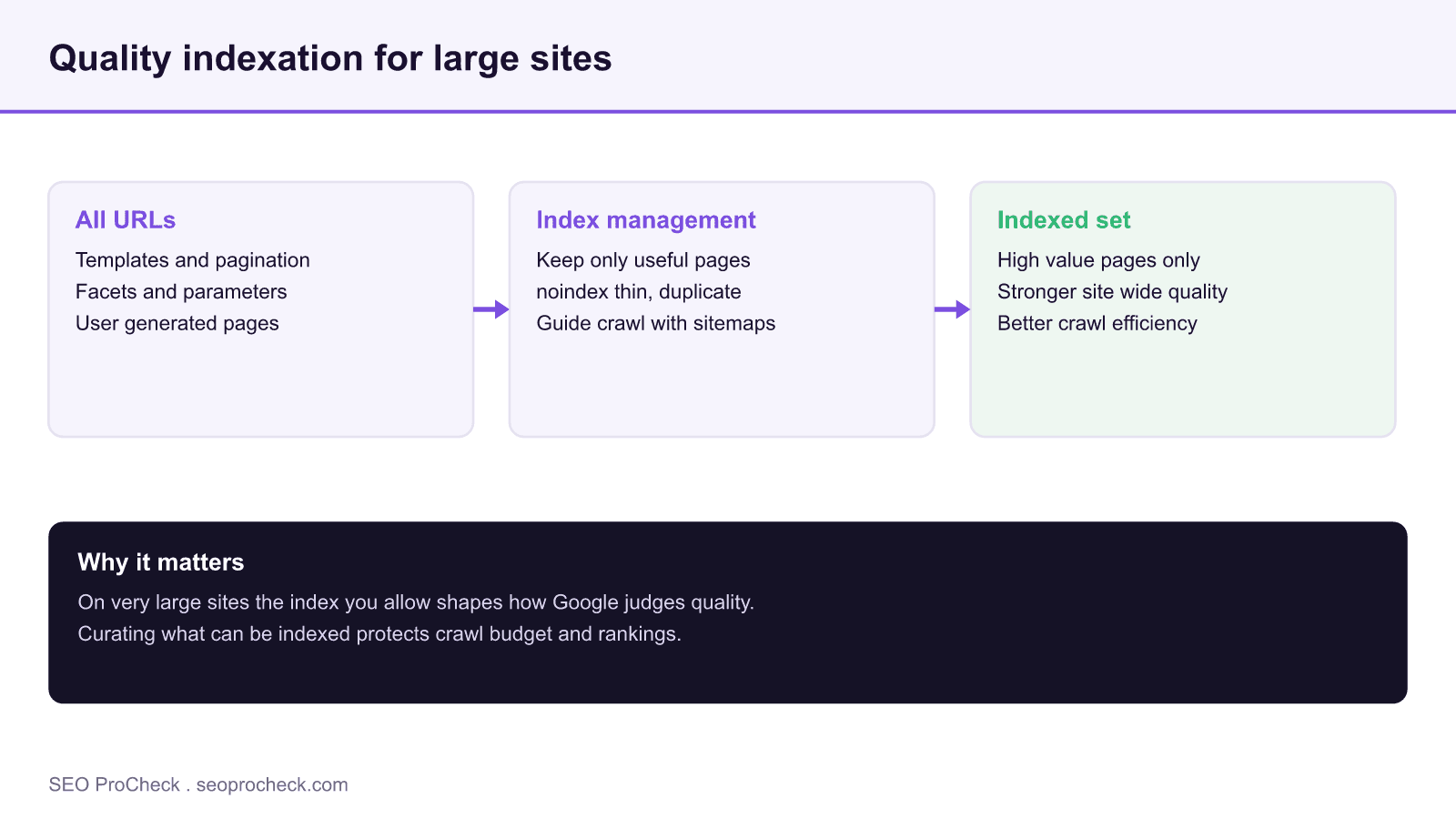
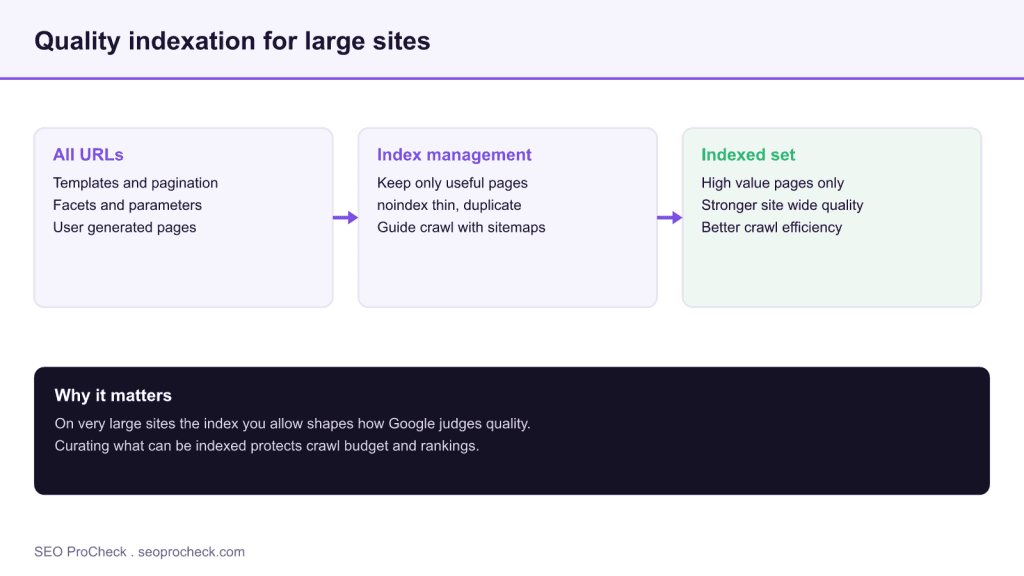
Quality indexation is the discipline of deciding, deliberately, what a large site allows into the search index. On a small site the question barely arises, because almost every page is intended to rank. On a site with hundreds of thousands or millions of URLs, the opposite is true: a large fraction of the URL space is templated, faceted, paginated, or user generated, and letting all of it into the index does more harm than good. This case revisits why curation beats volume.
The reason curation matters is that quality is judged partly at the site level. When a domain carries a heavy load of thin or near duplicate pages, that mass can weigh on how Google assesses the whole site, which means weak pages can drag on strong ones. At the same time, crawl budget is finite, so every crawl spent on a low value URL is a crawl not spent refreshing a page that earns traffic. Both effects point the same direction: a leaner, stronger index tends to serve a large site better than a sprawling one.
What usually needs managing
The bloat on large sites is predictable. Faceted navigation can generate near infinite parameter combinations. Internal search result pages create low value URLs that mirror real content without adding to it. Thin templated pages, such as location or attribute pages with little unique content, add count without value. Paginated archives and tag pages often duplicate discovery paths. User generated pages vary wildly in quality. Cataloging these categories is the first step, because each one calls for a different response.
The tools of index management
Several levers work together. A noindex tag removes a page from the index while keeping it usable for visitors, which suits thin pages that still serve a purpose. Canonical tags consolidate near duplicates onto a single strong URL. XML sitemaps that list only the canonical, valuable pages help Google focus discovery where it counts. Careful internal linking concentrates authority on the pages you want indexed and starves the crawl traps you do not. For genuinely retired content, a 410 status clears it cleanly. The art is applying the right lever to each category rather than a single blanket rule.
What has changed since
This topic has aged well, and if anything it is more pressing now. The surge of automated and templated content has pushed search to weigh site wide quality more heavily, which raises the penalty for carrying low value pages. Google has stated plainly that a focused set of strong pages generally outperforms a large index of weak ones. For practitioners running large sites, the enduring practice is to treat the index as a curated asset: inventory the URL space by template and performance, decide what deserves to be indexed, apply noindex, canonicals, sitemaps, and status codes deliberately, and measure the outcome on the pages you keep. Index management is not a one time cleanup. It is an ongoing part of running a large site well.
The companion study on deleting index bloat at scale shows this logic applied to a massive prune, and how Google selects a canonical explains the consolidation mechanics behind it. The full crawling and indexing library gathers the related work.
Common bloat categories and how to handle them
| Category | Recommended handling | Goal |
|---|---|---|
| Faceted parameter URLs | Block or noindex, remove links | Stop crawl traps |
| Internal search pages | noindex | Keep out of the index |
| Thin templated pages | noindex or enrich | Raise or remove value |
| Near duplicates | Canonical to one URL | Consolidate signals |
| Retired content | 410 Gone | Clean removal |
Frequently asked questions
What is quality indexation?
It is the practice of deliberately controlling which pages a large site allows into the search index, so that the indexed set favors high value pages rather than thin or duplicate ones.
Why does index bloat matter on large sites?
Because quality is judged partly at the site level and crawl budget is finite. A mass of thin pages can weigh on site wide quality and waste crawling that should refresh valuable pages.
How do I decide what to noindex?
Inventory the URL space by template and performance. Pages that generate no impressions or clicks and add no unique value, such as internal search pages and thin parameter URLs, are candidates for noindex.
Do canonicals help with index management?
Yes. Canonicals consolidate near duplicate pages onto a single strong URL, which reduces duplication in the index and focuses signals where you want them.
Is index management a one time task?
No. Large sites continuously generate new URLs through facets, search, and user content, so index management is an ongoing discipline rather than a single cleanup.
This SEO case study documents a successful optimization initiative, providing actionable insights for practitioners. The documented approach demonstrates how strategic SEO implementation drives measurable results.
Initial Situation
Understanding the starting point is essential context for evaluating any case study. This documentation covers the initial challenges, competitive position, and business objectives that shaped the SEO strategy.
Strategy and Approach
The strategic approach combined multiple SEO disciplines to address identified opportunities. Key decisions around prioritization and resource allocation provide a template for similar initiatives.
Implementation
Moving from strategy to execution required specific technical implementations, content development, and process changes. This case study documents the practical steps that translated strategy into action.
Results and Learnings
The outcomes demonstrate effectiveness through measurable improvements in rankings, traffic, and business metrics. Analysis of successes and challenges provides learning value for practitioners.
Case studies like this contribute to the SEO knowledge base, helping practitioners learn from documented real-world experiences.
Source: https://www.gsqi.com/marketing-blog/revisiting-quality-indexation-large-scale-sites/
Claude Vincent is a technical SEO consultant focused on crawlability, rendering, and AI-search visibility. He writes the field guides and case studies at SEO ProCheck, with a bias toward the durable, unglamorous work that decides whether search engines and AI answer engines can actually read and cite a site.
About SEO ProCheck
Technical SEO consulting and GEO strategy with 20 years of enterprise experience. Case studies, resources, and tools for search and AI visibility.
Work With Me
Technical SEO audits, GEO strategy, site migrations, and international SEO. Hourly consulting for teams who need hands-on support, not just reports.
Subscribe to our newsletter!







Recent Posts
- Can AI Crawlers Actually Read Your Site? I Measured 400 of the Biggest September 5, 2026
- The Pre-Publish Quality Gate for AI-Assisted Content August 6, 2026
- AGENTS.md vs llms.txt vs llms-full.txt: Which Agent File Does What July 18, 2026