


AI Summary
Broken link building is a link acquisition tactic: you find dead links on other sites that point to pages which no longer exist, then offer your own working, relevant page as the replacement. It converts because you flag a genuine problem for the site owner before you ask for anything, and relevance of your replacement decides the outcome.
- The workflow has six steps: find dead resources, find pages still linking, build a replacement, reach out, follow up once, and track results.
- The hit rate is modest but real; a strong, matching replacement beats a polished pitch every time.
- Send one polite follow up at most, and keep every message specific to the actual page and dead link.
- Scale the research and filtering, not the email volume, so outreach stays relevant rather than spammy.
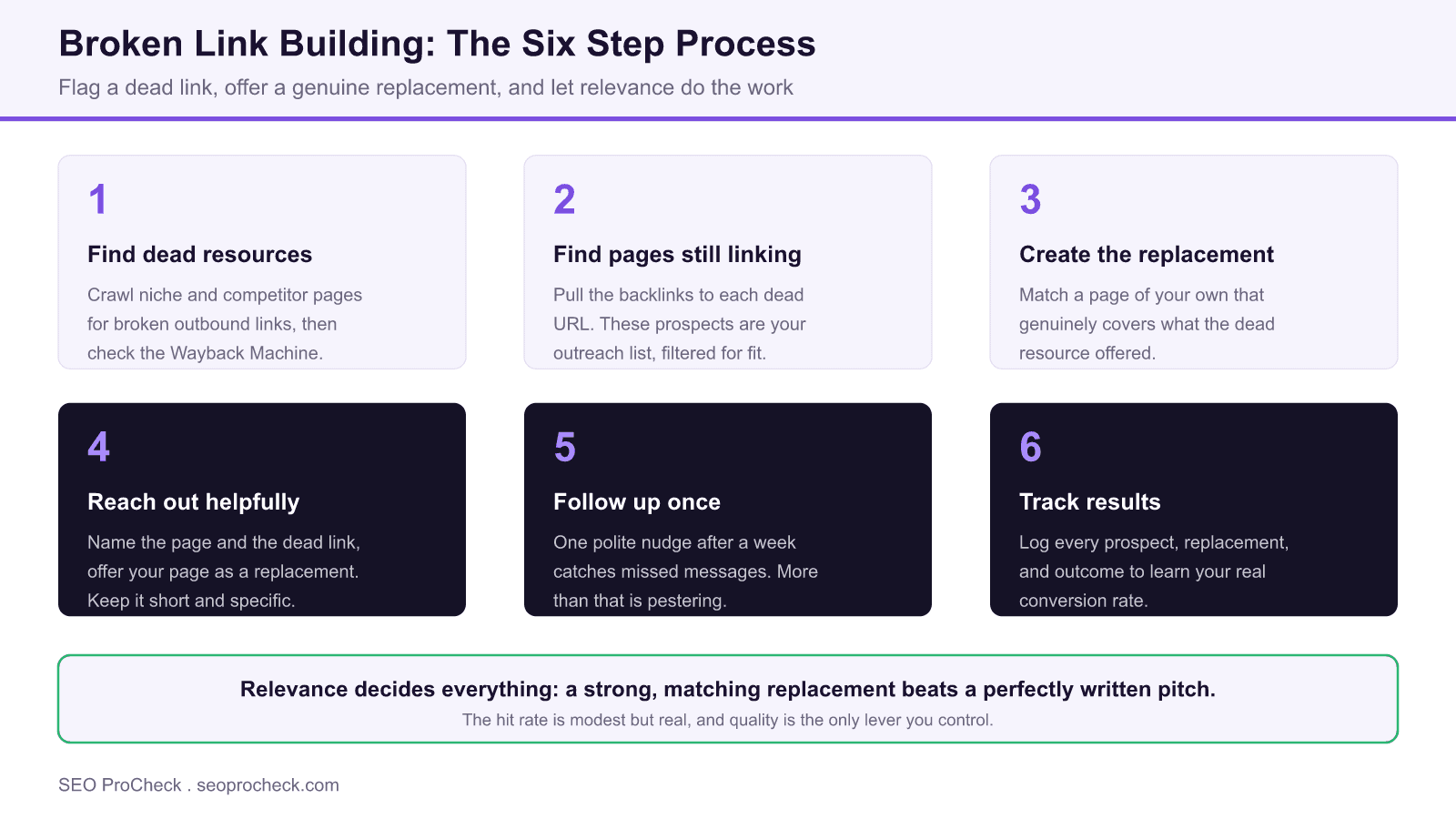
Broken link building means finding dead links on other websites that point to pages which no longer exist, then offering your own working, relevant page as the replacement. It works because you are flagging a genuine problem for the site owner before you ask for anything. The process is methodical: locate dead resources in your niche, find the pages that still link to them, prepare an equivalent replacement, reach out helpfully, follow up once, and track what lands. The hit rate is modest but real, and relevance decides everything.
What broken link building is
Broken link building is a link acquisition tactic built on a simple observation: the web is full of links that no longer work. Pages get deleted, sites get reorganized, companies shut down, and writers move on. When that happens, every page that linked to the now-missing resource is left pointing at a dead end. The reader who clicks gets an error page, and the site owner usually has no idea.
The tactic is to find those dead links, confirm that you have (or can create) a page that serves the same purpose as the missing resource, and let the linking site know. You are not asking for a favor out of thin air. You are pointing out something broken on their page and offering a working replacement that happens to be yours. If they agree, they update the link, their page improves, and you gain a relevant backlink.
It sits in the same family as other editorial link tactics covered in our link building fundamentals, but it has a sharper angle than most. The trigger is a real defect on the target page, not a vague pitch about why your content deserves a mention.
Why it works
Most outreach fails because it asks the recipient to do work for your benefit. Broken link building inverts that. You arrive with useful information: a link on their site is dead. That is worth knowing whether or not they ever link to you, and most site owners appreciate the heads up. The replacement suggestion rides along as a convenience, not a demand.
There is also a maintenance incentive on the other side. Dead outbound links signal neglect, frustrate readers, and do nothing for the linking page. A site owner who cares about quality wants to fix them. You are handing them a ready-made fix. That reasonable, low-friction ask is the entire reason the tactic converts better than cold "please link to me" emails, even though the absolute response rate is still far from guaranteed.
The step-by-step process
The work breaks into six stages. None of them are complicated on their own; the discipline is in doing them in order and not skipping straight to the email.
1. Find dead resources in your niche
Start by identifying pages and resources in your subject area that have died. There are several routes. You can crawl resource pages and competitor pages with a link checker to surface broken outbound links. You can study competitors who have lost pages, since any page that once attracted links and then vanished is a candidate. The Wayback Machine is essential here: when you find a dead URL, look up its archived snapshot to see exactly what the missing page contained, so you know whether you can genuinely replace it. A dead URL is only useful to you if you understand what it used to offer.
2. Find pages still linking to the dead URLs
A dead resource matters only if other pages still point to it. Take each confirmed dead URL and pull the list of pages linking to it using a backlink tool. These are your prospects. Prioritize the ones that are topically close to your content and on sites you would actually want a link from. A long list of low-quality linkers is not worth more than a short list of relevant, credible ones.
3. Create or identify your replacement
Now match a page of your own to the dead resource. Sometimes you already have an equivalent and the work is done. Often you do not, and you have a choice: build something that genuinely covers what the missing page covered, or move on. The replacement has to stand on its own as a fair substitute. If the dead page was a detailed statistics roundup and your page is a thin blog post, the swap will not feel reasonable to the person you are asking, and it should not.
4. Reach out helpfully
Contact the site owner or editor yourself. Note that you found a broken link on a specific page, name the dead URL, and mention that you have a page covering the same ground in case it is useful as a replacement. Keep it short, specific, and easy to act on. The article you are reading does not contact anyone for you; the outreach is something you send.
5. Follow up politely
Most messages get missed rather than refused. A single, courteous follow up after a week or so is reasonable and often the message that actually gets read. One follow up is plenty. Beyond that you are pestering people, and pestering does not build links.
6. Track results
Keep a simple record of every prospect: the dead URL, the page that linked to it, your replacement, the date you reached out, the date you followed up, and the outcome. Tracking tells you your real conversion rate, shows which niches and replacement types perform, and stops you from contacting the same person twice.
Realistic expectations
The hit rate on broken link building is low but real. Many prospects will not reply, some will fix the link without using yours, and a share will swap in your page. That is normal. The lever you actually control is quality: the more genuinely your replacement matches the dead resource, and the more relevant your page is to the linking site, the better your odds on every single email. Relevance is not a nice-to-have here, it is the whole game. A perfectly written pitch for an irrelevant replacement converts at roughly zero.
It pairs well with other earned-link work. If you are also running digital PR for SEO, the assets you create for coverage often double as strong replacement targets for broken link outreach.
How to scale without spamming
Scaling broken link building is about widening your pipeline of qualified prospects, not about increasing your email volume to the same standard. Batch the research: pull dead URLs and their linking pages in bulk, then filter hard for relevance before anything goes out. Group prospects by the replacement page they map to, so you are reusing one strong asset across many genuinely fitting opportunities rather than inventing weak ones.
Keep personalization real even as the numbers grow. You can reuse a structure, but each message should name the actual page and the actual dead link, because that specificity is what makes the message credible. The moment your outreach reads like it could have been sent to anyone, it stops working. Scale the sourcing and the filtering aggressively; keep the messages human.
Common mistakes
The failures are predictable. The first is the irrelevant replacement: offering a page that does not actually match what the dead resource provided. Site owners notice immediately, and it costs you credibility for any future contact. The second is mass templated email with no specifics, which lands as spam and gets deleted on sight. The third is being pushy, whether that means a hard sell, repeated follow ups, or framing the broken link as a problem the owner owes you for finding. The tactic works precisely because the ask is light. Make it heavy and you break it.
One technical note worth understanding: not every error page is a permanent gap. A genuinely removed resource usually returns a 404 or 410, and knowing the difference, which we cover in 404 vs 410 status codes, helps you judge whether a resource is truly gone or just temporarily unavailable before you build outreach around it.
A sample outreach message
Short, specific, and easy to act on. Something like this, adapted to the real page and link:
Subject: Broken link on your [topic] page

Hi [Name],

I was reading your guide at [their page URL] and noticed one of
the outbound links is dead. It points to [dead URL], which no
longer resolves.

I run a page covering the same ground here: [your URL]. If it is
a useful replacement, feel free to swap it in. Either way, wanted
to flag the broken link so a reader does not hit the dead end.

Thanks for the guide, it is a solid resource.

[Your name]
The six steps, the tools, and what good looks like
Use this table as a quick reference while you work through a broken link building batch.
| Step | What you do | Typical tools | What good looks like |
|---|---|---|---|
| 1. Find dead resources | Surface broken outbound links in your niche | Link checker, Wayback Machine | You know what the dead page used to offer |
| 2. Find pages still linking | Pull the backlinks to each dead URL | Backlink tool | A shortlist of relevant, credible prospects |
| 3. Create the replacement | Match or build a fair substitute page | Your own CMS and content | A page that genuinely covers the same ground |
| 4. Reach out helpfully | Flag the dead link, offer your page | Email, contact form | A short, specific, easy to act on message |
| 5. Follow up once | One polite nudge after about a week | A single reminder, never a barrage | |
| 6. Track results | Record prospects, outreach, and outcomes | Spreadsheet or CRM | A clear read on your real conversion rate |
FAQ
Sourcing and outreach can begin the same week, but replies trickle in over days and weeks, and any link equity takes longer still to reflect in rankings. Treat it as a steady, ongoing channel rather than a quick win.
Then your choice is to create one that genuinely covers what the dead resource offered, or to skip that prospect. Reaching out with a weak or off-topic substitute wastes the opportunity and damages your credibility.
One. A single polite follow up after about a week catches the messages that were simply missed. Beyond that you are pestering, which does not earn links and can sour a contact you might want later.
Relevance matters more than raw authority. A topically aligned link from a credible site in your niche is worth more than a high-authority link from an unrelated one. Filter prospects on fit first, then on quality.
Yes, when relevance is high. The web keeps producing dead links, and site owners still appreciate being told about them, so the underlying mechanism has not changed. What separates results from silence is fit: a replacement that truly matches the missing resource and a linking site that is topically close to your page.
Low but meaningful. Many prospects never reply, some fix the link without using your page, and a share swap yours in. Rather than chasing a headline percentage, focus on the one lever you control, the quality and relevance of your replacement, which lifts your odds on every message you send.
An advanced SEO audit maps your link profile, your best replacement assets, and the gaps worth chasing, so your outreach goes where it counts.
Take this with you
The assistant links open with a question about this page already written. Nothing is sent until you press enter.
Claude Vincent is a technical SEO consultant focused on crawlability, rendering, and AI-search visibility. He writes the field guides and case studies at SEO ProCheck, with a bias toward the durable, unglamorous work that decides whether search engines and AI answer engines can actually read and cite a site.
About SEO ProCheck
Technical SEO consulting and GEO strategy with 20 years of enterprise experience. Case studies, resources, and tools for search and AI visibility.
Work With Me
Technical SEO audits, GEO strategy, site migrations, and international SEO. Hourly consulting for teams who need hands-on support, not just reports.
Subscribe to our newsletter!








Recent Posts
- Most Top Sites Never Say Who They Are in Structured Data October 14, 2026
- Homepage Titles Are Mostly Too Short, Not Too Long October 8, 2026
- Who Actually Serves an llms.txt? 184 Top Sites Measured September 29, 2026