

Healthcare SEO Study: YMYL Rankings and E-E-A-T Requirements
- October 20, 2021
- Cross-Industry
AI Summary
Healthcare content sits in the Your Money or Your Life category, which means Google's quality raters assess it against a higher evidentiary bar than ordinary content. E-E-A-T is not a score you can raise directly: the only workable strategy is to make the underlying qualifications, sourcing and editorial governance inspectable on the page itself.
- YMYL covers any content where bad information could plausibly damage health, finances or safety.
- E-E-A-T is rater guideline vocabulary, not a ranking factor with a numeric value attached to a URL.
- Trust is the element the other three support, and it is carried by editorial policy, disclosures and a contactable organisation.
- Correlation studies in this space describe patterns among sites that already rank, which is not the same as identifying causes.
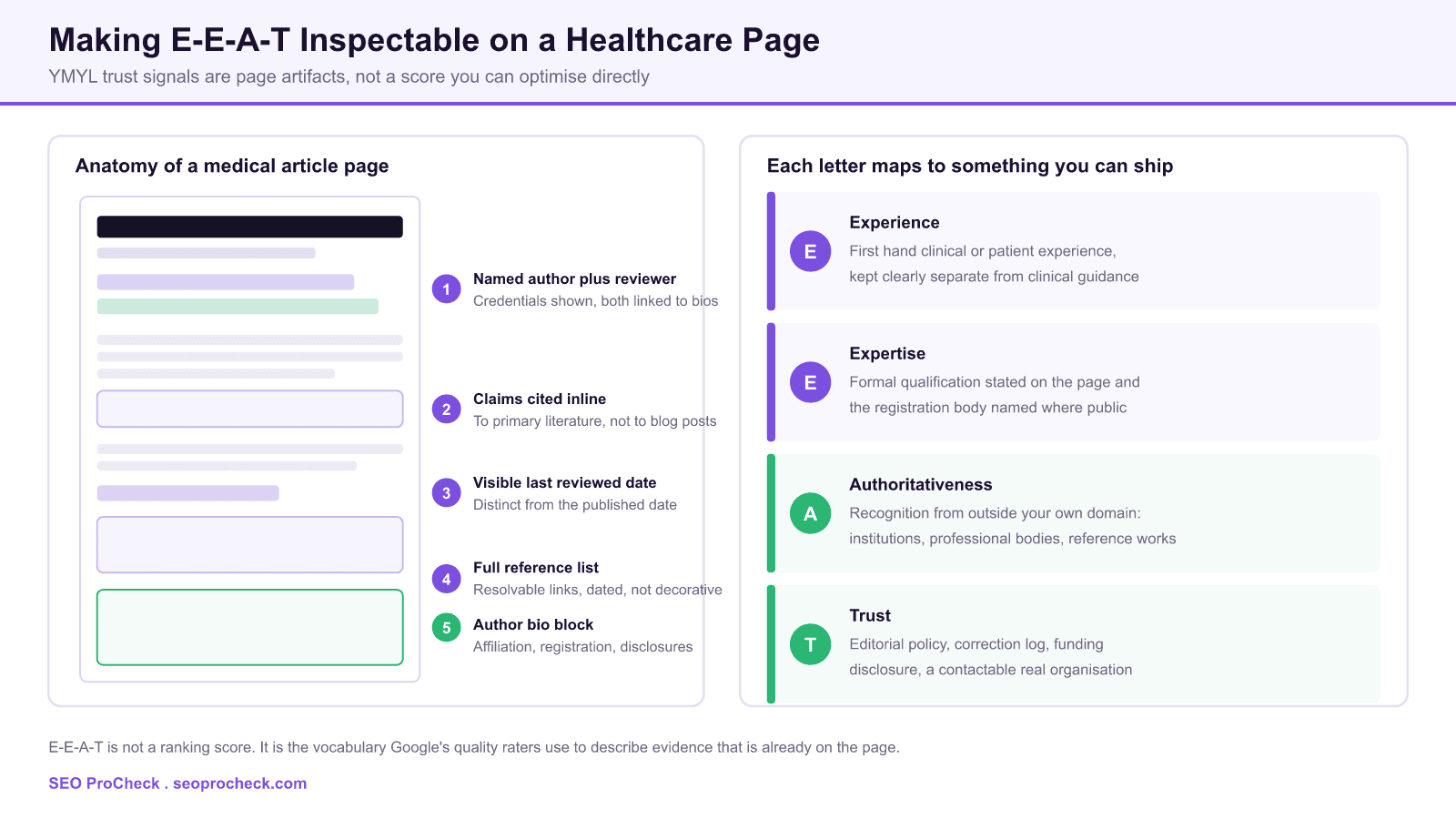
Almost every healthcare SEO recommendation reduces to one instruction: put the evidence on the page. The qualified clinician who wrote it, the guideline the dosage came from, the date someone last checked it, the organisation that stands behind it, and who paid for it. None of that is an SEO trick. It is what a careful reader in a medical context needs, and it happens to be exactly what a quality rater is instructed to look for. The sites that struggle in this vertical are not usually the ones with weak content; they are the ones whose good content is anonymous.
Healthcare is the hardest vertical in organic search, and it is hard for a structural reason rather than a competitive one. Search engines accept a degree of variance in most results, because a mediocre answer about houseplants costs nobody anything. In health, a wrong answer has a victim. That asymmetry is what the Your Money or Your Life designation exists to encode, and everything else in this article follows from it.
Key findings
The consistent pattern across published analyses of health search results is that visibility concentrates in a small set of established medical publishers, institutional sites and government health bodies, and that the sites holding those positions share a recognisable set of page level characteristics: named and credentialed authors, separate clinical review, inline citation to primary literature, explicit review dates and published editorial standards.
It is important to state what that pattern does and does not tell you. It is an observation about the population of pages that currently rank. It does not establish that adding a reviewer line to a page causes it to rank, and no publicly available dataset supports that causal claim. What it does establish is a reasonable operating standard: if effectively every page in a result set carries these artifacts and yours does not, you are asking to be evaluated on less evidence than your competitors.
What YMYL actually covers
Teams routinely over apply the YMYL label, treating an entire health domain as uniformly high risk. That is expensive and it dilutes the review capacity you have. The designation is about potential for harm, which varies enormously across a health site.
| Page type | Harm potential if wrong | Review tier | Required page artifacts |
|---|---|---|---|
| Dosage, interaction or contraindication guidance | High and immediate | Named clinical reviewer, annual review minimum | Author credentials, reviewer name and date, primary source citations, references |
| Symptom and condition explainers | High, drives care seeking decisions | Named clinical reviewer | Author credentials, reviewer, citations, last reviewed date |
| Procedure and treatment descriptions | Moderate to high | Clinical reviewer for claims, editor for the rest | Author credentials, references, disclosure of any commercial interest |
| Practitioner experience and patient stories | Low if clearly framed as experience | Editorial review | Clear labelling as personal experience, plus a pointer to clinical guidance |
| Service, pricing and appointment information | Low | Editorial review | Accurate organisation details, contact route, last updated date |
Tiering review effort by harm potential concentrates scarce clinical time where it changes outcomes.
Turning E-E-A-T into artifacts
The single most useful reframe is to stop treating E-E-A-T as an attribute of your site and start treating it as a checklist of things that must be physically present in the HTML. Abstract quality is unauditable. Artifacts are auditable, and you can crawl for them.
Experience is the letter most health sites ignore, because they assume clinical content must be impersonal. It does not have to be. A physiotherapist describing what patients typically find hardest in week two of a rehabilitation programme is contributing something no literature review provides. Keep it clearly separated from clinical guidance so a reader can tell observation from instruction.
Expertise means the qualification is stated on the page, not merely true. Name the credential, the specialty and, where the register is public, the professional body. Authoritativeness is the only element you cannot manufacture on your own site, because it is recognition from elsewhere: citations by institutions, inclusion in professional resources, and references from bodies in your field.
Trust is the one that carries the rest, and it is mostly site level rather than page level. An editorial policy that describes how content is produced and reviewed, a visible correction process, funding and commercial disclosure, and an organisation that a person could actually contact. Our companion piece on earning trust in finance covers the same problem in the other major YMYL vertical, and the structural answers rhyme.
Marking up authorship so machines can read it
Visible artifacts serve readers and raters. Structured data serves extraction, including by AI systems that summarise health information. Build the author as an entity with its own URL and reference it, rather than repeating a name string on every article.
{
  "@context": "https://schema.org",
  "@type": "MedicalWebPage",
  "headline": "Managing Type 2 Diabetes: Daily Monitoring",
  "lastReviewed": "2026-06-14",
  "author": {
    "@type": "Person",
    "name": "Dr Amara Osei",
    "honorificSuffix": "MBBS, MRCP",
    "url": "https://example.com/authors/amara-osei/",
    "jobTitle": "Consultant Endocrinologist"
  },
  "reviewedBy": {
    "@type": "Person",
    "name": "Dr Lena Fischer",
    "url": "https://example.com/authors/lena-fischer/"
  },
  "citation": ["https://www.who.int/publications/example"]
}
Two rules keep this honest. The lastReviewed value must match a date a human being actually reviewed the page, and it must be visible on the page too; a markup only date that nobody can see is the kind of thing that erodes trust rather than building it. And the author URL must resolve to a real bio page with substance on it. Building author pages as genuine entities is covered in our guide to entity SEO.
Methodology and data
Research in this area typically combines quantitative analysis of ranking data with qualitative examination of high performing sites, triangulating multiple sources and attempting to control for confounders such as domain authority and content age. That method is sound for describing what the top of a result set looks like. It is weak for attribution, because the strongest confounder in health search is not domain authority or content age, it is institutional status, and that is not something you can control for by matching on metrics.
If you want to test whether a change works on your own site rather than infer it from a population, run it as a controlled comparison: apply the change to a matched subset of templates, hold the rest as a control, and read the result over a period long enough to survive seasonality. That approach tells you about your site, which is the only site whose behaviour you actually need to predict.
Practical applications
- Crawl your own site for missing artifacts. Use a custom extraction to pull the author block, reviewer line and last reviewed date from every article template, then list the pages returning empty. That list is your backlog, in priority order once you sort it by traffic.
- Fix the reviewer gap before writing anything new. Adding clinical review to existing pages that already rank is cheaper and lower risk than publishing more unreviewed pages.
- Cite primary sources, not secondary coverage. A link to a guideline body or a journal article is evidence. A link to another blog summarising that article is not.
- Publish the editorial policy as a real page describing who writes, who reviews, how often, and how corrections are handled, then link it from every article footer.
- Separate advertising and affiliate relationships explicitly. In YMYL, an undisclosed commercial interest is a trust failure regardless of the content quality around it.
- Do not let a redesign strip the artifacts. Byline blocks, review dates and reference lists are frequently casualties of a template refresh because they are visually awkward. Add them to the acceptance criteria.
Limitations and context
As with all correlation studies, findings in this area indicate patterns rather than definitive causation. Results vary by query type, by market and by regulatory environment: health search in a country with a national health service behaves differently from one dominated by private providers, because the institutional sites that occupy the top positions are different. Any snapshot of algorithm behaviour is also temporary.
The reassuring consequence is that the recommendations here are unusually durable. Naming your authors, citing your sources, dating your reviews and disclosing your funding are not optimisations tuned to a particular version of a ranking system. They are what publishing responsibly in a high stakes field requires, and they would remain correct if every ranking system changed tomorrow.
FAQ
No, not as a measurable score applied to a page. Google has been explicit that E-E-A-T is a concept from the Search Quality Rater Guidelines, used by human raters to evaluate whether search results are useful. Those ratings inform system development rather than scoring individual URLs. The practical implication is that you cannot optimise an E-E-A-T number, you can only make the underlying evidence visible.
Your Money or Your Life pages are those where poor quality information could plausibly harm a person's health, financial stability, safety or wellbeing. In healthcare that covers symptom and condition pages, treatment and medication information, dosage guidance and diagnostic content. A recipe blog post that mentions a nutrient is not YMYL; a page telling someone how much of a supplement to take is.
Only the pages that give clinical guidance. Reviewing a page about how to book an appointment or what to bring to a consultation adds cost without adding safety. Tier your content: clinical claims get named clinical review, service and administrative content gets ordinary editorial review, and be transparent on the page about which tier applies.
A bio on its own is not a lever. What a bio does is make an existing qualification inspectable, both to human raters and to systems that extract entities from a page. If the author is genuinely qualified, the bio surfaces evidence that was previously invisible. If they are not, the bio simply documents that.
Tie the cadence to how fast the underlying evidence moves rather than to a fixed calendar. Drug dosing, guidelines and screening recommendations warrant an annual review at minimum and immediate review when a governing body issues a change. Stable anatomical or procedural explainers can go longer. Show the last reviewed date separately from the published date so readers can judge for themselves.
Rarely on broad symptom and condition queries, where established medical publishers hold a strong authority advantage. Small practices compete effectively on local and service intent, on specific procedures they actually perform, and on practitioner led content that reflects genuine first hand experience the large publishers cannot manufacture.
Is your health content carrying the evidence it should?
An audit checks every article template for authorship, review, citation and disclosure artifacts, and lists the gaps by traffic value.
Source: Industry research compilation
Claude Vincent is a technical SEO consultant focused on crawlability, rendering, and AI-search visibility. He writes the field guides and case studies at SEO ProCheck, with a bias toward the durable, unglamorous work that decides whether search engines and AI answer engines can actually read and cite a site.
About SEO ProCheck
Technical SEO consulting and GEO strategy with 20 years of enterprise experience. Case studies, resources, and tools for search and AI visibility.
Work With Me
Technical SEO audits, GEO strategy, site migrations, and international SEO. Hourly consulting for teams who need hands-on support, not just reports.
Subscribe to our newsletter!







Recent Posts
- Can AI Crawlers Actually Read Your Site? I Measured 400 of the Biggest September 5, 2026
- The Pre-Publish Quality Gate for AI-Assisted Content August 6, 2026
- AGENTS.md vs llms.txt vs llms-full.txt: Which Agent File Does What July 18, 2026