

AI Summary
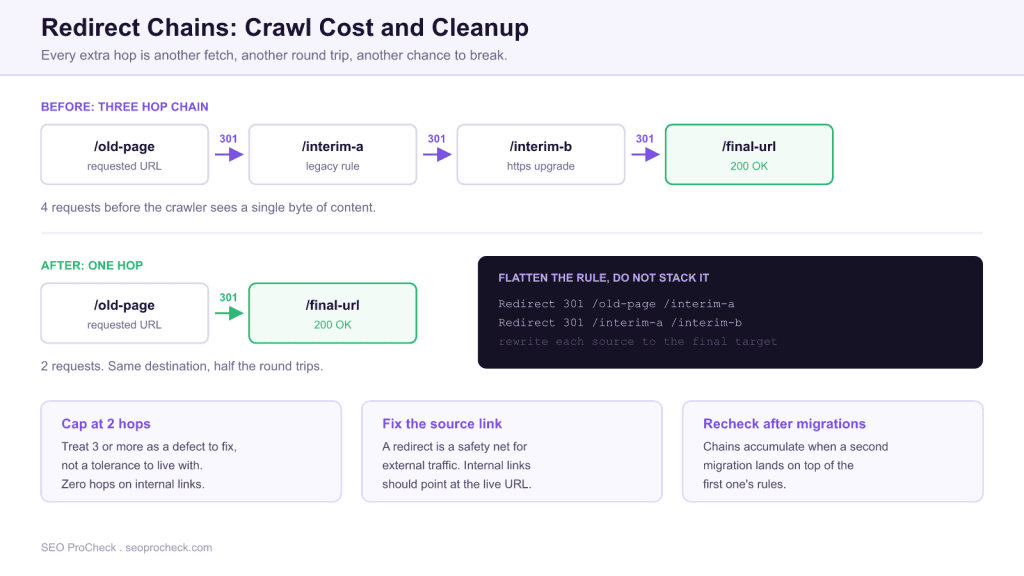
A redirect chain is any request that passes through more than one redirect before it reaches a 200 response. Google has said that a 301 passes PageRank without loss, so the real cost of a chain is crawl waste, added latency for users, and the risk that one broken hop in the middle takes the entire path down.
- "Link equity loss" is the wrong reason to fix chains. Crawl efficiency and reliability are the right ones.
- Google's documentation states Googlebot follows up to 10 hops in a single crawl attempt, then queues the URL for a later crawl.
- Every hop is a full round trip, so chains cost real users more than they cost rankings.
- Fix the source link, not just the redirect rule. Internal links should point at the final URL, never at a redirect.
Research into redirect chains examined their impact on rankings, crawl efficiency, and user experience. Understanding redirect behavior helps optimize site architecture and migration strategies.
The finding that matters most is a negative one: the thing most practitioners worry about, losing ranking strength through a chain, is not the thing that actually costs them. Chains cost crawl throughput, page speed, and reliability. Those are less dramatic than "losing link juice" but they are measurable, and they get worse quietly as a site accumulates migrations. This page covers what the evidence supports, how chains form, how to find them, and where the practical cutoff sits.
Authority Transfer
Google stated that redirect chains pass PageRank without degradation, contradicting earlier assumptions about chain-related loss. However, multiple redirects increased crawl latency and potential for error. Minimizing chains remained best practice even if authority transfer was complete.
This matters for prioritisation. If you believe every hop bleeds 15 percent of a page's strength, redirect cleanup looks like an emergency and you will spend engineering time on chains that carry almost no traffic and almost no links. Once you accept that signals survive the hops, the job re-sorts itself: fix the chains that sit on high traffic paths, on paths crawlers visit constantly, and on paths where a hop can break. Leave the harmless three hop chain on a page nobody requests at the bottom of the list.
Two caveats keep the rule honest. First, signals pass cleanly only if every hop actually resolves. A chain that ends in a 404 or a soft 404 passes nothing, because there is no destination to pass it to. Second, the destination has to be a genuine equivalent. A redirect from a discontinued product to a generic category page is frequently treated as a soft 404 rather than a move, and consolidation does not happen. The hop count is not the problem in either case, the endpoint is.
Crawl Efficiency
Each redirect added processing overhead and potential failure points. Long chains consumed crawl budget following redirects rather than crawling new content. Simplifying redirect paths improved crawl efficiency for large sites.
The mechanics are worth being precise about, because the phrase "crawl budget" gets used loosely. Googlebot does not fetch a redirect and the destination as one operation. It fetches the URL, receives a 3xx with a Location header, and schedules the next URL. A three hop chain is therefore four separate fetches spread across the crawl queue, not one fetch that takes slightly longer. Google's documentation states that Googlebot follows up to 10 hops in a single crawl attempt; if it has not reached content by then it stops and treats the result as a redirect error, picking the trail back up on a later crawl.
On a small site this is invisible. On a site with hundreds of thousands of URLs, where crawl rate is the constraint on how fast new and updated content gets discovered, it is not. This is the specific case where chain cleanup pays: large catalogues, frequent inventory turnover, and a redirect layer that has survived two or more platform migrations. If you want to know whether it applies to you, log file analysis answers it directly, because you can count what share of Googlebot's daily requests to your site returned a 3xx rather than a 200. Tracking that ratio over time is a more useful signal than any single crawl report, and it belongs in ongoing crawl budget monitoring.
User Experience
Redirect chains increased page load time perceptibly. Mobile users on slower connections experienced greater impact. Beyond SEO, user experience benefits justified redirect chain cleanup.
Each hop costs a full network round trip, and on a cross origin hop it can cost a DNS lookup and a fresh TLS handshake on top. On a fast desktop connection that is a few tens of milliseconds. On a high latency mobile connection it is meaningful, and it lands in the worst possible place: before anything has rendered, while the user is looking at a blank screen. Because the delay happens before the destination document even starts downloading, it pushes back every downstream metric rather than any single one.
Redirected image and asset URLs deserve a separate look. A chain on a hero image delays the element that usually defines the largest contentful paint, and asset chains are easy to miss because they never appear in a page level crawl report. If a chain sits on an image path, it can also stop the file being indexed at all, which is a different failure with the same root cause.
Practical Thresholds
Keeping redirect chains to 2-3 hops maximum balanced practicality with optimization. Resolving chains to direct links during site maintenance prevented accumulation. Monitoring for new chains after migrations helped maintain clean redirect architecture.
In practice it helps to hold two different thresholds rather than one. For redirects reached from outside your control, such as an old inbound link or a printed URL, tolerate up to two hops and treat three as a defect to schedule. For links inside your own templates, navigation, sitemaps and canonical tags, the threshold is zero. There is no reason for a site to link to a URL it knows will redirect, and this is where most of the avoidable cost lives.
The same rule applies to canonical tags: a canonical pointing at a redirecting URL forces the engine to resolve the hop before it can consolidate, and a canonical that points into a chain is a common cause of "Alternate page with proper canonical tag" and similar indexing states that look mysterious until you trace the path.
Where chains actually come from
Chains are almost never authored deliberately. They accumulate, and they accumulate in a small number of recognisable patterns.
| Pattern | What the chain looks like | Fix |
|---|---|---|
| Stacked migrations | Old URL to 2019 URL to 2023 URL. Each migration added rules on top of the last set instead of rewriting them. | Rewrite every source in the old map to point at the current final target, then retire the intermediate rules. |
| Protocol plus host | http to https, then non www to www, as two separate rules that fire in sequence. | One rule that sets protocol and host together, placed before any path level rules. |
| Trailing slash | A path rule redirects, then the server's canonical slash handler redirects again. | Write redirect targets in the exact canonical form the server will accept without a second rewrite. |
| Two layers of infrastructure | A CDN or edge worker redirects, then the origin application redirects again for its own reasons. | Decide which layer owns redirects. Audit both, because a crawl of the public URL is the only place the chain is visible. |
| Case and parameter normalising | Uppercase to lowercase, then a tracking parameter stripped, as separate hops. | Normalise everything in one pass before issuing the response. |
Status codes and what each one means inside a chain
| Response | Meaning | Consolidates signals | Use it when |
|---|---|---|---|
301 | Moved permanently. Aggressively cached by browsers. | Yes | The move is permanent and you are confident in the target. |
302 | Found, temporary. Google may still consolidate if it persists. | Not by intent | Genuinely temporary moves such as a seasonal takeover. |
307 | Temporary, preserves the request method. | Not by intent | Temporary moves where a POST must stay a POST. Also what HSTS produces internally. |
308 | Permanent, preserves the request method. | Yes | Permanent moves on endpoints that receive non GET requests. |
| Meta refresh | Client side. Requires the HTML to be fetched and parsed first. | Weakly | Avoid. Use only where you cannot set a server response. |
| JavaScript | Only applies after the page renders. | Weakly, and only once rendered | Last resort. Slowest option for users and crawlers alike. |
How to trace a chain in one command
Before reaching for a crawler, check a single path directly. This prints every status code and every Location header in the sequence, which is exactly what you need to see the shape of the chain:
curl -sIL https://example.com/old-page | grep -i "^HTTP/\|^location:"Reading the output: each HTTP/ line is one fetch, so a clean redirect shows two, and anything beyond three deserves attention. If the final line is not a 200, you have found a chain that ends in a broken destination, which is the version worth fixing first.
For site wide work, run a crawler that reports redirect chains as a distinct issue rather than counting redirects individually, and export the full path so you can rewrite each original source to its final target in one pass. The rewrite is the important part. Adding a new rule from the first URL to the final URL while leaving the intermediate rules in place does not shorten anything for a crawler that still holds the old intermediate URL.
Build the check into migrations
Chains are a migration byproduct, so the durable fix is a step in the migration process rather than a cleanup project afterwards. Before launch, run the old URL inventory through the proposed redirect map and confirm every entry resolves to a 200 in one hop. After launch, re-run it, because rules interact in production in ways staging does not always reproduce. Then re-run it once more after the next migration, since that is the moment a clean map turns into a chained one. Folding this into site migration planning costs an hour and prevents the accumulation entirely.
FAQ
Not directly, in the sense that ranking signals pass through the hops. The damage is indirect: slower discovery of changes on large sites, slower page loads for users, and a higher chance that one hop breaks and the whole path stops resolving. Fix them for reliability and speed rather than for fear of losing authority.
Two hops is tolerable for traffic arriving from sources you do not control. Three or more should go on the fix list. For links inside your own site, including navigation, sitemaps and canonical tags, the target is zero hops, because you control those URLs and can simply point them at the destination.
Google has said PageRank is not lost through 301 redirects, and that applies through a chain as well. The important condition is that every hop resolves and the final destination is a genuine equivalent of the original page. A chain that ends in a 404, or that lands on a generic category page instead of a replacement, consolidates nothing.
Use a crawler that reports chains as their own issue type and exports the full hop path, not just a count of redirects. Complement it with server log analysis to see which chains Googlebot is actually spending requests on, and use curl -sIL to spot check individual paths while you work.
Internal links first. Updating a template link to point at the live URL removes the hop for every user and every crawl of that page immediately, and it is usually a smaller change than untangling a redirect map. Keep the redirect rule in place afterwards, since it still serves external traffic and old bookmarks.
Not safely. Removing a redirect turns it into a 404 and discards whatever external links still point at that URL. The correct cleanup is to rewrite each old source so it points directly at the current final destination, keeping the same number of rules but reducing every path to one hop.
They affect the time before the destination document begins loading, which delays every rendering milestone that follows, including largest contentful paint. A chain on an image or asset URL is more damaging still, because it can delay the exact element that defines the largest contentful paint for that page.
Source: Redirect chain research compiled
Take this with you
The assistant links open with a question about this page already written. Nothing is sent until you press enter.
Claude Vincent is a technical SEO consultant focused on crawlability, rendering, and AI-search visibility. He writes the field guides and case studies at SEO ProCheck, with a bias toward the durable, unglamorous work that decides whether search engines and AI answer engines can actually read and cite a site.
About SEO ProCheck
Technical SEO consulting and GEO strategy with 20 years of enterprise experience. Case studies, resources, and tools for search and AI visibility.
Work With Me
Technical SEO audits, GEO strategy, site migrations, and international SEO. Hourly consulting for teams who need hands-on support, not just reports.
Subscribe to our newsletter!








Recent Posts
- Most Top Sites Never Say Who They Are in Structured Data October 14, 2026
- Homepage Titles Are Mostly Too Short, Not Too Long October 8, 2026
- Who Actually Serves an llms.txt? 184 Top Sites Measured September 29, 2026