

What Scraping 1.1 Million Search Results Taught Us About SEO
- August 22, 2022
- Cross-Industry
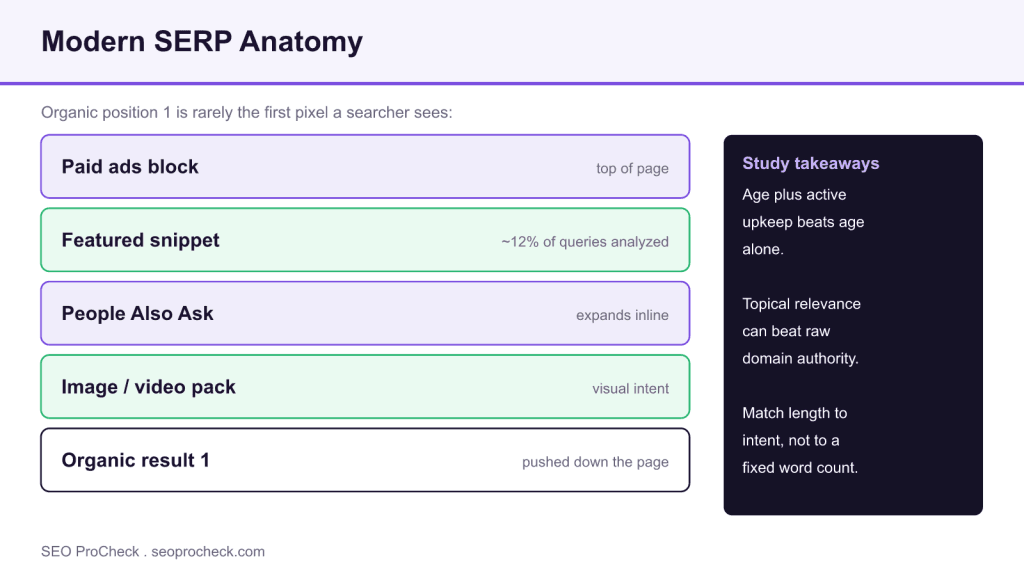
Authority Hacker analyzed 1.1 million Google results to see which factors correlate with ranking. The headline lessons: active, well-maintained domains beat old but neglected ones, topical relevance can outweigh raw authority, content length should match intent rather than a target, and SERP features now sit above many organic results.
- Domain age helps only when paired with ongoing content and link work.
- Topically relevant pages from smaller sites regularly beat broad-authority pages.
- Featured snippets appeared in roughly 12% of analyzed results and vary by query type.
- Correlation is not causation: use studies like this directionally and validate with your own data.
Authority Hacker conducted a study scraping and analyzing 1.1 million Google search results to identify patterns in what ranks well. The research examined page-level factors, domain characteristics, and SERP features across diverse query types, providing insights into both traditional ranking factors and the changing landscape of search results.
Domain Age and Authority
The study found that domain age correlated with higher rankings, though the relationship was more nuanced than simply "older is better." Domains that had been actively building content and links over many years ranked better than older domains that had been neglected. The combination of age plus ongoing development proved most important.
Domain authority metrics showed expected correlations, but the research noted significant variation. Lower-authority domains regularly appeared in top positions for specific queries where they had strong topical relevance. This suggests that topical authority in specific niches can compete with broad domain authority in the right contexts.
Content Characteristics
First-page results averaged longer content than second-page results, but with significant variance by query type. Informational queries showed the strongest length correlation, while navigational and some transactional queries showed shorter top results. The key insight: content length should match user intent and query type rather than following universal targets.
Keyword usage in titles and headings remained correlated with rankings, but exact-match optimization appeared less important than topical relevance. Pages ranking for competitive terms typically covered the topic comprehensively rather than repeating exact keywords. The research supports semantic optimization over keyword-focused approaches.
SERP Feature Prevalence
Featured snippets appeared in approximately 12% of analyzed results, with their presence varying dramatically by query type. "How to" and "what is" queries showed much higher featured snippet rates. Knowledge panels, People Also Ask boxes, and image carousels appeared with varying frequency depending on query intent and topic.
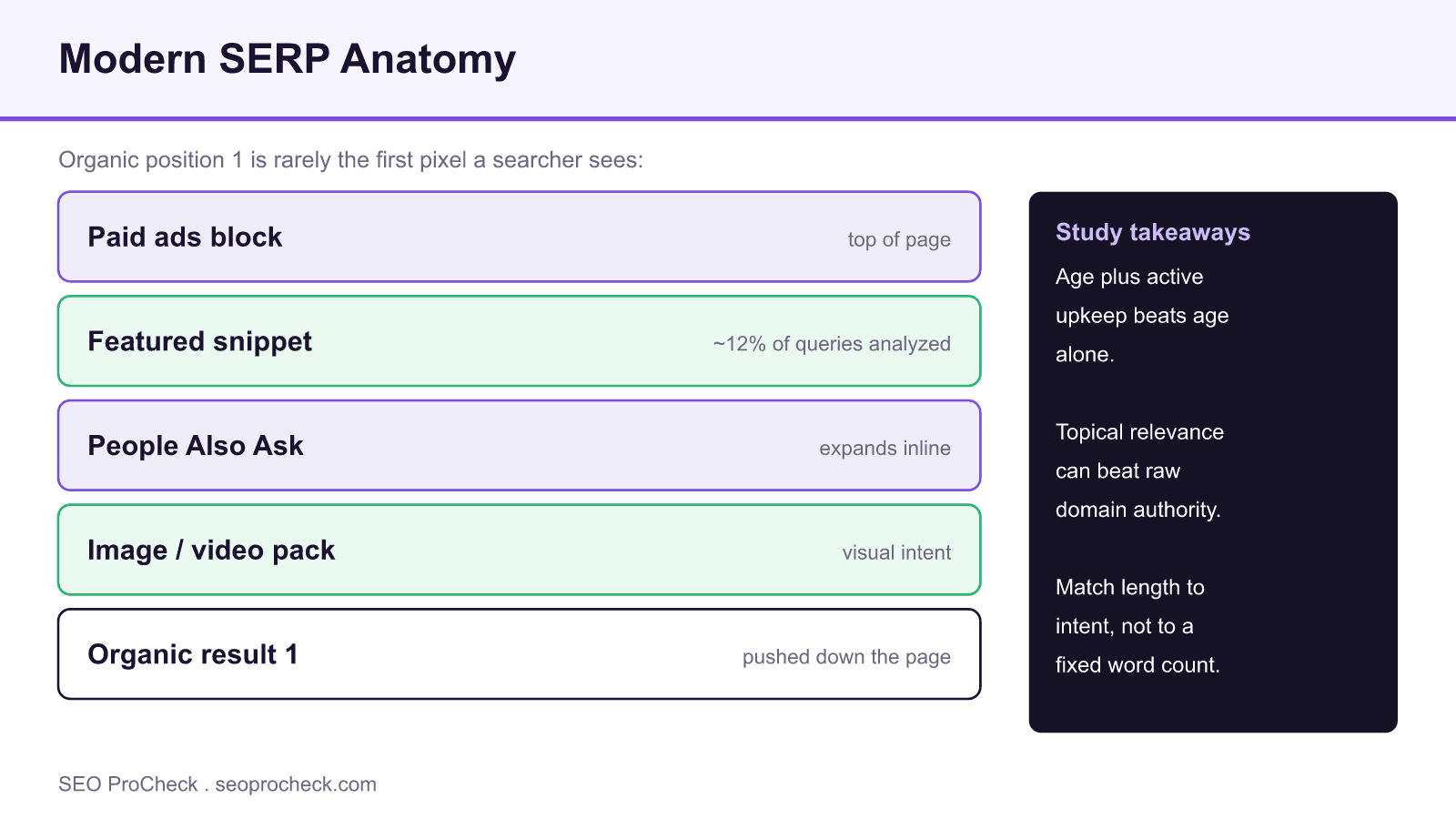
The increasing prevalence of SERP features means traditional "10 blue links" analysis understates competition for visibility. Top organic positions may appear below multiple SERP features, making actual visibility lower than position numbers suggest. Factor SERP feature competition into opportunity analysis.
Methodology Considerations
The researchers emphasized limitations: correlation studies can't prove causation, scraping captures point-in-time snapshots that may not reflect dynamic ranking, and query selection influences findings. Use such research directionally while validating against your own data and testing.
Source: Authority Hacker
How to Use Correlation Research Without Getting Burned
Large scale correlation studies are useful for direction, not for orders. A factor that correlates with ranking may be a symptom, not a cause. Longer top-ranking pages, for example, are usually longer because the winning intent needed more coverage, not because word count is a lever. The table below translates each finding into an action you can take and the caveat that keeps you honest.
| Study finding | What to actually do | Caveat |
|---|---|---|
| Active old domains rank better | Keep publishing and earning links on your existing domain; do not let it go stale | Age alone does nothing; upkeep is the real signal |
| Topical relevance beats raw authority | Build depth in a focused subject with topic clusters and pillar pages | You still need enough authority to enter the race |
| Length correlates with rank on info queries | Match depth to search intent, cover the whole question | Padding hurts; navigational and transactional pages stay short |
| Snippets appear in ~12% of results | Structure answers for featured snippets where the query invites one | Snippet rates vary hugely by query type |
What Has Changed Since This Study
The pattern the study flagged, that position one is rarely the first thing a searcher sees, has only intensified. SERP features have expanded, and AI generated summaries now sit above the classic results for many informational queries. The practical takeaway is unchanged but louder: your true visibility is not your rank number, it is where your listing falls once ads, snippets, People Also Ask, and image packs are counted. When you size an opportunity, model the whole result page, not just the ten blue links.
Frequently Asked Questions
Does an older domain automatically rank better?
No. The study found age helps only when the domain has kept building content and links. An old but neglected domain does not outrank a younger, actively maintained one. Treat ongoing upkeep, not age itself, as the signal that matters.
Is longer content always better for SEO?
No. First-page pages were longer on average, but mostly for informational queries where the topic demanded depth. Length is a symptom of matching intent, not a target. Navigational and many transactional pages rank while staying short.
How often do featured snippets appear?
In this dataset featured snippets appeared in roughly 12% of analyzed results, with much higher rates on how-to and what-is queries. The exact rate depends heavily on query type, so check the SERPs for your specific terms.
Can a low-authority site outrank a high-authority one?
Yes, in the right context. The research saw lower-authority domains win specific queries where they had strong topical relevance. Focused depth in a niche can beat broad authority for the queries that niche owns.
Why is my real visibility lower than my ranking position?
Because SERP features sit above organic results. Ads, a featured snippet, People Also Ask, and image or video packs can push position one well down the page, so a high rank number can still mean modest visibility.
Can I trust ranking correlation studies?
Use them for direction, not as rules. Correlation cannot prove causation, and scraped data is a point-in-time snapshot. Validate any finding against your own analytics and, where possible, a controlled test before acting on it.
Take this with you
The assistant links open with a question about this page already written. Nothing is sent until you press enter.
Claude Vincent is a technical SEO consultant focused on crawlability, rendering, and AI-search visibility. He writes the field guides and case studies at SEO ProCheck, with a bias toward the durable, unglamorous work that decides whether search engines and AI answer engines can actually read and cite a site.
About SEO ProCheck
Technical SEO consulting and GEO strategy with 20 years of enterprise experience. Case studies, resources, and tools for search and AI visibility.
Work With Me
Technical SEO audits, GEO strategy, site migrations, and international SEO. Hourly consulting for teams who need hands-on support, not just reports.
Subscribe to our newsletter!








Recent Posts
- Most Top Sites Never Say Who They Are in Structured Data October 14, 2026
- Homepage Titles Are Mostly Too Short, Not Too Long October 8, 2026
- Who Actually Serves an llms.txt? 184 Top Sites Measured September 29, 2026