

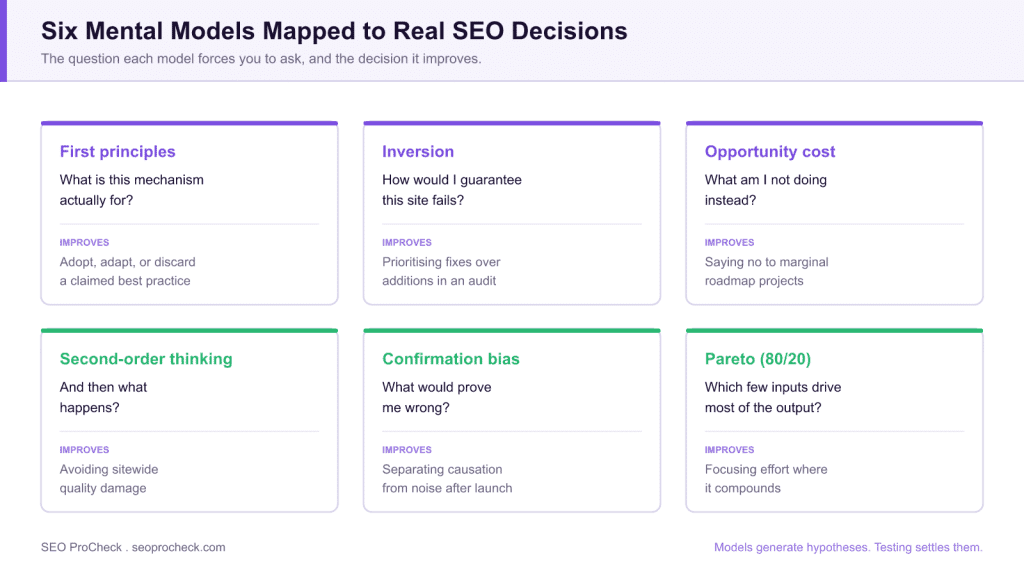
AI Summary
Mental models are reusable thinking frameworks, such as first-principles reasoning, inversion, and opportunity cost, that improve judgment when information is incomplete. In SEO, where the algorithm is opaque and feedback lags by weeks, they replace folklore with structured reasoning about which problems to work on and which tactics to skip.
- Inversion ("how would I guarantee failure?") is the fastest model for beginners because it produces an immediate audit checklist.
- Opportunity cost is the model SEO teams most often ignore: every marginal task displaces a better one.
- Second-order thinking prevents sitewide damage, since reversing a quality problem takes far longer than creating one.
- Models generate better hypotheses; they never replace measurement and testing.
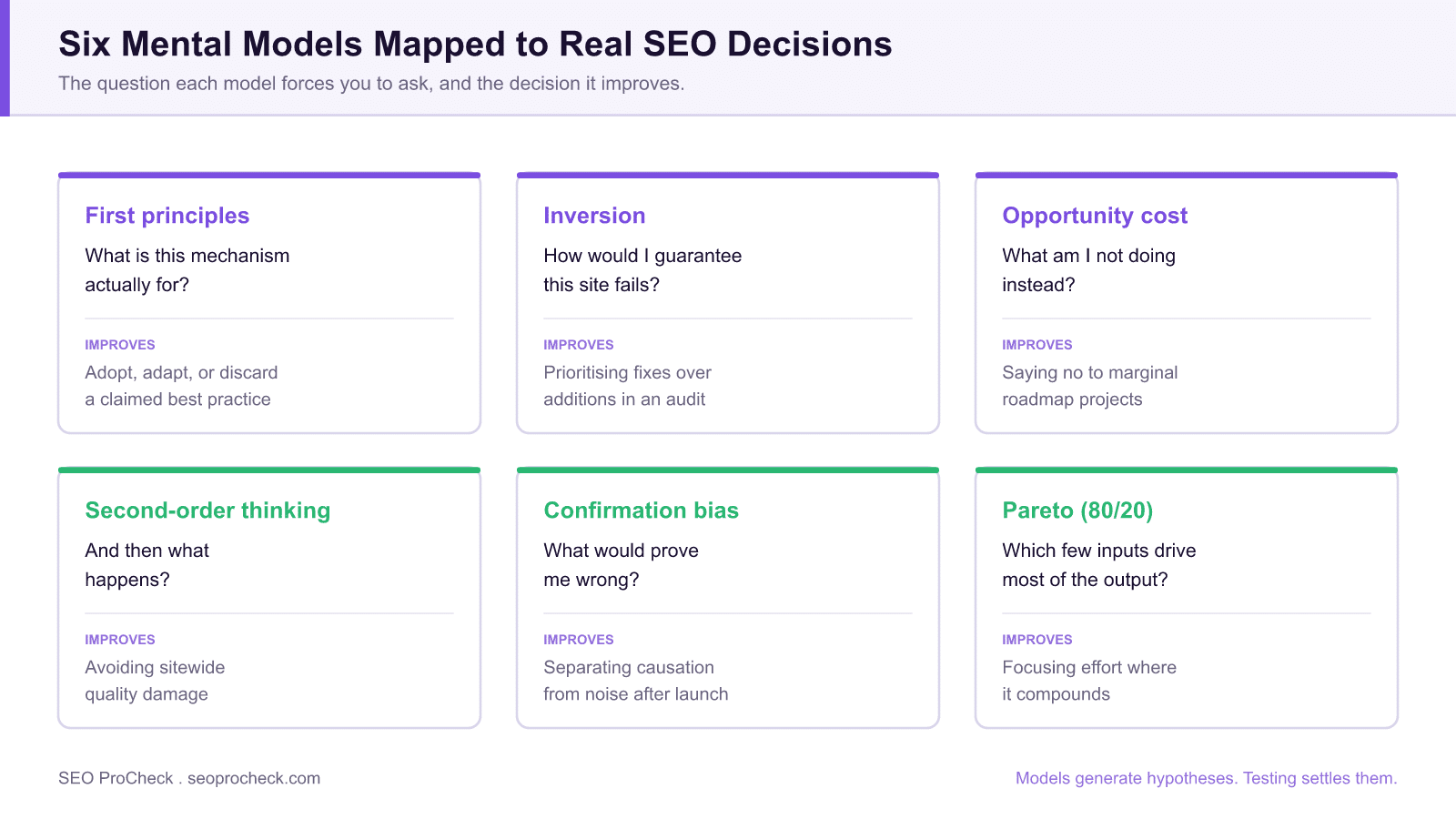
What are mental models and why do they matter for SEO? Mental models are reusable thinking frameworks, such as first-principles reasoning, inversion, or opportunity cost, that help you make better decisions with incomplete information. In SEO, where algorithms are opaque and feedback loops are slow, mental models replace guesswork with structured reasoning: they tell you which problems to work on, which tactics to skip, and when to stop.
Key Concepts
A mental model is a compressed, transferable explanation of how some part of the world works. It is not a fact to memorise but a lens you can point at an unfamiliar problem. The useful ones share three properties: they are short enough to recall under pressure, general enough to apply outside the field that produced them, and specific enough to change what you actually do next.
The value comes from holding several at once. Charlie Munger's term for this is a "latticework": no single model is reliable, but a handful drawn from different disciplines cross-check each other. Economics contributes opportunity cost and incentives, engineering contributes margin of safety and bottlenecks, psychology contributes confirmation bias and social proof, and statistics contributes base rates and regression to the mean. Applied to search, that latticework is a defence against the field's two chronic failure modes: adopting tactics because respected people repeat them, and reading causation into whatever moved after you shipped something.
One distinction matters before you start collecting them. A model is not a checklist. A checklist tells you what to do in a known situation; a model tells you how to think in an unknown one. SEO has plenty of checklists and a shortage of models, which is why so much practitioner disagreement is really two people applying different unstated frameworks to the same data.
Implementation Considerations
Reading about models changes nothing. What changes decisions is attaching a model to a recurring moment in your workflow so it fires automatically. Four attachment points work well in SEO teams:
- Attach inversion to the audit kickoff. Before listing opportunities, spend thirty minutes listing everything that would make this site unrankable. The failure list is shorter, more concrete, and better prioritised than the opportunity list, and it usually surfaces the issues that actually cap performance.
- Attach opportunity cost to sprint planning. Make the rule explicit: no task enters the sprint without a named alternative it beat. This forces the comparison teams normally skip, because every task looks worthwhile when judged alone.
- Attach second-order thinking to any sitewide or template change. Ask "and then what?" twice before shipping anything that touches many URLs at once. Programmatic pages, interlinking widgets, and bulk content generation all pass a first-order test and fail a second-order one.
- Attach a pre-mortem to large projects. Before a migration or replatform, assume it has already failed six months out and write the postmortem. Naming the failure modes in advance is the cheapest risk control available, and it converts vague unease into specific mitigations.
Expect friction. Models slow down the first few decisions they touch, and in a delivery-driven team that reads as overhead. The counterweight is to keep the ritual small: one question, asked at one moment, written down in one line.
Measuring Impact
You cannot measure a way of thinking directly, but you can measure the decisions it produces. The practical instrument is a decision log: a lightweight record, written before you ship, of what you expect to happen and why. Reviewed quarterly, it turns opinion into evidence and exposes which models are earning their keep.
| Log field | What to record | Why it matters |
|---|---|---|
| Decision and date | What you shipped, on which pages or templates | Anchors later analysis to a specific change window |
| Model applied | Which framework drove the call | Lets you see which models produce good calls over time |
| Predicted outcome | Direction, rough size, and expected timeframe | Prediction written in advance cannot be revised after the fact |
| What would prove me wrong | The observation that would falsify the reasoning | The direct antidote to confirmation bias |
| Alternative rejected | The next best use of the same effort | Makes opportunity cost visible and reviewable |
| Actual outcome | What happened, including confounds and updates | Separates real effects from seasonality and algorithm noise |
Three metrics fall out of a log kept for a couple of quarters: prediction hit rate (how often the expected direction was right), reversal rate (how often shipped work had to be undone, the clearest second-order-thinking score), and time-to-kill (how quickly the team abandons an idea that is not working). Improvement on those three is what better thinking looks like in practice. Where the change is on a repeatable template, promote the question from a log entry to a controlled experiment using SEO A/B split testing, which supplies the control group a decision log cannot.
Five Mental Models Applied to Concrete SEO Decisions
Reading about mental models is easy; the value comes from wiring them into everyday SEO calls. Here is how five well-known models change actual decisions practitioners face every week.
1. First-Principles Thinking: "Should I follow this best practice?"
Instead of asking "what does everyone do?", ask "what is this mechanism actually for?" Take title tags: the received wisdom is a character limit, but the first principle is that a title exists to win a click for a matching intent. That reframing explains why a truncated-but-compelling title can outperform a perfectly-sized generic one, and why Google rewrites titles it considers a poor match. First-principles thinking is also the fastest filter for SEO folklore: if you cannot trace a tactic back to how crawling, indexing, ranking, or click behavior works, treat it with suspicion.
2. Inversion: "How would I guarantee this site fails?"
Rather than asking how to rank, invert: what would make this site unrankable? Thin duplicated templates, orphan pages, slow server responses, content nobody would cite, no distinguishable expertise. Then simply stop doing those things. Inversion is especially useful in audits, because the list of "things that would kill this site" is usually shorter, more concrete, and more actionable than an open-ended list of optimizations.
3. Opportunity Cost: "Is this migration worth a quarter?"
Every sprint spent on a marginal schema tweak is a sprint not spent on content that could earn links. SEO teams chronically underweight opportunity cost because tasks feel productive in isolation. Before committing, estimate what the next best use of the same hours would return. This model is the honest answer to most "should we do X?" questions: X probably helps a little, but something else helps more.
4. Second-Order Thinking: "What happens after this works?"
Programmatic pages might win long-tail traffic (first order) but dilute sitewide quality signals and trigger scaled-content suppression (second order). Aggressive interlinking widgets lift crawl discovery but flatten your anchor-text signal. Asking "and then what?" before shipping is the cheapest insurance in SEO, because reversing a sitewide quality problem takes far longer than creating it. The same logic applies to intent targeting: winning a featured snippet or a People Also Ask slot changes your CTR profile, which changes which queries are worth targeting next.
5. Confirmation Bias (and its antidote): "Did my change really cause that lift?"
After shipping a change, every traffic uptick looks like vindication. The model here is to actively seek disconfirming evidence: check whether untouched pages rose too, whether the lift coincides with a seasonality curve or an algorithm update, and whether the query mix actually shifted toward the pages you changed. If you only look for confirming data, you will always find it, and you will scale tactics that never worked.
Quick-Reference: Mental Models Mapped to SEO Situations
| Mental model | Core question | Typical SEO situation | Decision it improves |
|---|---|---|---|
| First principles | What is this mechanism for? | Evaluating a "best practice" | Adopt, adapt, or discard tactics |
| Inversion | How would I guarantee failure? | Site audits, quality reviews | Prioritizing fixes over additions |
| Opportunity cost | What am I not doing instead? | Roadmap and sprint planning | Saying no to marginal projects |
| Second-order thinking | And then what happens? | Programmatic content, templates | Avoiding sitewide quality damage |
| Confirmation bias check | What would prove me wrong? | Post-launch measurement | Separating causation from noise |
| Pareto (80/20) | Which few inputs drive most output? | Keyword and page prioritization | Focusing effort where it compounds |
Why This Matters More in the AI-Search Era
Mental models have become more valuable, not less, since this piece was written. With AI Overviews, ChatGPT, and Claude now mediating a meaningful share of discovery, the feedback loops SEOs rely on are noisier than ever: you often cannot see the query, the click, or the citation. When data thins out, reasoning frameworks carry more of the load. First-principles thinking, for example, is exactly how you work out what makes AI assistants cite a page: clear claims, verifiable facts, and machine-readable structure such as JSON-LD structured data, rather than chasing platform-specific hacks that decay in months.
The Pareto model deserves special mention for prioritization: in most keyword portfolios a small fraction of pages drives the bulk of conversions, while the long tail delivers volume in aggregate. Knowing when to apply 80/20 focus versus when to invest in long-tail keyword coverage is itself a mental-model decision: the models tell you which regime you are in.
Frequently Asked Questions
A mental model is a compressed explanation of how something works that you can reuse across situations: a thinking shortcut that improves judgment. "Incentives drive behavior" and "correlation is not causation" are both mental models.
SEO decisions are made under uncertainty: the algorithm is opaque, results lag by weeks, and confounders are everywhere. Mental models give you structured ways to prioritize work, evaluate tactics, and interpret ambiguous data instead of relying on folklore or the loudest voice in the room.
Inversion. Asking "what would make this page fail to rank?" produces an immediately actionable checklist (slow loads, unclear topic, no unique value, poor internal links) without requiring deep algorithm knowledge.
A working set of five to ten covers most marketing decisions. Depth beats breadth: applying first principles, inversion, opportunity cost, second-order thinking, and 80/20 consistently is worth more than skimming a list of a hundred models.
No. Models generate better hypotheses and protect you from misreading data, but they are a complement to measurement, not a substitute. The strongest workflow is model-driven hypothesis, then test, then a deliberate search for disconfirming evidence.
The modern popularization traces largely to investor Charlie Munger, who advocated building a "latticework" of models drawn from many disciplines, among them psychology, engineering, and economics, and applying them in combination rather than relying on one lens.
This resource contributes to the knowledge base SEO practitioners need for effective optimization in an evolving search landscape.
Source: https://www.kevin-indig.com/mental-models-and-why-do-you-need-to-master-them/
Claude Vincent is a technical SEO consultant focused on crawlability, rendering, and AI-search visibility. He writes the field guides and case studies at SEO ProCheck, with a bias toward the durable, unglamorous work that decides whether search engines and AI answer engines can actually read and cite a site.
About SEO ProCheck
Technical SEO consulting and GEO strategy with 20 years of enterprise experience. Case studies, resources, and tools for search and AI visibility.
Work With Me
Technical SEO audits, GEO strategy, site migrations, and international SEO. Hourly consulting for teams who need hands-on support, not just reports.
Subscribe to our newsletter!







Recent Posts
- Finding a Competitor's Sitemap, and Turning It Into a Change Log September 15, 2026
- AI Crawler User Agents: The Current Names, and Which Ones Sites Actually Block September 9, 2026
- Can AI Crawlers Actually Read Your Site? I Measured 400 of the Biggest September 5, 2026