

AI Summary
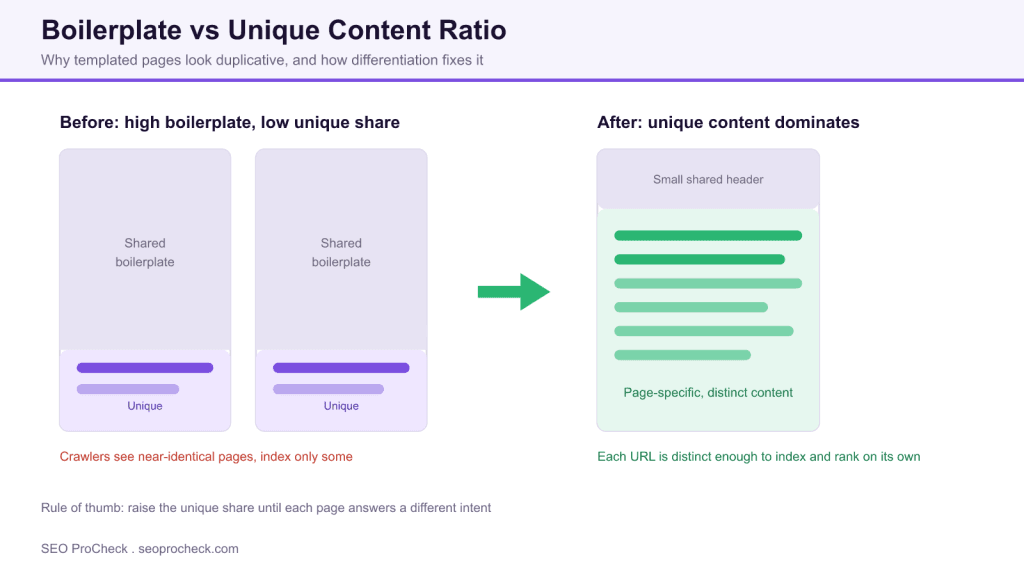
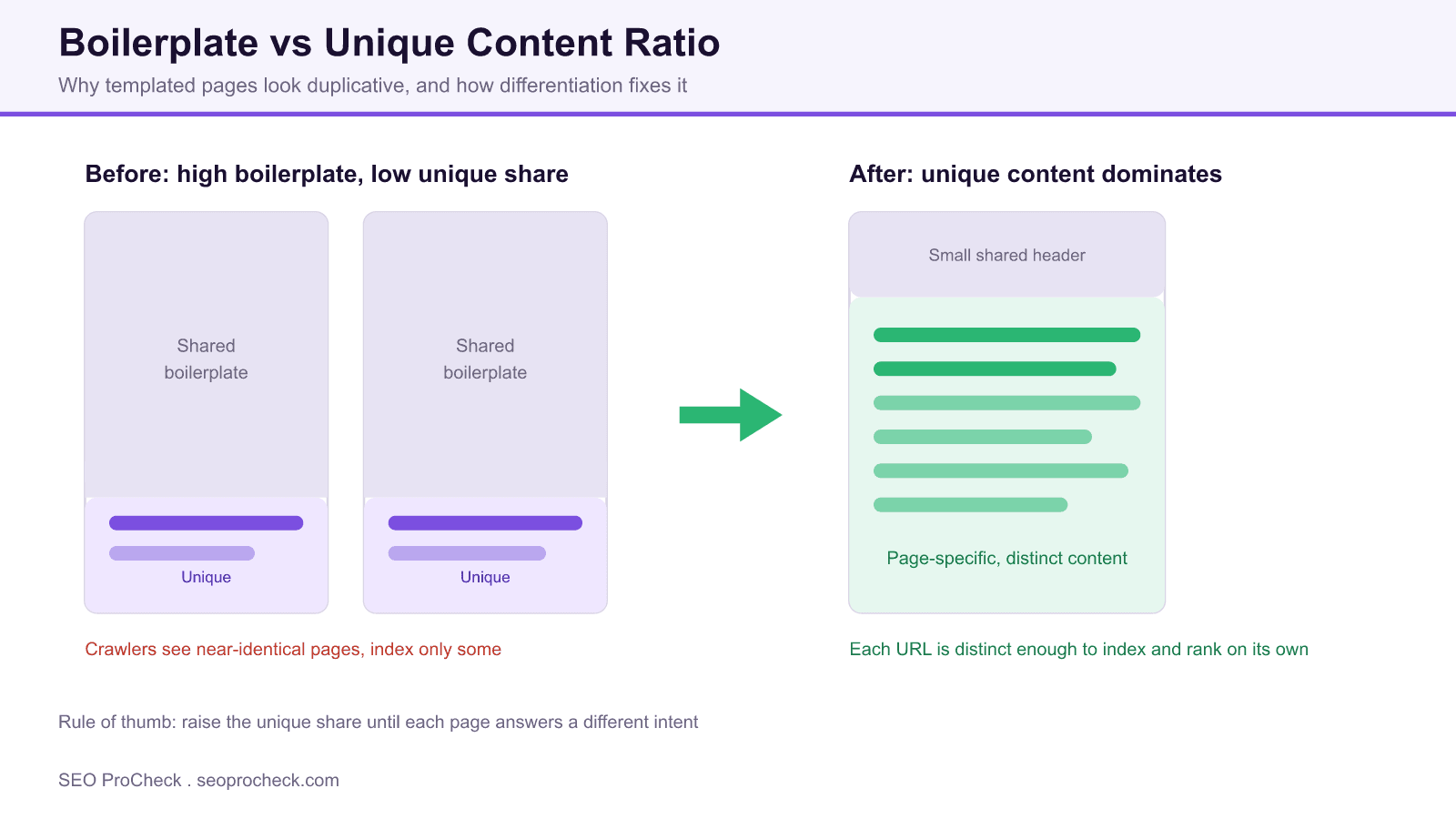
A duplicate content section is a block of text that repeats across many URLs, boilerplate, reused paragraphs, or templated copy, so that the unique part of each page is too small to stand on its own. The fix is to raise the unique content ratio: cut the repeated boilerplate, add page-specific detail, and consolidate pages that are too similar to justify separate URLs.
- Duplication here is internal boilerplate, not plagiarism: the same wording reused across your own templates.
- Risk: crawlers may index only some of the near-identical pages and each page loses topical distinctiveness.
- Measure the unique share: if boilerplate dwarfs the page-specific copy, that page is a candidate.
- Consolidate true twins with a 301 or canonical instead of leaving two thin pages to compete.
- Element Code: CQ
- Issue: See below
- Impact: Quality / trust / clarity
- Fix: See steps
- Detection: Crawler, manual review
What this issue means
A substantial block of content that repeats across many pages: boilerplate descriptions, reused paragraphs, or templated sections that make pages look near-identical to crawlers.
This is internal duplication, not copied third-party text. It shows up most on templated page types: product variants, location pages, category archives, and tag pages, where a large shared shell wraps a thin sliver of page-specific copy. Search engines do not penalize this the way many people fear, but they do collapse near-identical URLs into a single representative and quietly drop the rest, which is why pages you expect to see indexed never appear.
Why it matters
When the unique portion of a page is small relative to repeated boilerplate, search engines may see the pages as duplicative and index only some of them. It also weakens the topical distinctiveness each page needs to rank for its own intent.
There is a second cost that is easy to miss: crawl budget. On large templated sites, thousands of low-differentiation URLs soak up crawl activity that would be better spent on the pages you actually want ranked. Trimming boilerplate and consolidating twins concentrates both crawl attention and ranking signals on fewer, stronger URLs.
How to measure the unique content ratio
Before you change anything, quantify the problem so you can prove the fix later. A practical, repeatable method:
- Crawl the templated set with a tool such as Screaming Frog or Sitebulb and export the near-duplicate report, which clusters URLs by content similarity.
- Estimate the shared shell: count the words in the header, sidebar, footer, and any repeated intro or disclaimer that appears on every page in the template.
- Count the page-specific words: the copy that genuinely changes from one URL to the next.
- Divide: page-specific words over total words gives the unique ratio. When that number is low across a template, the whole set is at risk, not just one URL.
How to fix it
- Identify the repeated block across your templates.
- Reduce boilerplate and raise the ratio of unique, page-specific content.
- Differentiate templated pages with genuinely distinct information.
- Consolidate pages that are too similar to justify separate URLs.
When you consolidate, choose the right mechanism for the situation. If two URLs should truly be one, redirect the weaker with a 301 so its links flow to the survivor. If both must exist for users but only one should rank, point a rel="canonical" from the duplicate to the preferred URL. Never rely on a canonical as a substitute for actually reducing boilerplate: it is a hint, and engines can ignore it when pages differ too little to trust the signal.
Types of internal duplication and the right fix
| Pattern | Where it appears | Best fix |
|---|---|---|
| Boilerplate dominates | Location, product variant, tag pages | Add page-specific copy, cut shared filler |
| Near-identical twins | Two guides on one query | 301 the weaker into the stronger |
| URL parameter versions | Filters, sorts, session ids | Canonical to the clean URL |
| Paginated series | Deep category or blog archives | Self-referencing canonicals, unique intros |
| WWW or protocol variants | http, https, www, non-www | Redirect all variants to one canonical host |
Related: Duplicate Content FAQ
Frequently asked questions
Is a duplicate content section a Google penalty?
No. Internal duplication is a filtering issue, not a manual penalty. Google simply picks one representative URL and drops the near-identical copies, so the practical harm is pages that never get indexed rather than a sitewide punishment.
How much unique content does a templated page need?
There is no fixed threshold, but the page-specific copy should clearly outweigh the shared shell and should answer a distinct intent. If a user could not tell two pages apart from their unique sections, the ratio is too low.
Should I use a canonical tag or a 301 redirect?
Use a 301 when the duplicate should not exist as a separate page and users do not need it. Use a canonical when both URLs must remain reachable for people but only one should be indexed, such as filtered or sorted versions of a list.
Does noindex fix duplicate content?
It can keep the extra URLs out of the index, but it does not raise the quality of the page that remains. Prefer consolidation and stronger unique copy first, and reserve noindex for utility pages that genuinely should never rank.
How do I find duplicate sections across my site?
Crawl the site with a tool that reports near-duplicate clusters, such as Screaming Frog or Sitebulb, then review the groups it flags. Manual spot checks of your most templated page types usually confirm where the boilerplate is heaviest.
Can two of my own pages compete for the same keyword?
Yes. When two similar pages target one query they split signals and often both rank lower than a single merged page would. Consolidating them into one authoritative URL usually lifts performance.
Related reading on SEO ProCheck:
- More technical SEO FAQs
- Browse the full SEO checks library
- How an advanced SEO audit surfaces duplication at scale
Want a second set of eyes on your content quality?
Content quality is half of technical SEO. See how an advanced SEO audit works →
Take this with you
The assistant links open with a question about this page already written. Nothing is sent until you press enter.
Claude Vincent is a technical SEO consultant focused on crawlability, rendering, and AI-search visibility. He writes the field guides and case studies at SEO ProCheck, with a bias toward the durable, unglamorous work that decides whether search engines and AI answer engines can actually read and cite a site.
About SEO ProCheck
Technical SEO consulting and GEO strategy with 20 years of enterprise experience. Case studies, resources, and tools for search and AI visibility.
Work With Me
Technical SEO audits, GEO strategy, site migrations, and international SEO. Hourly consulting for teams who need hands-on support, not just reports.
Subscribe to our newsletter!








Recent Posts
- Most Top Sites Never Say Who They Are in Structured Data October 14, 2026
- Homepage Titles Are Mostly Too Short, Not Too Long October 8, 2026
- Who Actually Serves an llms.txt? 184 Top Sites Measured September 29, 2026