

Duplicate Content FAQ: Identifying & Fixing Content Duplication
- September 28, 2025
- Technical SEO FAQ
AI Summary
Duplicate content is the same or substantially similar content appearing at more than one URL, either inside your site or across different sites. There is no formal penalty for most of it; Google simply filters duplicates and shows one version, but that dilutes link equity and wastes crawl budget, so consolidate signals onto a single preferred URL.
- Accidental duplication is filtered, not penalized; only deceptive, scraped, or spun content risks a penalty.
- Common internal causes are URL parameters, www versus non www, HTTP versus HTTPS, and faceted navigation.
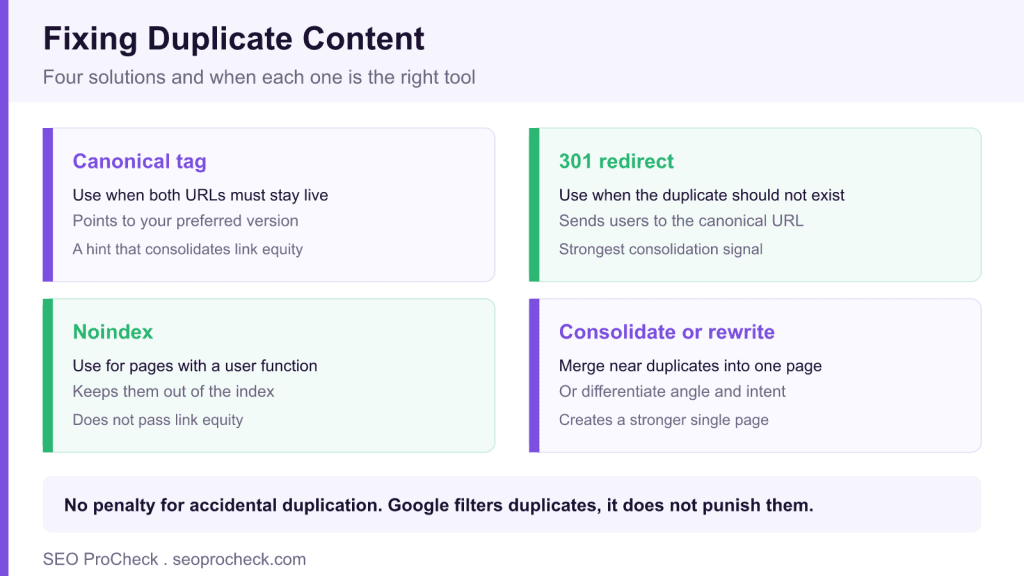
- Use canonical tags when both URLs must stay live and 301 redirects when the duplicate should not exist.
- Robots.txt blocks crawling, not indexing, so use noindex when you truly want a page out of the index.

Complete guide to duplicate content in SEO. How to identify internal and external duplication, understand the impact on rankings, and implement solutions.
Table of Contents
Duplicate Content Basics
What is duplicate content?
Content that appears in more than one location (URL) on the web. Can be identical or substantially similar. Exists internally (within your site) or externally (across different sites). Google must choose which version to show in search results, potentially ignoring others.
Why is duplicate content a problem?
Search engines struggle to determine which version to rank. Link equity gets diluted across multiple URLs. Crawl budget wasted on duplicate pages. User experience suffers with inconsistent URLs. Not usually a penalty, but reduces ranking effectiveness significantly.
Is there a duplicate content penalty?
No formal penalty for most duplicate content. Google filters duplicates, showing one version and ignoring others. You lose potential rankings but aren't punished. Exception: manipulative duplication (scraping, spinning) intended to deceive can trigger penalties. Accidental duplication is filtered, not penalized.
How much duplicate content is too much?
No specific threshold. Small amounts (boilerplate footers, similar product descriptions) are normal and handled by Google. Significant portions of your site being duplicated causes problems. If the majority of a page matches another page, it's likely duplicate. Context and intent matter.
What is near-duplicate content?
Content that's substantially similar but not identical. Same article with minor rewording, same template with only product name changed, or syndicated content with attribution added. Google treats near-duplicates similarly to exact duplicates. Similarity matters, not just identical matches.
Types of Duplication
What is internal duplicate content?
Duplication within your own site. Same content accessible at multiple URLs. Common causes: URL parameters, session IDs, www/non-www versions, HTTP/HTTPS versions, trailing slashes, pagination, print pages, faceted navigation. Under your control to fix.
What is external duplicate content?
Same content appearing on different domains. Causes: content syndication, scraping/theft, using manufacturer descriptions, guest posts on multiple sites, press releases. Harder to control. Original source typically should rank, but not guaranteed.
What are URL parameter duplicates?
Same page content accessible with different URL parameters: ?color=blue, ?sort=price, ?ref=email. Each parameter version may be seen as separate URL. Creates exponential duplication in e-commerce with faceted navigation. Requires careful management via canonicals or robots.txt.
What are www vs non-www duplicates?
Site accessible at both www.example.com and example.com. Every page potentially duplicated. Solution: 301 redirect one version to the other, set preference in Search Console (legacy), use consistent internal links. Most sites use non-www now.
What are HTTP vs HTTPS duplicates?
Site accessible at both http:// and https://. With HTTPS standard, all HTTP should 301 redirect to HTTPS. Ensure redirects work properly. Update internal links to HTTPS. Mixed accessibility creates duplication and security warnings.
What if my content is scraped?
Other sites copying your content. Google usually identifies original source, but not always. Build strong signals of originality: publish first, build authority, get legitimate links to your version. File DMCA if theft is significant. Focus on strengthening your own site.
SEO Impact
How does duplicate content affect rankings?
Google chooses one version to show, filtering others. The "wrong" version might be chosen. Link equity splits between duplicates instead of consolidating. Important pages may be ignored. You compete with yourself. Overall ranking potential diminishes.
How does duplication affect crawling?
Crawl budget wasted on duplicate URLs. Google may spend time crawling variations instead of unique content. Large sites with massive duplication (faceted navigation) may have important pages crawled less frequently. Cleaning duplicates improves crawl efficiency.
What is link equity dilution?
When external sites link to different duplicate URLs, link value spreads instead of concentrating. Page A and page B both get links, but neither gets full credit. Consolidating to one URL combines all link equity. Canonicalization and redirects solve this.
What if Google indexes the wrong version?
Google's choice may not match your preference. A parameter URL might rank instead of clean URL. HTTP might appear instead of HTTPS. Implement proper canonicals and redirects. Google generally respects clear signals. Check URL Inspection to verify indexed version.
Identifying Duplicates
How do I find duplicate content on my site?
Crawl with Screaming Frog or Sitebulb; look for duplicate title tags, meta descriptions, and content. Search Console's Page indexing report flags some duplicates. Use site: searches with specific phrases. Check URL variations manually. Tools like Siteliner scan for duplication.
How does Search Console report duplicates?
The Page indexing report shows "Duplicate without user-selected canonical" and "Duplicate, Google chose different canonical than user". Indicates pages Google considers duplicate and which version it prefers. Review to ensure Google's choices match your intentions.
How do I use site: search to find duplicates?
Search: site:yourdomain.com "exact phrase from your content". If multiple pages appear, you have internal duplication. Without site:, search shows if content exists elsewhere on web. Put unique sentences in quotes for exact matching.
How do I check for external duplication?
Copyscape compares your content against web. Paste URL or text to find copies. Paid version offers batch checking. Google search for unique phrases also works. Useful for finding scraped content or checking syndication spread. Regular monitoring recommended for valuable content.
What tools detect duplicate content?
Screaming Frog: finds internal duplicates via near-duplicate detection. Sitebulb: duplicate content reports. Copyscape: external duplicate detection. Siteliner: free internal duplicate scanning. Search Console: flags canonical issues. Each serves different purpose; combine for complete picture.
Solutions
How do canonical tags solve duplication?
Canonical tag tells search engines which URL is the "main" version. Duplicate pages point canonical to preferred URL. Link equity consolidates. Google typically respects canonicals (they're hints, not directives). Implement on all pages, including self-referencing canonicals.
When should I use redirects vs canonicals?
301 redirects: when duplicate URL should no longer exist (users should be sent to canonical). Canonicals: when both URLs need to remain accessible (parameters for functionality, but one is preferred for SEO). Redirects are stronger signals than canonicals.
When should I use noindex for duplicates?
When pages serve user function but shouldn't be indexed: print versions, parameter variations for filters. Noindex keeps pages accessible but removes from index. Doesn't consolidate link equity like canonicals. Use when you don't want any version of that page indexed.
Can robots.txt prevent duplicate content issues?
Blocking crawling prevents pages from being seen, but URLs can still be indexed via links (showing "No information available"). Robots.txt prevents crawling, not indexing. For true removal, use noindex. Robots.txt helps manage crawl budget for known parameter patterns.
When should I consolidate duplicate pages?
When duplicates serve no distinct purpose, merge into one comprehensive page. Redirect deprecated versions to survivor. Better than maintaining duplicates with canonicals. Consolidation creates stronger single page. Use when one definitive version is possible.
When should I rewrite duplicate content?
When you need multiple pages on similar topics but current versions are too similar. Differentiate angles, target different keywords, serve different intents. Substantial rewriting (not just word swapping) creates genuine uniqueness. More effort but better outcome than canonicalization.
Prevention
How do I prevent internal duplicate content?
Consistent URL structure (www or not, trailing slash or not). Self-referencing canonicals on all pages. Proper parameter handling. 301 redirects for consolidation. Consistent internal linking. Canonical management in CMS. Prevent issues from inception; fixing later is harder.
What CMS settings help prevent duplicates?
Configure canonical tag plugins. Set preferred domain (www/non-www). Handle pagination properly. Control archive pages (categories, tags, dates). Manage print versions. WordPress, Shopify, etc. have specific settings and plugins for duplicate prevention.
How do I handle content syndication safely?
Syndication partners should noindex their copies, which Google recommends over a rel=canonical for syndicated content, and link back to your original at minimum. A rel=canonical pointing to your version can still help with other engines. Ensure your version is indexed first before syndicating. Clear attribution matters. Syndication can be beneficial if managed correctly.
What about manufacturer product descriptions?
Using identical manufacturer descriptions creates duplication across all retailers. Solutions: rewrite descriptions to be unique, add substantial original content (reviews, comparisons, specs), use manufacturer text minimally supplemented by original content. E-commerce differentiation matters.
How often should I audit for duplicates?
Regular crawls catch emerging issues. Full duplicate audit quarterly for large sites. After major site changes or migrations. When adding new content types or functionality. Monitoring Search Console for duplicate warnings. Prevention is easier than correction.
How do I handle duplicate content for international sites?
Same content in same language for different countries can be seen as duplicate. Use hreflang tags to indicate language/country targeting. Not duplication if properly tagged. Content in different languages is not duplicate. Localize content where possible beyond just hreflang.
Duplicate content causes and fixes
| Cause | Type | Recommended fix |
|---|---|---|
| www vs non www | Internal | 301 redirect to one preferred host |
| HTTP vs HTTPS | Internal | 301 redirect all HTTP to HTTPS |
| URL parameters | Internal | Canonical to the clean URL |
| Faceted navigation | Internal | Canonical or noindex filtered views |
| Content syndication | External | Partner noindexes its copy and links back to you |
| Manufacturer descriptions | External | Rewrite and add original content |
| Scraped content | External | Publish first, build authority, file DMCA |
Frequently Asked Questions
Is there a duplicate content penalty?
There is no formal penalty for most duplicate content. Google filters duplicates by showing one version and ignoring the others, so you lose potential rankings but are not punished. The exception is manipulative duplication such as scraping or spinning intended to deceive, which can trigger a penalty.
What is near-duplicate content?
Near-duplicate content is substantially similar but not identical, such as the same article with minor rewording or a template where only the product name changes. Google treats near-duplicates much like exact duplicates, because similarity is what matters, not just identical matches.
What are www vs non-www duplicates?
This happens when your site is reachable at both www.example.com and example.com, which can duplicate every page. The fix is to 301 redirect one version to the other, keep internal links consistent, and pick a single preferred host. Most sites standardize on the non www version today.
How do canonical tags solve duplication?
A canonical tag tells search engines which URL is the main version, so duplicate pages point their canonical to the preferred URL and link equity consolidates there. Google generally respects canonicals, though they are hints rather than directives. Use self referencing canonicals on all pages.
When should I use noindex for duplicates?
Use noindex when a page serves a genuine user function but should not appear in search, such as print versions or filtered parameter views. Noindex keeps the page accessible while removing it from the index. Note that it does not consolidate link equity the way a canonical does.
Can robots.txt prevent duplicate content issues?
Not fully. Robots.txt prevents crawling, but a blocked URL can still be indexed through links, showing with no description. For true removal from the index you need noindex, which requires the page to be crawlable. Robots.txt is better for managing crawl budget on known parameter patterns.
Related on SEO ProCheck
- SEO audit FAQ: how duplication surfaces during a site audit.
- Meta robots and X-Robots-Tag reference: the noindex directive in depth.
- Top SEO factors: where indexation hygiene fits overall.
Take this with you
The assistant links open with a question about this page already written. Nothing is sent until you press enter.
Claude Vincent is a technical SEO consultant focused on crawlability, rendering, and AI-search visibility. He writes the field guides and case studies at SEO ProCheck, with a bias toward the durable, unglamorous work that decides whether search engines and AI answer engines can actually read and cite a site.
About SEO ProCheck
Technical SEO consulting and GEO strategy with 20 years of enterprise experience. Case studies, resources, and tools for search and AI visibility.
Work With Me
Technical SEO audits, GEO strategy, site migrations, and international SEO. Hourly consulting for teams who need hands-on support, not just reports.
Subscribe to our newsletter!








Recent Posts
- Most Top Sites Never Say Who They Are in Structured Data October 14, 2026
- Homepage Titles Are Mostly Too Short, Not Too Long October 8, 2026
- Who Actually Serves an llms.txt? 184 Top Sites Measured September 29, 2026