

We Analyzed 11.8 Million Google Search Results: Ranking Factors
- February 12, 2022
- Cross-Industry
AI Summary
Backlinko partnered with Ahrefs, SEMrush, SimilarWeb, and MarketMuse to study 11.8 million Google results, and the strongest patterns were link related: more referring domains and greater linking domain diversity correlated with higher rankings. Correlation is not causation, so treat the findings as directional guidance rather than a checklist.
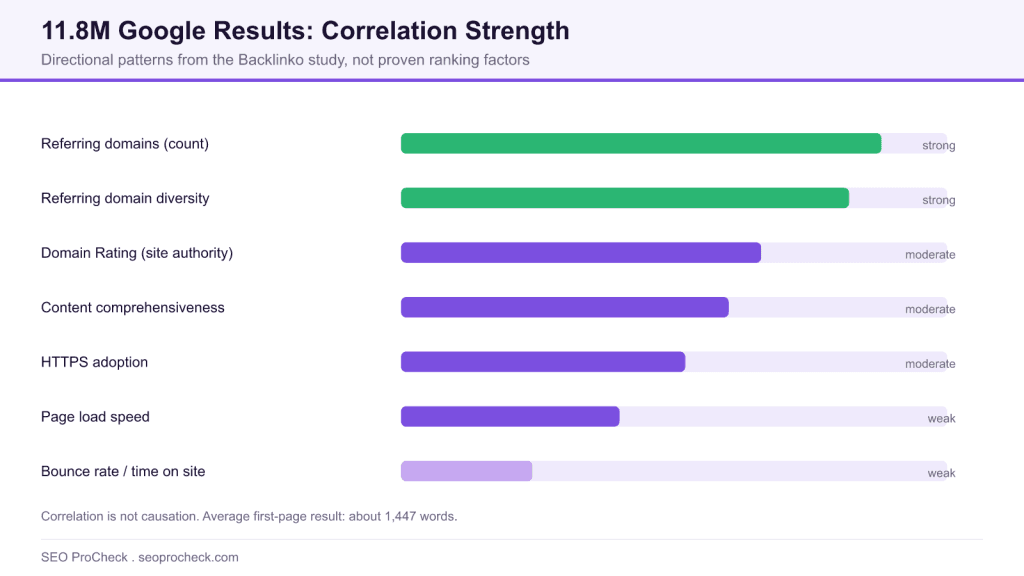
- Referring domain count and diversity showed the strongest correlations in the study.
- The average first page result contained roughly 1,447 words, but length reflects depth, not a target.
- HTTPS and speed correlated with rankings, largely as markers of overall site quality.
- Engagement metrics like bounce rate showed weak correlations that may reflect reverse causation.
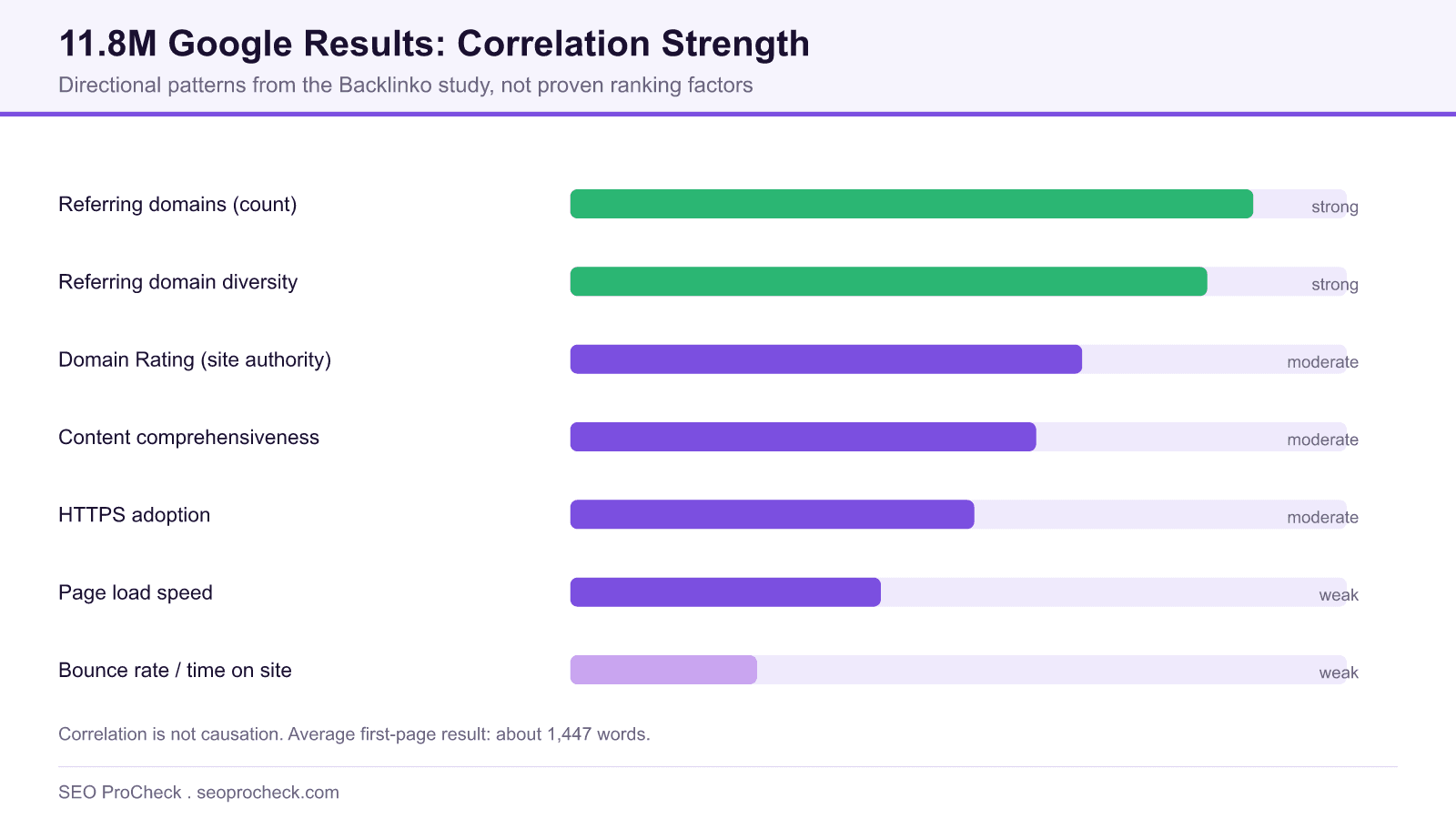
Backlinko partnered with Ahrefs, SEMrush, SimilarWeb, and MarketMuse to analyze 11.8 million Google search results, creating one of the most comprehensive ranking factor correlation studies ever conducted. While correlation doesn't prove causation, the study provides valuable insights into patterns that distinguish high-ranking pages from lower-ranked competitors.
Link Authority Correlations
Pages with more referring domains ranked significantly higher than those with fewer backlinks. The relationship between referring domain count and rankings was among the strongest correlations in the study. Notably, the diversity of linking domains mattered more than raw link count, suggesting that broad link acquisition outperforms concentrated link building from few sources.
Domain-level authority (measured by Domain Rating) showed positive correlation with rankings, but page-level link metrics showed stronger correlation. This suggests that while domain authority helps, individual pages still need their own link signals to rank well. New pages on authoritative domains may not automatically rank without page-specific link building.
Content and On-Page Factors
Longer content correlated with higher rankings, with the average first-page result containing approximately 1,447 words. However, the study authors cautioned against interpreting this as "write longer content to rank better." Longer content may simply cover topics more comprehensively, naturally attracting more links and engagement. Content length should be determined by topic requirements rather than arbitrary targets.
HTTPS adoption showed strong correlation with first-page rankings, with the vast majority of top results using secure connections. While HTTPS is a confirmed ranking factor, its near-universal adoption on top-ranking pages likely reflects correlation with overall site quality rather than the modest ranking boost HTTPS provides.
Technical and User Experience Factors
Page loading speed showed modest correlation with rankings. Sites loading in under 3 seconds ranked higher on average than slower sites. The study used time-to-first-byte and full page load metrics. While not the strongest correlation, speed's importance for user experience makes optimization worthwhile regardless of direct ranking impact.
Bounce rate and time on site showed weak correlations that may reflect reverse causation: pages ranking higher naturally receive more qualified traffic that bounces less, rather than low bounce rates causing higher rankings. The study highlighted the challenge of distinguishing cause from effect in engagement metrics.
Interpretation and Application
Correlation studies cannot identify ranking factors definitively. Google's algorithm uses hundreds of signals, many interacting in complex ways that aggregate studies cannot isolate. Use these findings as directional guidance rather than a ranking factor checklist. Focus on factors that improve user experience and naturally attract links rather than optimizing for correlation metrics.
Source: Backlinko
Reading the Correlations Without Overreacting
The value of a study this large is the direction it points, not a formula to copy. The table restates the headline correlations alongside the practical read, so you can separate what to prioritize from what to note and move on.
| Factor | Correlation with rankings | How to act on it |
|---|---|---|
| Referring domains | Strong | Earn links from many distinct, relevant domains, not repeat links from a few |
| Linking domain diversity | Strong | Prioritize breadth of sources over sheer link volume |
| Domain authority | Moderate | Build site authority, but still earn page level links for key URLs |
| Content comprehensiveness | Moderate | Cover the topic fully; let the subject set the length |
| HTTPS and speed | Modest | Treat as table stakes and quality signals, not a shortcut to rank |
| Bounce rate and time on site | Weak | Improve for users; do not chase as a direct ranking lever |
What Correlation Studies Cannot Tell You
Google's algorithm blends hundreds of signals that interact in ways an aggregate study cannot isolate, so a strong correlation never proves a lever. The content length finding is the clearest example: longer pages rank well partly because thorough coverage naturally attracts links and satisfies intent, not because word count itself is rewarded. Padding a page to hit a number tends to dilute it. Let the question determine the depth, a point we expand on in our content length myth analysis.
Turning the Findings Into Priorities
If you use this study to set priorities, the link data argues for a diversified acquisition approach: digital PR, original research, and genuinely useful assets that many different sites want to reference. The page level link finding is a reminder that a strong domain does not automatically float a new URL, so route internal links and outreach to the pages you most want to rank. Our internal linking guide covers how to distribute that authority, and because speed remains a genuine user experience factor regardless of its modest correlation, our Core Web Vitals overview is worth pairing with any link program.
Frequently Asked Questions
What was the strongest ranking correlation in the Backlinko study?
Link related signals were strongest. Both the number of referring domains and the diversity of those linking domains correlated more with higher rankings than most other factors measured across the 11.8 million results.
Does the study prove longer content ranks better?
No. The average first page result was around 1,447 words, but the authors cautioned against chasing length. Longer pages often rank because they cover a topic thoroughly, which attracts links and satisfies intent, not because of word count alone.
If HTTPS correlates with rankings, will switching boost me a lot?
Probably not on its own. HTTPS is a confirmed but modest factor, and its near universal presence on top results mostly reflects that quality sites use it. Adopt HTTPS as a baseline, not as a ranking shortcut.
Do bounce rate and time on site affect rankings?
The study found only weak correlations that may reflect reverse causation, since higher ranking pages attract more qualified traffic that bounces less. Improve these metrics for users rather than treating them as direct ranking levers.
Why does page level link data matter if my domain is strong?
The study found page level link metrics correlated more strongly than domain level authority. A strong domain helps, but individual pages still benefit from their own links, so new URLs may need page specific link building to rank.
How should I use correlation studies in my strategy?
Use them as directional guidance, not a checklist. Focus on the factors that improve user experience and naturally earn links, and avoid optimizing for a metric just because it correlates with rankings.
Take this with you
The assistant links open with a question about this page already written. Nothing is sent until you press enter.
Claude Vincent is a technical SEO consultant focused on crawlability, rendering, and AI-search visibility. He writes the field guides and case studies at SEO ProCheck, with a bias toward the durable, unglamorous work that decides whether search engines and AI answer engines can actually read and cite a site.
About SEO ProCheck
Technical SEO consulting and GEO strategy with 20 years of enterprise experience. Case studies, resources, and tools for search and AI visibility.
Work With Me
Technical SEO audits, GEO strategy, site migrations, and international SEO. Hourly consulting for teams who need hands-on support, not just reports.
Subscribe to our newsletter!







Recent Posts
- Finding a Competitor's Sitemap, and Turning It Into a Change Log September 15, 2026
- AI Crawler User Agents: The Current Names, and Which Ones Sites Actually Block September 9, 2026
- Can AI Crawlers Actually Read Your Site? I Measured 400 of the Biggest September 5, 2026