

AI Summary
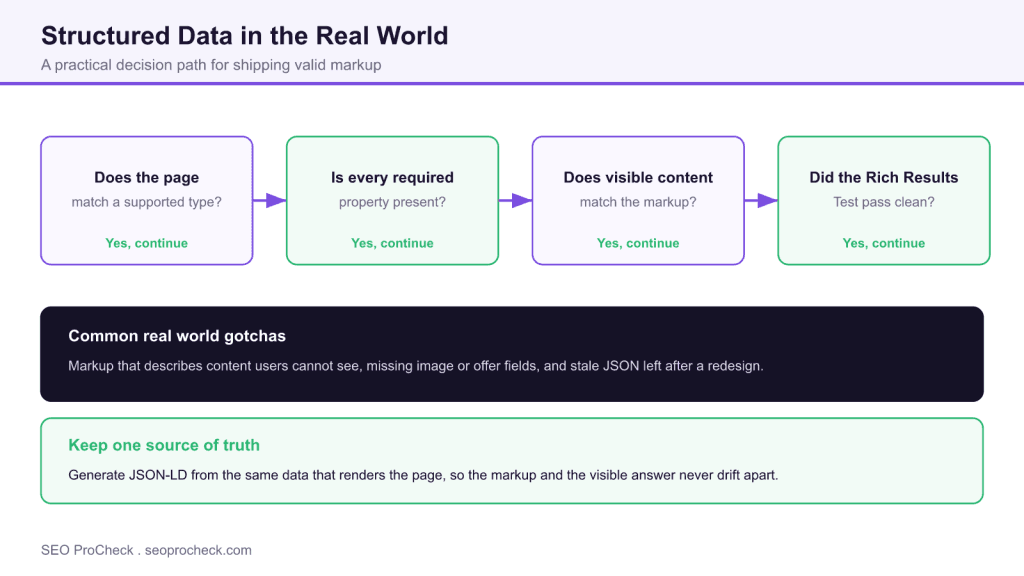
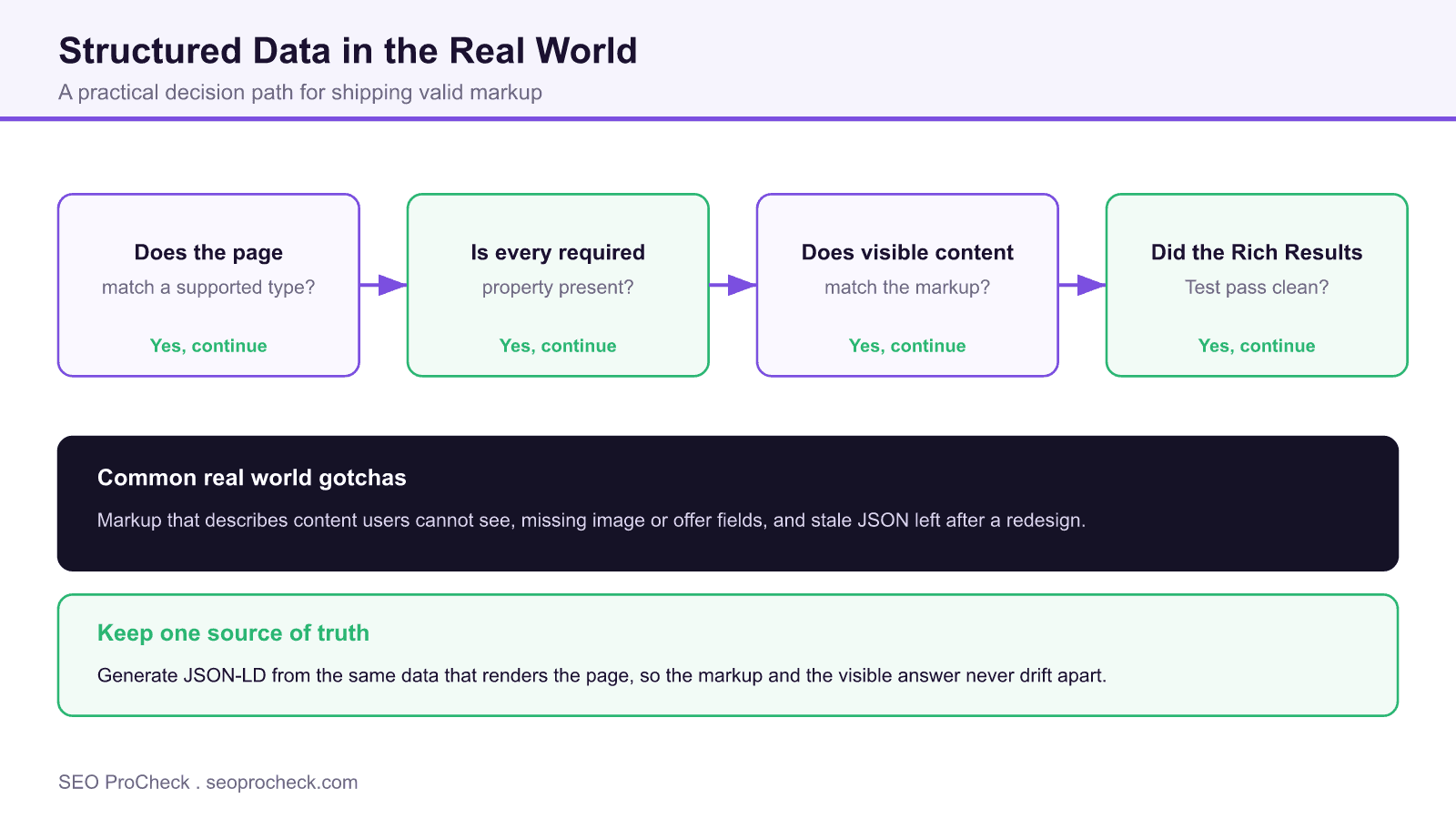
Real world structured data work is less about memorising schema and more about a few reliable checks: does the page match a supported type, are all required properties present, does the markup match visible content, and does the Rich Results Test pass. Generate the JSON-LD from the same data that renders the page so the two never drift apart.
- Confirm the page maps to a supported type before writing any markup.
- Required properties missing is the most common reason a rich result fails.
- Markup must reflect what the user can see, or it can be ignored or penalised.
- Keep one source of truth so visible content and JSON-LD stay in sync after redesigns.
Structured data helps search engines understand content context and enables rich results in search listings. This resource covers schema implementation strategies and best practices for maximizing structured data benefits.
Schema Types and Applications
Different schema types serve different purposes. Article, Product, LocalBusiness, FAQ, HowTo, and other schemas each provide specific functionality. Selecting appropriate schema types for your content enables relevant rich results and improves search engine understanding.
Implementation Best Practices
JSON-LD provides the recommended format for schema implementation. Proper nesting, complete required fields, and accurate data all contribute to schema effectiveness. Testing with Google's Rich Results Test ensures proper implementation before deployment.
Rich Results Impact
While schema isn't a direct ranking factor, rich results improve click-through rates. Review stars, FAQ accordions, recipe cards, and other rich results make listings more prominent and informative. This visibility advantage can significantly impact traffic from search.
This resource provides practical guidance for implementing structured data that improves search presence.
A practical decision path
Most structured data problems in the real world are not exotic. They come down to four questions asked in order, and a page that answers yes to all four is usually in good shape. First, does this page genuinely match a supported schema type, or are you forcing a type onto content that does not fit? Second, are all the required properties present and populated with real values? Third, does the markup describe content the user can actually see? Fourth, does the Rich Results Test pass without warnings that matter? Working the questions in sequence stops you from polishing syntax on a page that was never eligible in the first place.
The failure modes cluster into a short list. Markup that describes invisible content is the one Google calls out most often, because it looks like an attempt to claim a rich result the page does not earn. Missing required properties is the most common reason a technically valid block still produces no rich result. And stale markup left behind after a redesign is the quiet killer: the template changed, the visible content moved, but the old JSON-LD still asserts prices, ratings, or answers that no longer exist on the page.
Common questions and how to resolve them
The table below collects the questions that come up most in implementation reviews and the practical answer for each.
| Question | Short answer | Practical guidance |
|---|---|---|
| Can I mark up content in a tab or accordion? | Yes, if it is present in the HTML and available to the user, even behind an interaction | Make sure it is in the rendered DOM, not injected only after a click that Google will not perform |
| Do I need every property? | Required properties yes, recommended properties help | Fill required fields first, then add recommended ones to improve eligibility |
| JSON-LD or microdata? | JSON-LD is preferred | Use JSON-LD for maintainability and to keep markup separate from layout |
| Why is my valid markup not showing a rich result? | Eligibility is not a guarantee of display | Confirm the type is still supported and that quality and policy conditions are met |
| How do I keep markup accurate? | Generate it from the page data | Template the JSON-LD from the same source that renders the visible content |
The single most valuable habit is to treat the JSON-LD as a projection of the page, not as a separate document. If your price, your rating, or your answer text is generated from a field in your content management system, generate the matching structured data property from that same field. Do that and the markup cannot silently disagree with the page, which eliminates the most common and most dangerous class of structured data error in one move.
What is changed since this Q and A
Two shifts are worth noting. First, Google has trimmed the set of rich results shown in general search, most visibly for FAQ and HowTo, so eligibility and display have diverged more than they used to: your markup can be perfectly valid and still not produce a visible enhancement. Check the current Search Central documentation before promising a rich result to stakeholders. Second, structured data has become more valuable for entity understanding in AI powered search and answer engines, which read well labelled data to decide what a page is about and whether to cite it.
None of that changes the core discipline. Match a supported type, fill the required properties, mirror the visible content, validate, and keep one source of truth. For the wider strategic picture, pair this with our schema markup guide, the foundations in an introduction to structured data markup, and the inspection workflow in getting structured data for any website.
Frequently asked questions
Can I add schema to content hidden in tabs or accordions?
Yes, as long as the content exists in the rendered HTML and is available to the user, even behind a click. Avoid marking up content that is only injected after an interaction Google will not perform, because if it is not in the page Google renders, it does not count.
Why is my valid structured data not producing a rich result?
Valid markup earns eligibility, not a guaranteed display. The rich result type may have been reduced or retired, required properties may be missing, or Google may have decided not to show it for quality or policy reasons. Confirm the type is still supported and that all required fields are present.
Should I use JSON-LD or microdata?
Use JSON-LD. It keeps your structured data in a single block that is separate from your visible HTML, which makes it easier to maintain and less likely to break when you change your layout.
What is the most common structured data mistake?
Two mistakes dominate: missing required properties, and markup that describes content the user cannot see. The second is more serious because Google treats it as an attempt to claim a rich result the page does not earn, which can lead to a structured data manual action.
How do I stop my markup from going stale after a redesign?
Generate the JSON-LD from the same data that renders the visible page, rather than hand coding it as a separate document. When the price, rating, or answer is templated from one source, the markup cannot silently disagree with what users see.
Do required and recommended properties matter equally?
Required properties must be present for eligibility, so fill those first. Recommended properties are optional but they strengthen the entity and can improve how the result is displayed, so add them once the required fields are in place.
Take this with you
The assistant links open with a question about this page already written. Nothing is sent until you press enter.
Claude Vincent is a technical SEO consultant focused on crawlability, rendering, and AI-search visibility. He writes the field guides and case studies at SEO ProCheck, with a bias toward the durable, unglamorous work that decides whether search engines and AI answer engines can actually read and cite a site.
About SEO ProCheck
Technical SEO consulting and GEO strategy with 20 years of enterprise experience. Case studies, resources, and tools for search and AI visibility.
Work With Me
Technical SEO audits, GEO strategy, site migrations, and international SEO. Hourly consulting for teams who need hands-on support, not just reports.
Subscribe to our newsletter!







Recent Posts
- Finding a Competitor's Sitemap, and Turning It Into a Change Log September 15, 2026
- AI Crawler User Agents: The Current Names, and Which Ones Sites Actually Block September 9, 2026
- Can AI Crawlers Actually Read Your Site? I Measured 400 of the Biggest September 5, 2026