AI Summary
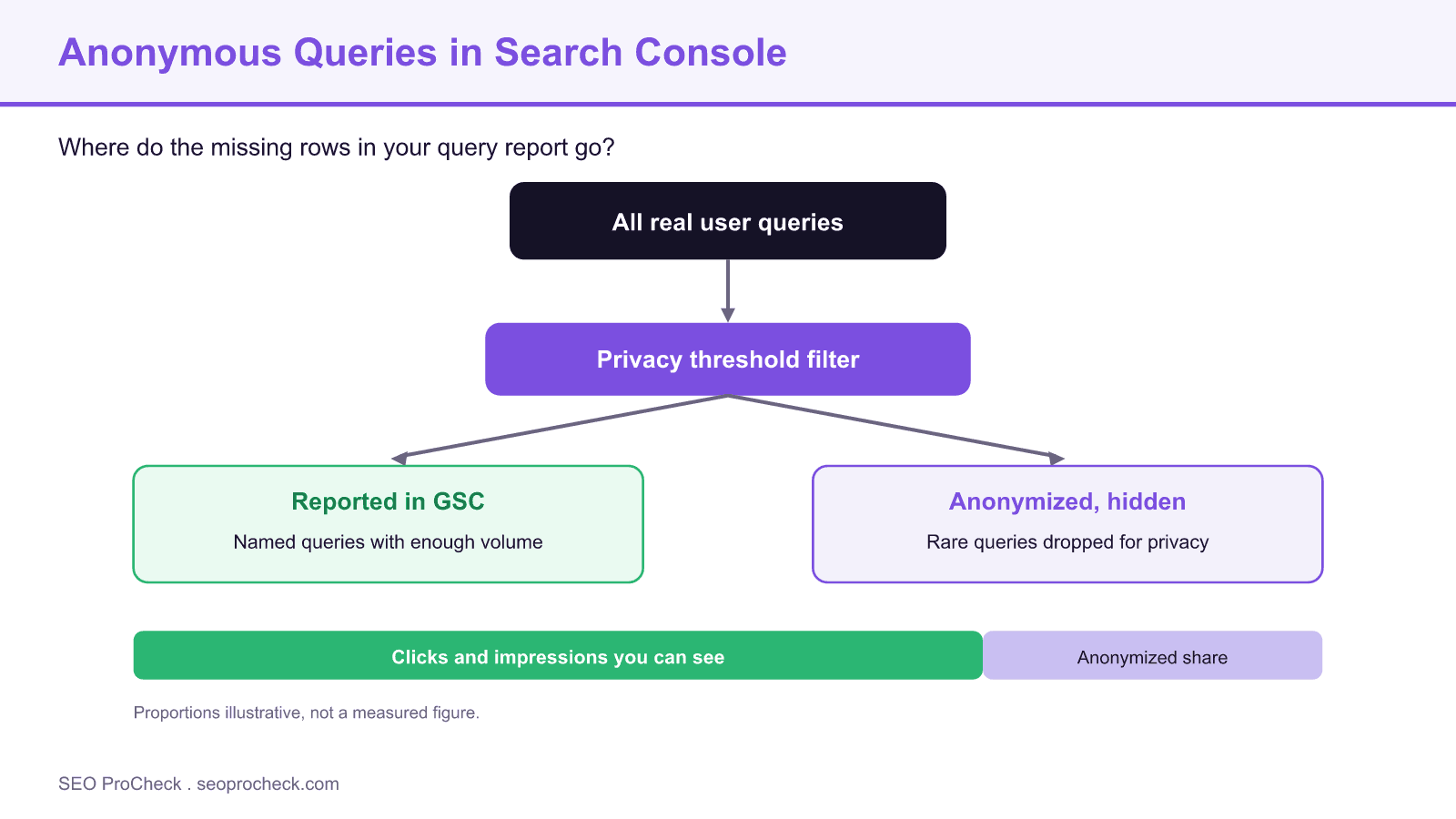
Anonymized queries are the search terms Google strips out of the query view in Search Console to protect user privacy, which is why the rows you see never add up to your reported totals. They are not missing traffic, only hidden labels, and you can recover most of the intent behind them with page level analysis and other data sources.
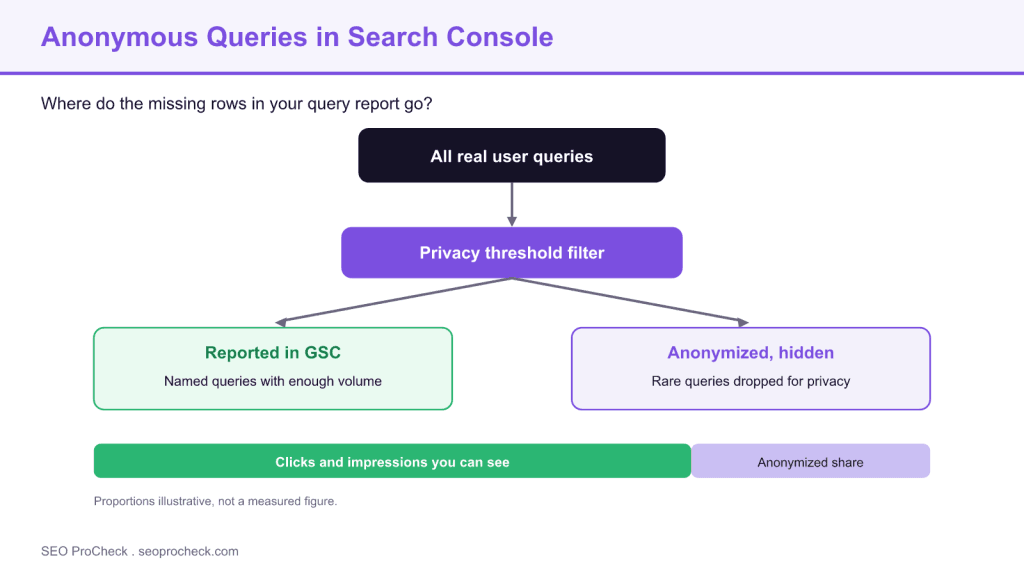
- Google hides rare or potentially identifying queries from the query dimension, but still counts their clicks and impressions in your totals.
- That gap is why the sum of your query rows is always lower than the Performance report total.
- You can rebuild intent from the page dimension, the Search Analytics API, on site search logs, and first party analytics.
- The anonymized share is usually larger for smaller sites and long tail pages, where individual queries are rarer.
What anonymized queries actually are
Open the Performance report in Google Search Console, add up every query row for a page, and the total will fall short of the clicks the same report shows at the top. The difference is not a bug and it is not lost traffic. Google removes a slice of queries from the query dimension because they are rare enough that publishing them could, in theory, identify the person who searched. Those clicks and impressions still count in your totals; only the text label is withheld.
This is a deliberate privacy design, not an accident, and it has been part of Search Console for years. The practical effect is that the query view is a sample, not a census. On a small or freshly launched site, where many searches happen only a handful of times, the anonymized share can swallow a large part of the report.
Why practitioners keep tripping over it
The confusion usually starts when someone exports queries, sums the clicks in a spreadsheet, and compares that number to the headline figure. When the two do not match, people assume the export is broken or that tracking is misconfigured. In reality the export is faithful; it simply cannot include rows Google chose to suppress.
The second trap is keyword forecasting. If you build a demand model only from visible queries, you understate the true breadth of intent reaching your pages, especially in long tail topics. Treat the visible list as your best labeled sample and assume there is a tail of unlabeled intent sitting behind it.
How to recover the hidden intent
You cannot unmask individual anonymized queries, but you can approximate what they were. Pivot from the query dimension to the page dimension: a page still reports its full clicks and impressions, so you can see which URLs pull the hidden demand even when the exact words are withheld. Layer in your on site search logs, which capture the language visitors use once they arrive. Pull the Search Analytics API for larger, more stable samples than the interface exports, and cross reference first party analytics for landing page behavior.
For a structured way to think about the full spread of language your pages could answer, our guide to natural language query coverage and the keyword universe check both help you map intent beyond the labeled rows. If a page earns impressions but almost no clicks and no visible queries, confirm it is actually eligible to rank with the indexable URL not indexed check before blaming anonymization.
Where your query data hides and how to recover it
| Data view | What it shows | Query text hidden? | Practical move |
|---|---|---|---|
| GSC query dimension | Labeled queries above the privacy threshold | Yes, rare ones removed | Use as a labeled sample, not a total |
| GSC page dimension | Full clicks and impressions per URL | No | See which pages pull hidden demand |
| Search Analytics API | Larger, more stable pulls | Yes, same rule | Model the tail with more rows |
| On site search logs | Words visitors type after arriving | No | Read real audience language |
| First party analytics | Landing page and behavior data | No query text | Confirm intent with on page actions |
What has changed since
The privacy threshold behind anonymized queries is long standing, but the reasons to care about it keep growing. Search Console added a twenty four hour view that surfaces very recent performance, yet the same anonymization rule applies, so fresh data is often even patchier at the query level. As AI Overviews and other answer surfaces absorb more informational searches, the click stream feeding your labeled queries thins out further, which can make the anonymized share look larger over time. None of that changes the core habit: read pages, not just queries, and triangulate intent from more than one source.
Frequently asked questions
Why do my Search Console query rows not add up to the total?
Google withholds rare or potentially identifying queries from the query dimension while still counting their clicks and impressions in the headline totals. The visible rows are a labeled sample, so their sum is always lower than the reported total.
Are anonymized queries lost traffic?
No. The visits are real and are included in your click and impression totals. Only the text of the query is hidden, not the traffic itself.
Can I see the exact anonymized queries anywhere?
Not directly, by design. You can approximate them by pivoting to the page dimension, reading on site search logs, and using the Search Analytics API for larger samples.
Do anonymized queries hurt my SEO?
They do not harm rankings. They only limit your visibility into the exact wording behind some searches, which is a reporting limitation rather than a ranking penalty.
Why do small sites have a bigger anonymized share?
Smaller and newer sites collect many searches that happen only a few times, and rare queries are exactly the ones Google suppresses for privacy, so a larger portion of their data is anonymized.
How do I report on intent when the queries are hidden?
Combine the page level view in Search Console with on site search data and first party analytics. Together they reveal the topics and language driving traffic even when individual query labels are missing.
Original summary and source
Google's Dirty Little Secret, Anonymous Queries provides valuable insights for SEO practitioners. This resource examines approaches and considerations that can improve organic search performance.
Key Concepts
Understanding the fundamental principles behind this topic helps inform strategic decisions. Whether optimizing for traditional search or emerging AI platforms, foundational concepts remain relevant. This resource covers the essential knowledge practitioners need.
Implementation Considerations
Moving from concept to execution requires understanding practical constraints and opportunities. Different situations call for different approaches. This resource provides guidance for applying concepts in real-world contexts.
Measuring Impact
SEO efforts require measurement to demonstrate value and guide optimization. Identifying appropriate metrics, establishing baselines, and tracking progress enables data-driven improvement. This resource addresses how to evaluate success.
This resource contributes to the knowledge base SEO practitioners need for effective optimization in an evolving search landscape.
Source: https://seogets.com/blog/what-are-anonymous-queries/
Claude Vincent is a technical SEO consultant focused on crawlability, rendering, and AI-search visibility. He writes the field guides and case studies at SEO ProCheck, with a bias toward the durable, unglamorous work that decides whether search engines and AI answer engines can actually read and cite a site.
About SEO ProCheck
Technical SEO consulting and GEO strategy with 20 years of enterprise experience. Case studies, resources, and tools for search and AI visibility.
Work With Me
Technical SEO audits, GEO strategy, site migrations, and international SEO. Hourly consulting for teams who need hands-on support, not just reports.
Subscribe to our newsletter!