

Building Topic Authority for AI Recognition
- October 26, 2024
- GEO (Generative Engine Optimization), AI and Search
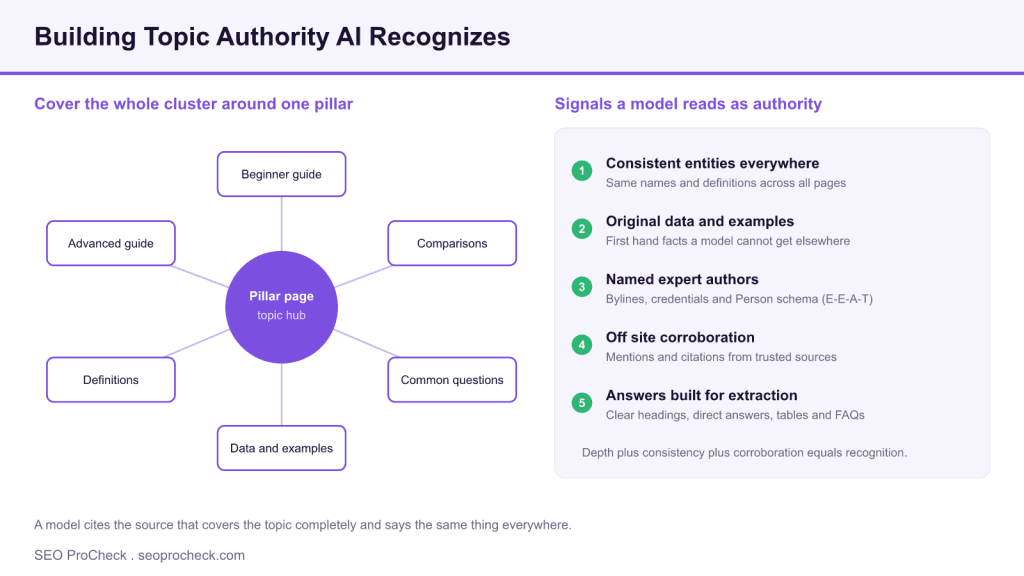
AI Summary
Topic authority that AI systems recognize is built by covering a topic completely across a pillar and its cluster, defining entities consistently on every page, and backing claims with original data and named expert authors. Generative engines cite the source that resolves a question fully and says the same thing everywhere, so depth, consistency, and off site corroboration matter more than any single ranking.
- Structure content as a pillar page linked to supporting pages that cover every subtopic and question.
- Use the same entity names and definitions across all pages so a model can resolve you to one clear entity.
- Add original data, named authors, and Person and Organization schema to strengthen E-E-A-T signals.
- Earn off site mentions and citations, since models corroborate a claim across independent sources.
What topic authority means to an AI system
Topic authority is the degree to which a domain is treated as a reliable, comprehensive source on a subject. Search engines have rewarded it for years through concepts like expertise and topical depth. Generative engines raise the stakes because they do not return ten links; they compose an answer and cite a small handful of sources. To be one of those sources, your site has to read as the place that covers the topic completely, defines its concepts consistently, and corroborates with the rest of the web. A single strong page is not enough; the model is assessing the cluster and the entity behind it.
The mechanism is worth stating plainly. When a model answers a question, it draws on patterns learned in training and, increasingly, on retrieved passages from live pages. It prefers sources that resolve the whole question, agree with themselves across pages, and are echoed by other trusted sites. Every recommendation below serves one of those three tests: completeness, consistency, and corroboration.
Cover the cluster, not just the keyword
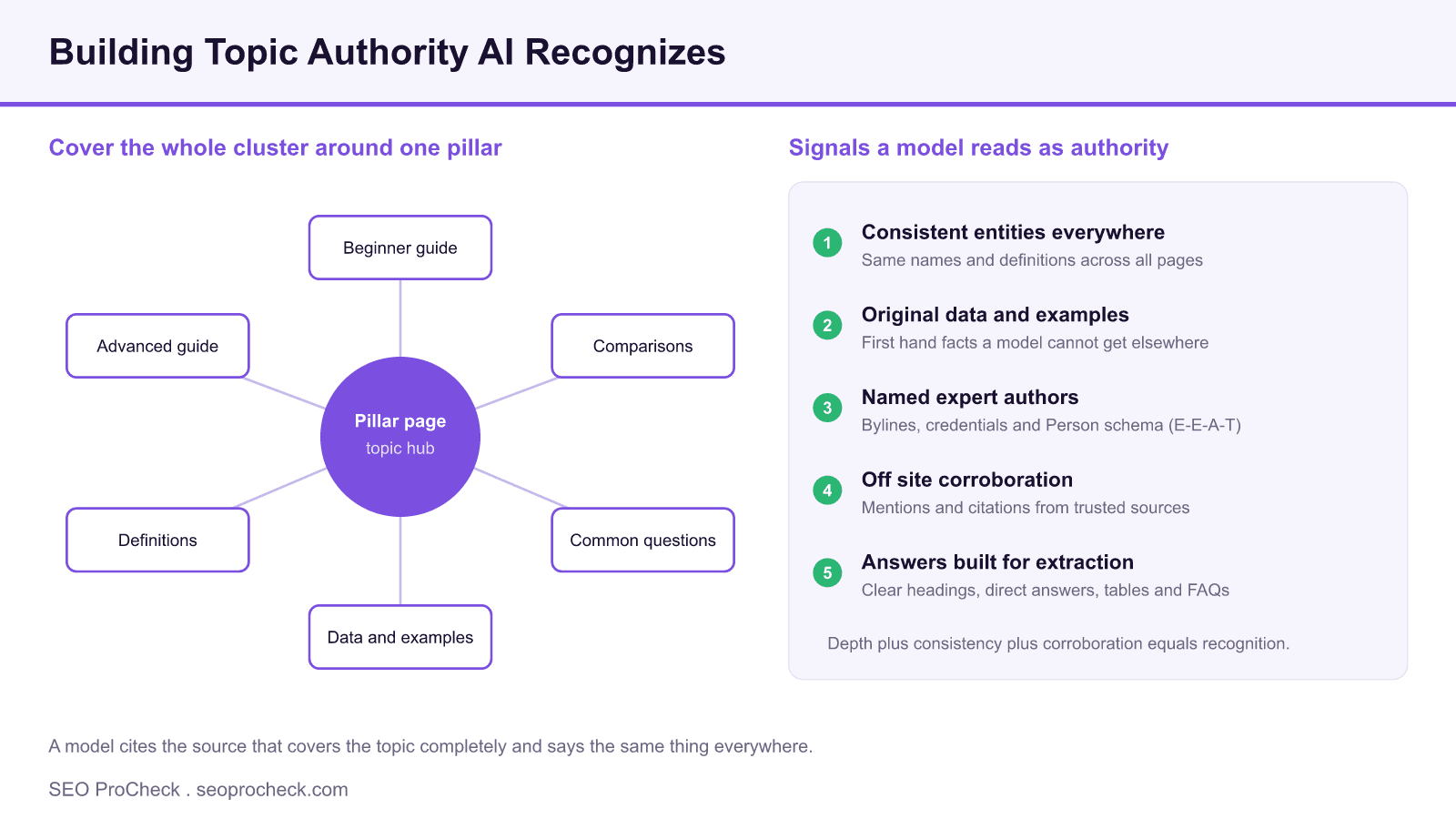
Completeness is architectural. Build a pillar page that frames the topic broadly and link it to supporting pages that each resolve one subtopic or question, exactly as the diagram shows. A site about, say, container gardening needs the pillar plus supporting pages on soil, watering, light, containers, common pests, and seasonal care. Each supporting page goes deep on its slice and links back to the pillar and sideways to its siblings. That internal link structure is how you tell a crawler, and by extension a model, that these pages form one coherent body of knowledge rather than scattered posts.
Gaps are what hold sites back. If competitors answer a question in the cluster and you do not, the model has a reason to cite them instead. Map the full question set for your topic and make sure every meaningful question has a home. The internal linking mechanics that hold a cluster together are covered in depth in our guide to topic clusters and pillar pages, linked below.
Say the same thing everywhere: entity consistency
Consistency is about entities. An entity is a specific thing the model tries to recognize: your brand, a product, a defined concept. If page A calls your method the Rapid Audit Framework and page B calls it the Quick Audit Method, you have split one entity into two weak ones. Pick canonical names and definitions and use them verbatim across the cluster. Reinforce the entity with structured data: Organization schema for the brand, Person schema for authors, and sameAs links to authoritative profiles so the model can tie your entity to known references.
| Signal | How to build it | Why a model values it |
|---|---|---|
| Cluster coverage | Pillar plus supporting pages for every subtopic | Resolves the whole question in one source |
| Entity consistency | Canonical names, definitions, Organization and Person schema | Lets the model resolve you to one clear entity |
| Original data | Surveys, tests, first hand examples and numbers | Adds facts the model cannot source elsewhere |
| Author expertise | Named bylines, credentials, author pages | Strengthens E-E-A-T and trust in claims |
| Off site corroboration | Citations, mentions and links from trusted sites | Independent sources confirm your claims |
Give the model facts it cannot get elsewhere
Original data is the strongest differentiator. Anyone can restate common knowledge, and a model already holds common knowledge. What it does not have is your proprietary survey result, your before and after test numbers, or a worked example from your own practice. Publishing genuine first hand data gives the model a reason to cite you specifically, because you are the origin of the fact. Present that data in clean tables and clear sentences so it is easy to extract. Do not invent numbers to fill the gap; fabricated data is both an ethics failure and a credibility risk if it contradicts reality the model has seen elsewhere.
Pair data with named authors. A byline attached to a real person with visible credentials and an author page carries more weight than anonymous content, and it feeds the experience and expertise parts of E-E-A-T. Use Person schema, link the author to their profiles, and let them write in a voice that shows first hand knowledge.
Corroboration lives off your site
The third test, corroboration, you cannot fully control from your own pages. Models weigh whether other trusted sources say the same thing about you and your claims. That makes digital PR, genuine citations, and being referenced by other sites part of topic authority, not a separate marketing silo. When an independent publication describes your framework using your canonical name, it reinforces the entity and confirms the claim. Aim for mentions from sources your audience already trusts rather than volume for its own sake.
Finally, structure everything for extraction. A model lifts a passage more easily when the answer sits under a clear heading, leads with a direct statement, and is followed by supporting detail. Tables, definition lists, and FAQ blocks all extract cleanly. Content that buries the answer in the middle of a long paragraph is harder to quote, so lead with the answer and elaborate after.
Give it time and measure the right thing
Topic authority compounds slowly. A cluster does not flip a switch the week you publish it; the model needs to crawl the pages, connect the entity, and observe corroboration accumulate. Measure progress by coverage of your question set, consistency of your entity references, and how often assistants cite you when you run your priority prompts, rather than by the ranking of one page. Those inputs move before the outcome does, so they tell you the work is landing even during the lag.
Put it together
These pieces reinforce each other, and several have dedicated guides. The internal architecture is covered in topic clusters and pillar pages, the trust signals in our complete E-E-A-T guide, the citation mechanics in how to get cited in AI, and the entity foundations in our entity SEO guide. Build the cluster, keep the entity consistent, publish original facts under named authors, and earn corroboration, and you give generative engines every reason to treat you as the authority on your topic.
Frequently asked questions
How is topic authority for AI different from traditional SEO authority?
Traditional authority was measured largely by backlinks and rankings for individual keywords. AI recognition adds two demands: your content must resolve the whole question across a cluster, and it must be internally consistent and corroborated off site. A single ranking page is no longer enough because the model assesses the entity and the depth behind it.
What is the fastest way to start building topic authority?
Map the full set of questions in your topic, build a pillar page, and fill the biggest coverage gaps with supporting pages first. Then unify the names and definitions you use for key concepts across every page so a model resolves you to one clear entity. Coverage and consistency give the quickest, most durable gains.
Do I need original data to be cited by AI?
It is not strictly required, but it is the strongest differentiator. Models already hold common knowledge, so restating it gives them no reason to cite you specifically. First hand data, tests, and examples make you the origin of a fact, which is exactly what a model cites.
How does E-E-A-T fit into topic authority for AI?
E-E-A-T signals like named authors, credentials, and author pages help a model trust the claims on your pages. Adding Person and Organization schema with sameAs links lets the system connect your content to a recognized entity, which reinforces both the trust and the identity a citation depends on.
Why do off site mentions matter if I have great content?
Generative engines corroborate claims across independent sources. When trusted sites describe your work using your canonical names, they confirm both your claims and your entity, which raises the odds a model treats you as authoritative. Your own pages alone cannot supply that independent confirmation.
How should I structure pages so AI can use them?
Lead each section with a direct answer under a clear, descriptive heading, then add supporting detail. Use tables, definition lists, and FAQ blocks so key facts extract cleanly. Content that buries the answer inside a long paragraph is harder for a model to lift and quote.
Take this with you
The assistant links open with a question about this page already written. Nothing is sent until you press enter.
Claude Vincent is a technical SEO consultant focused on crawlability, rendering, and AI-search visibility. He writes the field guides and case studies at SEO ProCheck, with a bias toward the durable, unglamorous work that decides whether search engines and AI answer engines can actually read and cite a site.
About SEO ProCheck
Technical SEO consulting and GEO strategy with 20 years of enterprise experience. Case studies, resources, and tools for search and AI visibility.
Work With Me
Technical SEO audits, GEO strategy, site migrations, and international SEO. Hourly consulting for teams who need hands-on support, not just reports.
Subscribe to our newsletter!








Recent Posts
- Most Top Sites Never Say Who They Are in Structured Data October 14, 2026
- Homepage Titles Are Mostly Too Short, Not Too Long October 8, 2026
- Who Actually Serves an llms.txt? 184 Top Sites Measured September 29, 2026