

AI Summary
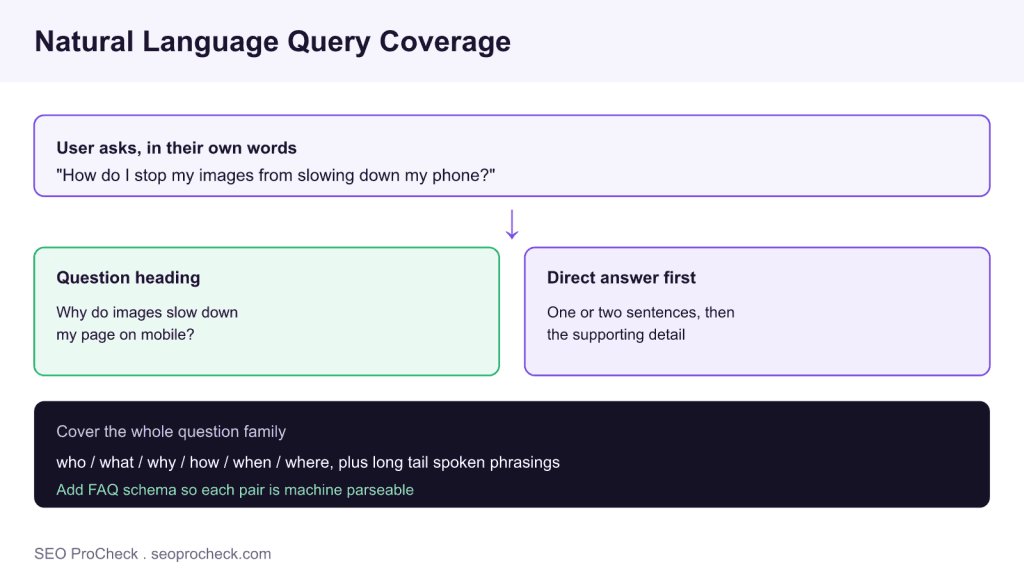
Natural language query coverage measures how well your content matches the full, conversational way people actually ask questions, in search boxes, by voice, and to AI assistants. Content that mirrors that phrasing with question headings and direct answers captures long tail and voice traffic that keyword stuffed pages miss.
- Write headings as the questions users ask, using who, what, why, how, when, and where.
- Give a direct one or two sentence answer first, then the supporting detail.
- Cover the whole question family around a topic, including long tail spoken phrasings.
- Element code CO-010: a content GEO check that flags pages not optimized for conversational queries.
What natural language query coverage is
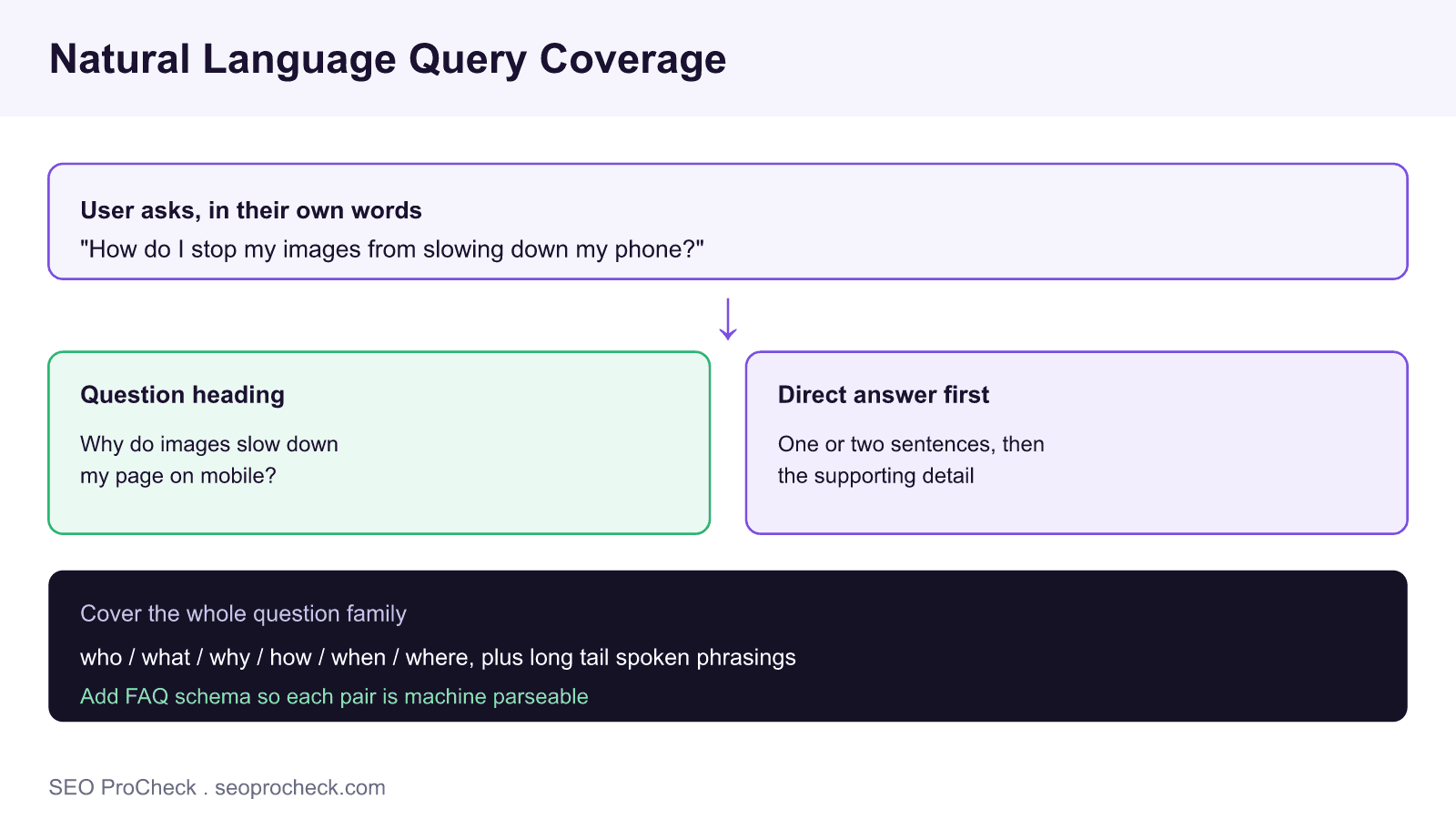
Natural language query coverage is a measure of how completely your content matches the way real people phrase questions, in full conversational sentences rather than clipped keywords. Search behavior has shifted. People type and speak questions the way they would ask a colleague: how do I stop my images from slowing down my phone, rather than image speed mobile. Voice assistants and AI chat interfaces have accelerated this, because speaking a question naturally produces longer, more conversational strings than typing ever did. Within the SEO ProCheck framework this is check CO-010 in the content GEO group, which flags pages that are not optimized for conversational queries and therefore miss the natural language traffic around their topic.
Why conversational coverage matters
Two forces make this a growing priority. First, long tail volume: conversational queries are longer and more specific, which individually have low volume but collectively make up a large share of all searches, and they usually carry clearer intent and less competition. A page that answers the exact question a user asked tends to convert and engage better than one that ranks for a broad head term but does not resolve the specific need. Second, retrieval mechanics: voice assistants and AI answer engines parse a question and look for content that directly addresses it. Content phrased as a matching question with a concise answer is far easier for these systems to retrieve and read aloud or cite than dense prose that never states the question.
How to fix a page that fails this check
Three techniques cover most of the work. First, use question headings. Convert topic label headings into the actual questions users ask, phrased with the natural interrogatives who, what, why, how, when, and where. A heading that reads Why do images slow down my page on mobile will match a real query in a way that a heading reading Performance never will. Second, write naturally. Draft the surrounding copy the way people speak, in plain, complete sentences, rather than in compressed keyword phrases, so the language aligns with conversational search strings. Third, answer directly. Under each question heading, lead with a clear one or two sentence answer, then expand with detail. The direct answer is what a voice assistant reads back and what an AI Overview lifts.
Cover the whole question family. Around any topic there is a cluster of related questions, the how, the why, the what if, the how much, the how long. Mapping and answering that family, rather than a single phrasing, is what moves a page from partial to strong natural language coverage. Pair the pattern with FAQ structured data so each question and answer is explicitly machine parseable.
How to detect the issue
Detection is a query analysis exercise. Study how your audience actually phrases things using several sources: the People Also Ask box on target queries, autocomplete suggestions, Google Search Console query data for questions you already appear for, on site search logs, and customer support transcripts. Then compare that real language against your page. If your headings are topic labels rather than questions, if the page never states the question a user would ask, or if answers are buried instead of stated up front, the page is failing natural language coverage. A page that passes reads as a set of real questions, each answered directly.
AI search and GEO considerations
AI systems are built to process conversational input, so content that mirrors natural questions and answers them plainly is disproportionately likely to be retrieved and cited. The combination that performs best is a question heading, a direct answer first, natural surrounding language, and FAQ schema. That structure serves classic featured snippets, voice results, and generative answers from a single well organized page, which is the efficient way to earn visibility across all three.
Keyword phrasing versus natural language phrasing
| Old keyword phrasing | Natural language query | Heading that matches it |
|---|---|---|
| image speed mobile | why do images slow down my page on mobile | Why do images slow down my page on mobile? |
| breadcrumb schema setup | how do I add breadcrumb schema to my site | How do I add breadcrumb schema? |
| lazy load lcp | should I lazy load my hero image | Should I lazy load the hero image? |
| author schema seo | does author attribution help seo | Does author attribution help SEO? |
Frequently Asked Questions
What is natural language query coverage?
It is how well your content matches the full, conversational way people ask questions in search, by voice, and to AI assistants. Content that mirrors that phrasing with question headings and direct answers captures long tail and voice traffic that keyword focused pages miss.
Why is conversational search growing?
Voice assistants and AI chat interfaces let people ask questions in complete, spoken sentences instead of clipped keywords. That produces longer, more natural queries, and content written to match them is easier for these systems to retrieve and read back.
What is check CO-010?
CO-010 is the SEO ProCheck content GEO check for natural language query coverage. It flags pages that are not optimized for conversational queries, which means they miss natural language and voice search traffic.
How do I optimize for natural language queries?
Use question headings phrased with who, what, why, how, when, and where, write surrounding copy the way people speak, and lead each section with a direct one or two sentence answer before the detail. Add FAQ schema so the pairs are machine parseable.
What is the question family and why cover all of it?
Around any topic sits a cluster of related questions: the how, the why, the how much, the how long. Answering the whole family rather than one phrasing is what moves a page from partial to strong coverage and captures more long tail intent.
How do I find the questions my audience asks?
Mine the People Also Ask box, autocomplete suggestions, Google Search Console query data, on site search logs, and support transcripts. Then phrase your headings in that real language rather than in internal topic labels.
Related checks
Quick Reference
Element Code: CO-010
Issue: Content not optimized for conversational queries
Impact: Missing natural language search traffic
Fix: Optimize for how people naturally ask questions
Detection: Query analysis
What Is This Issue?
Users increasingly search using natural language. Content should match conversational patterns.
Why This Matters for Your Website
Conversational search is growing. Matching patterns improves retrieval.
How to Fix This Issue
- Question headings: How, what, why
- Natural phrasing: Write as people speak
- Direct answers: Clear responses
Tools for Detection
- Query analysis: Study patterns
AI Search and GEO Considerations
AI systems process conversational queries. Matching format improves retrieval.
TL;DR (The Simple Version)
Write content matching how people naturally ask questions. Use question headings and conversational language.
Take this with you
The assistant links open with a question about this page already written. Nothing is sent until you press enter.
Claude Vincent is a technical SEO consultant focused on crawlability, rendering, and AI-search visibility. He writes the field guides and case studies at SEO ProCheck, with a bias toward the durable, unglamorous work that decides whether search engines and AI answer engines can actually read and cite a site.
About SEO ProCheck
Technical SEO consulting and GEO strategy with 20 years of enterprise experience. Case studies, resources, and tools for search and AI visibility.
Work With Me
Technical SEO audits, GEO strategy, site migrations, and international SEO. Hourly consulting for teams who need hands-on support, not just reports.
Subscribe to our newsletter!








Recent Posts
- Most Top Sites Never Say Who They Are in Structured Data October 14, 2026
- Homepage Titles Are Mostly Too Short, Not Too Long October 8, 2026
- Who Actually Serves an llms.txt? 184 Top Sites Measured September 29, 2026