AI Summary
The core of a 2020 SEO tutorial still works: match search intent, publish genuinely useful content, earn links, and keep the site technically clean. What changed by 2026 is the surface, with AI answers, entity based understanding, and a stronger emphasis on demonstrated experience and trust sitting on top of those fundamentals.
- The enduring fundamentals are search intent, quality content, internal linking, and a crawlable architecture.
- Core Web Vitals evolved, and Interaction to Next Paint replaced First Input Delay as a metric in March 2024.
- AI Overviews and answer engines now sit above the classic list of ten blue links.
- Experience and trust signals and entity understanding carry more weight than exact match keywords.

Why a 2020 tutorial is still worth your time
A well built SEO tutorial from 2020, like the one this post points to, teaches the parts of search that barely move. It walks through understanding what a searcher wants, structuring a page to answer that intent, building internal links so authority and context flow through the site, earning external links from real sources, and keeping the technical foundation crawlable and fast. Every one of those remains true in 2026. If you learned SEO from that material, you did not learn the wrong thing; you learned the load bearing part.
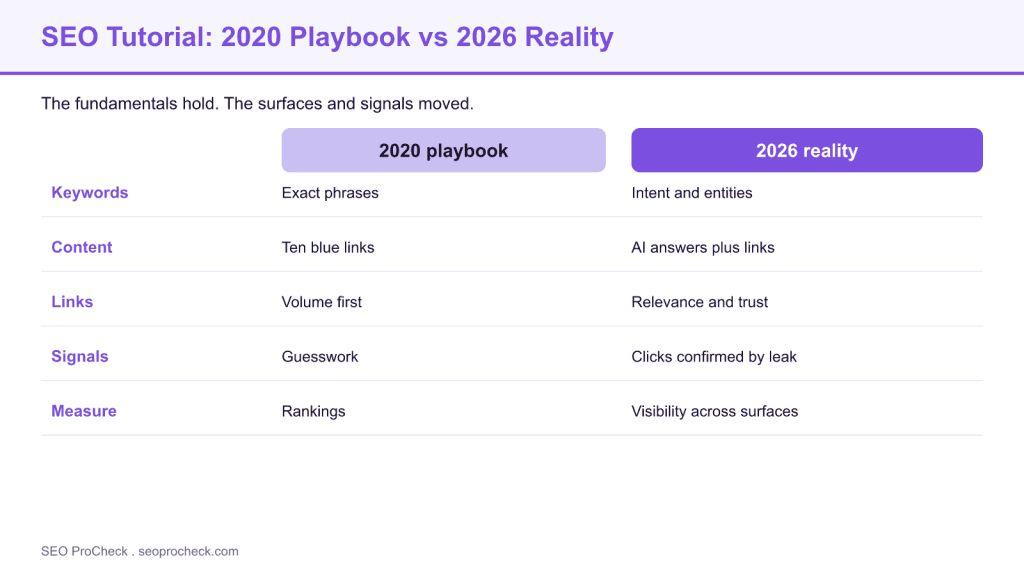
The risk is not that the fundamentals expired. It is that a 2020 guide cannot mention the surfaces and signals that arrived afterward, so a reader could finish it with an accurate but incomplete map. The comparison diagram above lays the 2020 playbook next to 2026 reality so you can see what to keep and what to add.
What still holds
Search intent is still the first question: informational, navigational, commercial, or transactional. Content that genuinely satisfies that intent still wins, and thin or padded pages still lose. Internal linking still shapes how crawlers and users move through a site, and a clear, shallow architecture still helps important pages get found. Links from trustworthy, relevant sources still carry weight. Technical hygiene, correct indexing, canonical clarity, and reasonable speed, is still the floor you have to clear before anything else matters.
For the keyword side of that foundation, our ultimate guide to keyword research covers the enduring method without the dated tooling.
What you have to add for 2026
Three big shifts sit on top of the 2020 base. First, the result page changed: AI Overviews and answer engines summarize answers above the traditional links, so being quotable and clearly structured matters more, and pure ranking position tells you less. Second, Google leaned harder into experience, expertise, authoritativeness, and trust, rewarding content that shows real first hand knowledge rather than rephrased consensus. Third, understanding moved from strings to entities, so consistent naming and topical depth beat exact match keyword repetition.
Two practical additions follow. Make sure AI crawlers can reach your content by reviewing AI crawler access, and hold your pages to a modern bar with the AI content quality check. Neither replaces the 2020 fundamentals; they extend them.
2020 tutorial step versus 2026 practice
| Area | 2020 tutorial | 2026 practice |
|---|---|---|
| Keywords | Target exact phrases | Serve intent and related entities |
| Content | Best answer on the page | Best answer that also shows real experience |
| Result page | Ten blue links | AI answers layered above the links |
| Speed | Focus on First Input Delay | Interaction to Next Paint since March 2024 |
| Links | Volume and authority | Relevance, trust, and editorial intent |
| Measurement | Rank tracking | Visibility across search and AI surfaces |
What has changed since 2020
Several concrete things arrived after the tutorial was written. Google shipped a Helpful Content system in 2022 and later folded that thinking into its core ranking systems by 2024. Core Web Vitals swapped First Input Delay for Interaction to Next Paint as an official metric in March 2024, changing how responsiveness is measured. Generative answers, first as Search Generative Experience and then as AI Overviews, moved summaries above the classic results. Mobile first indexing finished rolling out, and zero click behavior grew as more answers appeared directly on the results page. The fundamentals in the 2020 guide still apply; these are the layers to add on top.
Frequently asked questions
Is a 2020 SEO tutorial still worth reading in 2026?
Yes. The fundamentals it teaches, search intent, quality content, internal linking, links, and technical hygiene, still drive rankings. Just pair it with newer material on AI search, experience signals, and entities.
What SEO basics never change?
Understanding what the searcher wants, answering that intent thoroughly, structuring a crawlable site, earning trustworthy links, and keeping the technical foundation clean have stayed constant for years.
What is the biggest change since 2020?
The arrival of AI generated answers above traditional results is the largest shift. It rewards clearly structured, quotable, genuinely expert content and makes single ranking positions less decisive.
Do keywords still matter?
Yes, but as a way to understand intent and entities rather than phrases to repeat. Modern search maps queries to meaning, so topical depth and consistent naming matter more than exact match density.
How has Core Web Vitals changed since 2020?
The metric set evolved. In March 2024 Interaction to Next Paint replaced First Input Delay as the responsiveness metric, so audits built only around the older metric are out of date.
Does AI search make traditional SEO obsolete?
No. AI systems still pull from crawlable, well structured, trustworthy pages. Traditional SEO is the input that AI search draws on, so the fundamentals remain necessary.
Original summary and source
The Ultimate SEO Tutorial For 2020 provides valuable insights for SEO practitioners. This resource examines approaches and considerations that can improve organic search performance.
Key Concepts
Understanding the fundamental principles behind this topic helps inform strategic decisions. Whether optimizing for traditional search or emerging AI platforms, foundational concepts remain relevant. This resource covers the essential knowledge practitioners need.
Implementation Considerations
Moving from concept to execution requires understanding practical constraints and opportunities. Different situations call for different approaches. This resource provides guidance for applying concepts in real-world contexts.
Measuring Impact
SEO efforts require measurement to demonstrate value and guide optimization. Identifying appropriate metrics, establishing baselines, and tracking progress enables data-driven improvement. This resource addresses how to evaluate success.
This resource contributes to the knowledge base SEO practitioners need for effective optimization in an evolving search landscape.
Claude Vincent is a technical SEO consultant focused on crawlability, rendering, and AI-search visibility. He writes the field guides and case studies at SEO ProCheck, with a bias toward the durable, unglamorous work that decides whether search engines and AI answer engines can actually read and cite a site.
About SEO ProCheck
Technical SEO consulting and GEO strategy with 20 years of enterprise experience. Case studies, resources, and tools for search and AI visibility.
Work With Me
Technical SEO audits, GEO strategy, site migrations, and international SEO. Hourly consulting for teams who need hands-on support, not just reports.
Subscribe to our newsletter!