

AI Summary
Modern keyword research is less about chasing search volume and more about mapping real intent to the right page, then judging whether you can realistically rank. Work it as a pipeline: gather seeds, expand with tools and the SERP itself, group by intent, score difficulty, and map one primary query to each URL.
- Start from customer language and the live SERP, not only a tool's raw suggestions.
- Group keywords by intent (informational, commercial, transactional) before you do anything else.
- Intent and difficulty decide priority. Volume is a tie breaker, not the first filter.
- The deliverable is a keyword map: one primary query plus a small cluster of variants per URL.

Keyword research for SEO: The ultimate guide provides valuable insights for SEO practitioners. This resource examines approaches and considerations that can improve organic search performance.
The pipeline, not a keyword dump
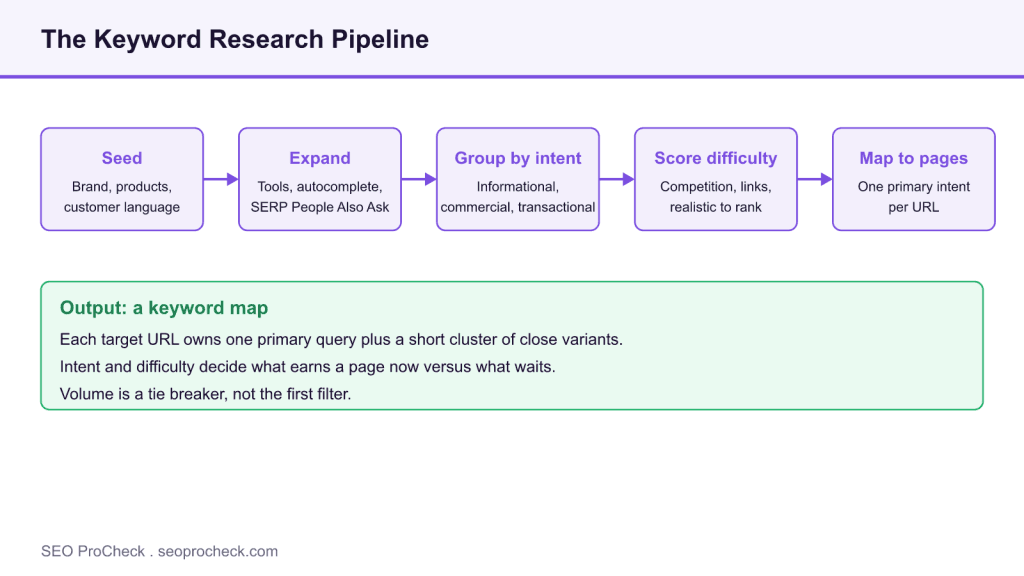
A list of ten thousand keywords is not research, it is a spreadsheet. Useful keyword research is a pipeline that turns raw terms into a decision about which page targets what. The stages are simple and they run in order.
- Seed. Start from your products, your customers' own words, and the questions sales and support hear. These seeds are the vocabulary the tools will expand.
- Expand. Feed seeds into a keyword tool, but also mine autocomplete, People Also Ask, and related searches. The SERP is a free expansion engine most people ignore.
- Group by intent. Sort terms into informational, commercial, and transactional buckets. Intent, not volume, decides what kind of page each query needs.
- Score difficulty. Judge whether you can realistically rank given the competing pages, their authority, and their content depth.
- Map to pages. Assign one primary query, plus a small cluster of close variants, to each target URL.
Read the SERP before you trust the volume
Volume tells you how many people search a term. It does not tell you what Google thinks the term means, and Google decides what ranks. Before committing to a keyword, search it and read the page one results. If the page is filled with product listings, an informational article will not rank there no matter how good it is, and vice versa. The SERP layout, the content type of the top results, and the presence of features like People Also Ask or a featured snippet tell you what to build. Our guide to search intent types breaks down how to read those signals.
Intent types and what each one needs
| Intent | What the searcher wants | Example query | Page that wins |
|---|---|---|---|
| Informational | To learn or understand | how does keyword research work | Guide, tutorial, or explainer |
| Commercial | To compare before buying | best keyword research tools | Comparison or review roundup |
| Transactional | To act or buy now | keyword research tool free trial | Product, pricing, or signup page |
| Navigational | To reach a specific place | ahrefs login | The brand's own destination page |
Mixing intents on one page is the most common reason a promising keyword never ranks. A page that tries to explain and sell at once usually does neither well.
From keywords to a keyword map
The output of the pipeline is a keyword map: a table that assigns each target URL one primary query and a short cluster of closely related variants it can rank for on the same page. This prevents two of your own pages competing for the same term, which is keyword cannibalization, and it makes content briefs obvious. When you score difficulty, weigh it against your site's authority, not in the abstract; a keyword that is easy for an established site can be out of reach for a new one. Our walkthroughs of keyword difficulty and keyword mapping cover both halves, and content gap analysis shows how to find the queries competitors rank for that you do not.
What has changed since: AI Overviews and zero click
Two shifts change how you read a keyword list today. First, Google AI Overviews now answer many informational queries directly at the top of the results, so some purely informational terms convert to clicks far less than their volume suggests. That does not make them worthless, since being cited in an overview still builds visibility, but it does mean you should weight commercial and transactional intent more heavily when prioritizing. Second, exact match volume is a weaker guide than it was: Google groups synonyms and understands intent well enough that ranking for a topic cluster matters more than matching a single string. Research the topic and the intent, map a cluster to each page, and treat the volume column as a tie breaker rather than the headline.
Frequently asked questions
It is the process of finding the terms people search, understanding the intent behind them, and deciding which pages on your site should target which queries. The goal is a keyword map that assigns each URL a primary query it can realistically rank for.
Intent first. Volume tells you how many people search a term but not what they want or whether you can rank. Group keywords by intent, judge difficulty against your own authority, and use volume as a tie breaker between otherwise equal options.
The live SERP is a free expansion engine. Mine Google autocomplete, People Also Ask, and related searches, plus the questions your sales and support teams hear. Free tools and Search Console query data fill in the rest before you pay for anything.
Search intent is the goal behind a query: to learn, to compare, to buy, or to reach a specific site. It matters because Google ranks pages that match the dominant intent. A page whose type does not match the intent rarely ranks, no matter how good it is.
A keyword map is a table that assigns each target URL one primary query plus a small cluster of close variants. It prevents two of your own pages competing for the same term and turns research into clear content briefs.
No, but they change the weighting. AI Overviews answer many informational queries directly, so some high volume informational terms send fewer clicks. Commercial and transactional intent hold up better, and being cited in an overview still builds visibility, so prioritize accordingly.
This resource contributes to the knowledge base SEO practitioners need for effective optimization in an evolving search landscape.
Source: https://searchengineland.com/keyword-research-seo-guide-447027
Take this with you
The assistant links open with a question about this page already written. Nothing is sent until you press enter.
Claude Vincent is a technical SEO consultant focused on crawlability, rendering, and AI-search visibility. He writes the field guides and case studies at SEO ProCheck, with a bias toward the durable, unglamorous work that decides whether search engines and AI answer engines can actually read and cite a site.
About SEO ProCheck
Technical SEO consulting and GEO strategy with 20 years of enterprise experience. Case studies, resources, and tools for search and AI visibility.
Work With Me
Technical SEO audits, GEO strategy, site migrations, and international SEO. Hourly consulting for teams who need hands-on support, not just reports.
Subscribe to our newsletter!








Recent Posts
- Most Top Sites Never Say Who They Are in Structured Data October 14, 2026
- Homepage Titles Are Mostly Too Short, Not Too Long October 8, 2026
- Who Actually Serves an llms.txt? 184 Top Sites Measured September 29, 2026