

AI Summary
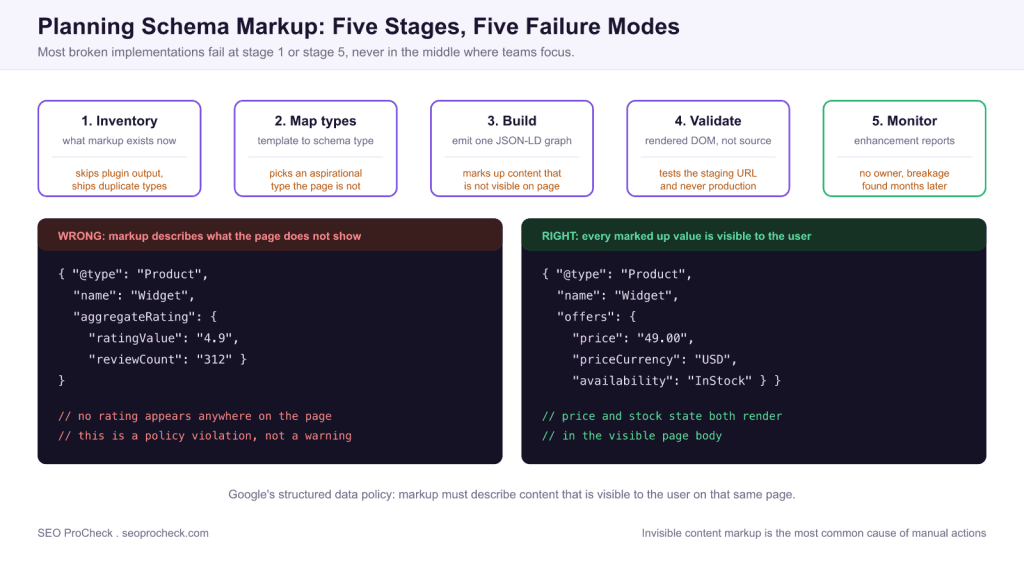
A schema implementation succeeds or fails on the two stages teams skip: inventorying the markup a site already emits before adding more, and assigning an owner to monitor it afterwards. The build itself is the easy part, and the single most damaging mistake is describing content in markup that never appears on the visible page.
- Plan in five stages: inventory, map templates to types, build one JSON-LD graph, validate the rendered production DOM, then monitor the enhancement reports.
- Marking up invisible content is a policy violation that can trigger a manual action, not a warning you can defer.
- Choose the type that honestly describes the page. A category page is a CollectionPage even when it lists products.
- Validate on production, because plugin and JavaScript injected markup never appears in the raw source you tested.
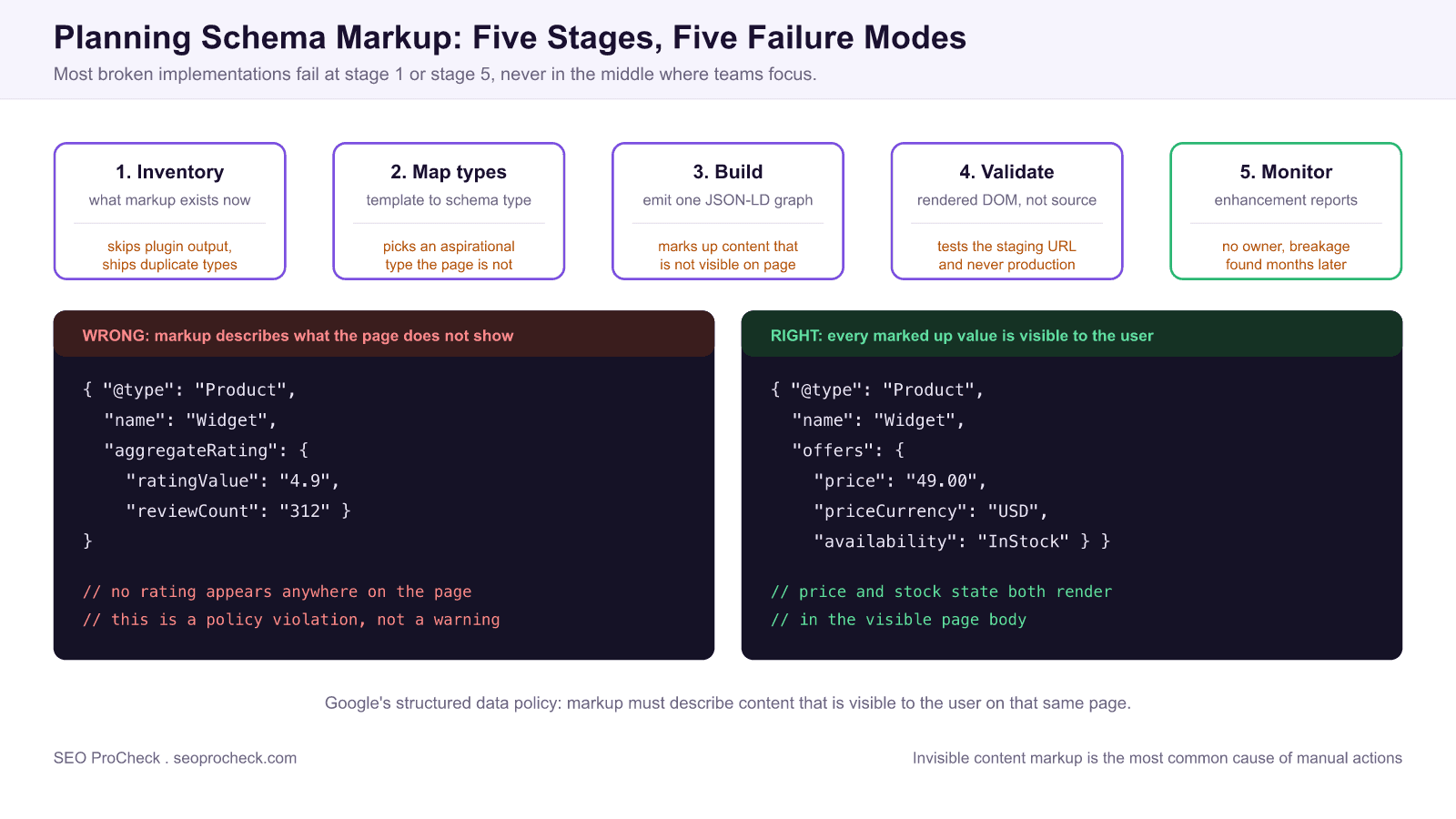
Schema markup projects rarely fail because someone wrote invalid JSON. They fail because nobody checked what the site was already emitting, because the type chosen described an ambition rather than the page, or because the implementation was validated once on a staging URL and then never looked at again. The syntax is the easiest part of the job and it absorbs most of the attention.
What follows is a planning sequence built around where implementations actually break, together with the mistake taxonomy that causes real damage rather than cosmetic validator warnings.
Schema Types and Applications
Type selection is a description problem, not a marketing problem. The question to answer for each template is what this page fundamentally is, and the honest answer is usually less exciting than the one that would unlock the richest snippet. A category listing page that lists twenty products is a CollectionPage or an ItemList. It is not a Product, and marking it as one produces markup that contradicts the page.
Work template by template rather than page by page, because schema is deployed at the template level and a site with two hundred thousand URLs typically has fewer than fifteen distinct templates. For each one, record the type, the required properties, the recommended properties worth adding, and where each value will be sourced from in the CMS.
| Template | Honest type | Tempting wrong type | Why the wrong choice backfires |
|---|---|---|---|
| Blog post or guide | Article or BlogPosting | NewsArticle | NewsArticle implies a news publication and invites scrutiny the site cannot support |
| Product category listing | CollectionPage with ItemList | Product | Claims a single product identity, price and availability the page does not have |
| Service page for a local business | Service, linked to LocalBusiness | Product with offers | Invents price and availability semantics that do not apply to a service |
| Support or help article | Article, or HowTo when genuinely stepwise | FAQPage | FAQ treatment is heavily restricted now and the page is not a question list |
| Homepage | WebSite plus Organization | LocalBusiness on a multi location brand | Collapses many locations into one entity with one address |
| Recipe or tutorial with steps | Recipe or HowTo | Article only | Leaves a documented rich result on the table for no reason |
Where a type has a dedicated property guide, use it as the specification rather than working from memory. The LocalBusiness property guide and the FAQ schema guide both list required against recommended properties, and the FAQ guide in particular explains why a type that was worth deploying in 2021 is a poor priority today.
Implementation Best Practices
JSON-LD is the recommended format and there is no serious argument for anything else on a new build. Beyond that, the practices that separate durable implementations from fragile ones are mostly about structure and ownership.
Emit one graph, not a pile of islands. A page that outputs four unconnected JSON-LD blocks forces search engines to guess whether the Organization in block one is the publisher in block three. Connecting nodes with identifiers turns those guesses into stated facts, and the graph nesting and entity connection guide covers the identifier pattern properly.
<script type="application/ld+json">
{
  "@context": "https://schema.org",
  "@graph": [
    { "@type": "Organization", "@id": "https://example.com/#org",
      "name": "Example Ltd", "url": "https://example.com/" },
    { "@type": "WebSite", "@id": "https://example.com/#website",
      "url": "https://example.com/", "publisher": { "@id": "https://example.com/#org" } },
    { "@type": "WebPage", "@id": "https://example.com/guide/#webpage",
      "url": "https://example.com/guide/", "isPartOf": { "@id": "https://example.com/#website" } },
    { "@type": "Article", "headline": "Planning schema markup",
      "mainEntityOfPage": { "@id": "https://example.com/guide/#webpage" },
      "publisher": { "@id": "https://example.com/#org" } }
  ]
}
</script>
Treat required and recommended properties differently. Required properties gate eligibility outright. Recommended properties frequently determine how rich the rendering is, so skipping them caps your upside while leaving the implementation technically valid. A validator that reports zero errors and eleven warnings is telling you something worth reading.
Source values from the same place the page renders them. When the visible price comes from one field and the marked up price comes from another, they will diverge the first time somebody runs a promotion. Bind both to the same data source and the consistency problem disappears permanently.
Decide where the markup is injected before you build. Server rendered output is the most reliable. Tag manager injection is the most fragile, because it depends on the container firing and on Google rendering the page before the markup exists. If you must inject client side, validation on production stops being optional.
Rich Results Impact
Set expectations correctly before the work starts, because most disappointment is a briefing failure rather than an implementation failure. Structured data is not a ranking factor. Valid markup makes a page eligible for a rich result, and eligibility is a permission rather than a promise. Google still decides whether to render the treatment based on query, device, page quality and its own confidence in the data.
That means the realistic outcome of a good implementation is a listing that occupies more space and carries more pre click information at the position you already hold, which shows up as a click through rate improvement rather than a rank improvement. Types with no current visual treatment can still be worth deploying for entity clarity, particularly as AI answer engines lean on machine readable data, but they should not be sold internally on the promise of a snippet.
The Mistakes That Cause Real Damage
Validator warnings and policy violations are different categories of problem. The table below separates the cosmetic from the consequential.
| Mistake | How it shows up | Severity | Fix |
|---|---|---|---|
| Marking up content not visible on the page | Passes validation, may draw a manual action | Severe, policy violation | Render every marked up value, or remove it from the markup |
| Self serving reviews on your own products | Review rich results silently withdrawn | Severe, policy violation | Only mark up reviews collected independently of the seller |
| Duplicate blocks from plugin and theme | Two Organization or Article nodes per page | High, contradictory signals | Inventory output, disable all but one source |
| Markup value drifts from rendered value | Price mismatch flagged, snippet suppressed | High | Bind markup and template to the same data source |
| Disconnected nodes with no identifiers | Valid, but entities are not related | Moderate, lost opportunity | Use one graph with identifier references |
| Missing recommended properties | Warnings in the Rich Results Test | Low to moderate | Add them where the data genuinely exists |
| Validated on staging only | Production emits nothing at all | High, invisible until traffic fails to move | Test the live URL after every release |
Validation That Catches Regressions
One validation pass at launch tells you the implementation was correct on the day it shipped. It says nothing about the state of the markup six months later, which is when most breakage occurs. Build the checking into a rhythm instead.
At launch, run the Rich Results Test against live production URLs for each template, not against a staging build and not against pasted code. Confirm the rendered DOM contains the markup if any of it is injected client side. After launch, watch the Search Console enhancement reports for each type you deployed, because a rising invalid item count is the earliest reliable signal that a release has broken something. When markup is valid but no rich result appears, the diagnostic sequence in the guide to validating and debugging structured data separates the eligibility conditions from the implementation faults.
Finally, give the reports an owner by name. Enhancement reports that belong to everyone belong to nobody, and the failure mode at stage five is not technical at all.
Frequently Asked Questions
What is the most common schema markup mistake?
Marking up content that does not appear on the page. Ratings, prices, authors or FAQ answers that exist only inside the JSON-LD block violate Google's structured data policies and can trigger a manual action against the site's rich results. Every value in your markup should be findable by a user reading the rendered page.
Should you use JSON-LD, Microdata or RDFa?
Use JSON-LD. Google explicitly recommends it, and the operational advantages are decisive: the markup lives in one block, it can be injected without rewriting page templates, and it can be validated and diffed independently of the HTML. Microdata scattered through the markup is far harder to audit and breaks more easily during unrelated template changes.
How do you choose the right schema type for a page?
Describe what the page actually is, not what you would like it to rank for. A category listing page is a CollectionPage, not a Product, no matter how many products it lists. Start from Google's list of types that have documented rich result support, pick the closest honest match, and only then check which properties are required.
Do you need to validate on the live page or is the source enough?
Validate the rendered page on production. If your markup is injected by JavaScript, by a tag manager or by a plugin, the raw HTML source will not show what Google eventually processes. The Rich Results Test fetches and renders the live URL, which is why testing a staging environment or a local build can pass while production quietly fails.
How often does schema markup break after it is implemented?
More often than teams expect, and almost always silently. Theme updates, plugin conflicts, CMS migrations and template refactors all strip or duplicate markup without any visible symptom on the page. Assign an owner to the Search Console enhancement reports and treat a rising invalid item count as a production incident.
Can two plugins output conflicting schema on the same page?
Yes, and it is extremely common on WordPress. An SEO plugin, a theme and a reviews plugin can each emit their own Article or Organization block, leaving search engines to reconcile contradictory claims about the same entity. Inventory what is already being emitted before adding anything, and consolidate onto one source of truth.
Plan the inventory, choose types that describe the page honestly, emit one connected graph, validate on production, and put a name against the monitoring. Implementations that follow that sequence tend to survive the next three theme updates, which is a more useful benchmark than passing a validator once.
Source: https://thegray.company/blog/implement-schema-avoid-mistakes
Claude Vincent is a technical SEO consultant focused on crawlability, rendering, and AI-search visibility. He writes the field guides and case studies at SEO ProCheck, with a bias toward the durable, unglamorous work that decides whether search engines and AI answer engines can actually read and cite a site.
About SEO ProCheck
Technical SEO consulting and GEO strategy with 20 years of enterprise experience. Case studies, resources, and tools for search and AI visibility.
Work With Me
Technical SEO audits, GEO strategy, site migrations, and international SEO. Hourly consulting for teams who need hands-on support, not just reports.
Subscribe to our newsletter!







Recent Posts
- Can AI Crawlers Actually Read Your Site? I Measured 400 of the Biggest September 5, 2026
- The Pre-Publish Quality Gate for AI-Assisted Content August 6, 2026
- AGENTS.md vs llms.txt vs llms-full.txt: Which Agent File Does What July 18, 2026