

How an Overlooked SEO Tactic Delivered 33% Traffic Growth for IFTTT
- May 22, 2023
- Website Architecture
AI Summary
The overlooked tactic in this IFTTT case study is internal linking done deliberately and at scale, which the source credits with 33 percent organic traffic growth. Instead of publishing more pages, the team connected the pages the site already had, so crawlers and searchers could finally reach them.
- An unlinked page is invisible: no internal link means no reliable crawl path and almost no ranking authority.
- Internal links pass both discovery and relevance, so descriptive anchor text tells Google what the target page is about.
- Large template sites, such as SaaS integration libraries, gain the most because they hide thousands of deep pages.
- You can ship this without writing a single new article, which is why it is so often overlooked.
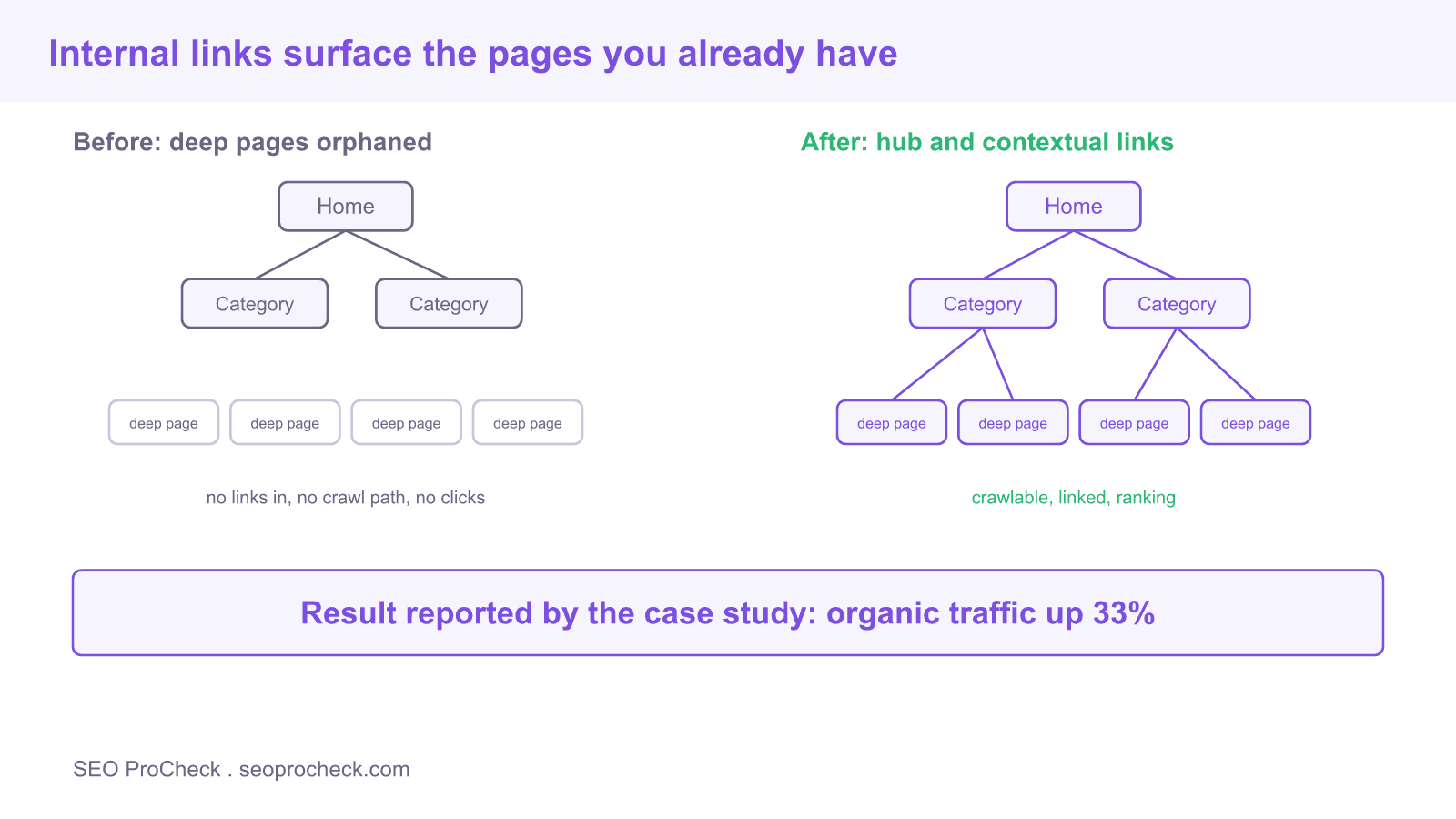
The most valuable SEO wins are often pages you already published and then forgot to connect. This case study, documented by Uproer for the SaaS platform IFTTT, credits an overlooked tactic, internal linking carried out deliberately and at scale, with 33 percent organic traffic growth. No new content strategy, no link building campaign, just a disciplined pass over the internal link graph so that deep pages could finally be found. Below is how that tactic works and how to run it on your own site.
The overlooked tactic: internal links, done at scale
Internal linking sounds basic, which is exactly why it gets skipped. Teams pour effort into new pages and external links while the pages already on the site sit unlinked, buried many clicks from the home page. An internal link does two jobs at once. It gives crawlers a path to discover and recrawl the target, and it passes ranking signals along with the anchor text, which tells Google what the destination is about. When a large template site wires its deep pages into clear hubs, the whole library becomes discoverable and the collective authority starts flowing to pages that were previously stranded.
Why deep pages go orphaned in the first place
Orphaned and weakly linked pages are the default state of any site that grew quickly. A page can end up stranded for several ordinary reasons: it was published from a spreadsheet import with no navigation entry, its category was removed but the page stayed, pagination pushed it past page two of a listing where nothing links deeper, or a redesign dropped the module that used to link to it. On a SaaS platform with an applet or integration library, each new connector becomes a page, and the linking simply never keeps up with the publishing. The result is a huge tail of pages that Google can technically index but rarely crawls and never ranks.
How to find and fix weakly linked pages
Run this as an audit, then a fix, then a measurement. The table lists the practical methods for each stage.
| Step | How to do it | What you learn |
|---|---|---|
| Find orphans | Compare your full URL list from the sitemap against pages a crawler reaches by following links | Pages with zero internal links in |
| Find weak pages | Count internal links per URL and flag pages sitting four or more clicks from home | Pages that are linked but starved of authority |
| Check crawl reality | Read server logs to see which URLs Googlebot actually visits and how often | Whether the crawler ever reaches the tail |
| Build hubs | Create or improve category and topic hub pages that list and link the deep pages | A durable crawl path for the whole set |
| Add contextual links | Link related deep pages to each other from within the body copy | Relevance signals and reduced click depth |
Anchor text and placement that actually helps
Not every internal link carries the same weight. A link inside the main body copy, surrounded by related text, passes clearer relevance than the same link buried in a footer that appears site wide. Use descriptive anchor text that names the target topic rather than generic phrases, keep the anchors varied and natural rather than exact match on every link, and place the most important links high in the content where both users and crawlers reach them first. Reducing click depth matters too: moving a valuable page from five clicks deep to two clicks from the home page often does more than any single new link.
What to measure
Track three things before and after the change. First, crawl coverage from your logs and from the Pages report in Search Console, since the first sign of success is Google crawling and indexing more of the tail. Second, impressions and clicks for the newly linked pages, which is where the traffic growth shows up. Third, click depth as a health metric, aiming to pull important pages closer to the home page over time. Attribute cautiously, because internal linking usually rolls out alongside other work, so compare the linked set against a similar unlinked set where you can.
FAQ
An orphaned page is a URL that no other page on your site links to, so a crawler following links never reaches it. It may still sit in your sitemap, but with no internal links in it gets crawled rarely and struggles to rank. Connecting it to a relevant hub or body link fixes the problem.
There is no fixed number, but every important page needs at least one link from a page that is itself well linked, and ideally several from related content. Focus on relevance and click depth rather than a raw count, and make sure no valuable page sits more than three clicks from the home page.
Yes. Internal links create the crawl path Google uses to discover and recrawl a page, and they pass relevance through anchor text and authority through the link graph. This case study credits internal linking at scale with 33 percent organic growth, which is consistent with how discovery and authority flow through a site.
Links inside the main body copy, surrounded by related text, carry the clearest relevance and are the most useful. Sitewide footer or navigation links help discovery but pass weaker topical signals. Put your most important internal links high in the content where users and crawlers reach them first.
Use descriptive anchor text that names the topic of the target page, so both users and Google understand where the link goes. Vary the wording naturally across links rather than repeating the exact same phrase every time, and avoid vague anchors such as click here.
Export the full list of URLs from your sitemap, then crawl the site by following links only and compare the two lists. Any URL in the sitemap that the link crawl never reached is orphaned. Server logs add confidence by showing which pages Googlebot actually visits.
Tools and further reading
- Map which pages link where with the internal link analyzer.
- Generate a complete URL list to hunt for orphans using the XML sitemap generator.
- Confirm which deep pages Googlebot actually crawls with the log file analyzer.
- Read more website architecture case studies.
Reference: original case note
This SEO case study documents a successful optimization initiative, providing actionable insights for practitioners. The documented approach demonstrates how strategic SEO implementation drives measurable results.
Initial Situation
Understanding the starting point is essential context for evaluating any case study. This documentation covers the initial challenges, competitive position, and business objectives that shaped the SEO strategy.
Strategy and Approach
The strategic approach combined multiple SEO disciplines to address identified opportunities. Key decisions around prioritization and resource allocation provide a template for similar initiatives.
Implementation
Moving from strategy to execution required specific technical implementations, content development, and process changes. This case study documents the practical steps that translated strategy into action.
Results and Learnings
The outcomes demonstrate effectiveness through measurable improvements in rankings, traffic, and business metrics. Analysis of successes and challenges provides learning value for practitioners.
Case studies like this contribute to the SEO knowledge base, helping practitioners learn from documented real-world experiences.
Claude Vincent is a technical SEO consultant focused on crawlability, rendering, and AI-search visibility. He writes the field guides and case studies at SEO ProCheck, with a bias toward the durable, unglamorous work that decides whether search engines and AI answer engines can actually read and cite a site.
About SEO ProCheck
Technical SEO consulting and GEO strategy with 20 years of enterprise experience. Case studies, resources, and tools for search and AI visibility.
Work With Me
Technical SEO audits, GEO strategy, site migrations, and international SEO. Hourly consulting for teams who need hands-on support, not just reports.
Subscribe to our newsletter!





Recent Posts
- Can AI Crawlers Actually Read Your Site? I Measured 400 of the Biggest September 5, 2026
- The Pre-Publish Quality Gate for AI-Assisted Content August 6, 2026
- AGENTS.md vs llms.txt vs llms-full.txt: Which Agent File Does What July 18, 2026