

AI Summary
Linktree grew a very large organic footprint on the back of indexed creator profile pages, then lost a significant share of it, and the Ahrefs case study concluded the decline was likely self inflicted through the removal of top traffic user profiles. The lesson is not about Linktree: it is that when your index is made of other people's pages, a single product decision about profile visibility becomes your biggest SEO event of the year.
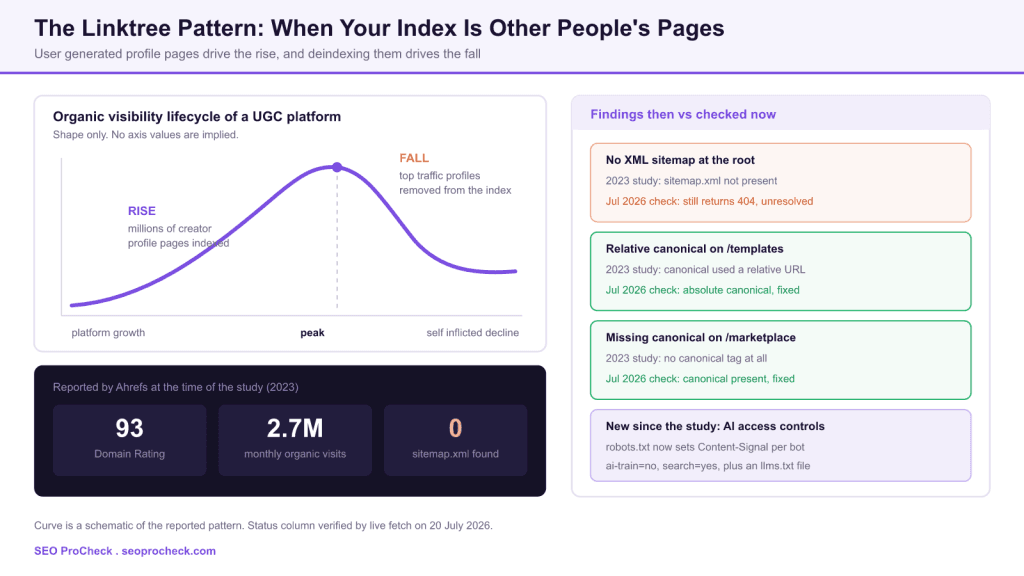
- The study reported a Domain Rating of 93 and roughly 2.7 million monthly organic visits at the time of writing.
- The decline was attributed to removing high traffic user profiles from the index, not to an algorithm update.
- Technical findings included a missing sitemap.xml, a relative canonical on /templates and no canonical at all on /marketplace.
- Rechecked in July 2026: both canonical issues are now fixed, sitemap.xml still returns 404, and robots.txt now carries Content-Signal AI directives.
Platforms whose organic visibility is built from user generated profile pages are running a different business from publishers, and they carry a different risk. Linktree is the cleanest public illustration: enormous index footprint, enormous authority, and a traffic curve that turned down not because Google changed its mind but because the platform changed what it let Google see. If you run a marketplace, a directory, a profile network or any product where users create the pages, the single question worth answering is: what percentage of our organic traffic would survive if we deindexed our top one percent of user pages tomorrow?
Linktree is a link in bio tool. Creators sign up, get a page at a path on the platform's domain, and drop that link into a social profile that does not allow multiple outbound links. The SEO consequence of that product design is that the company accumulated an index of millions of pages it did not write, each carrying a creator's name, and each capable of ranking for that creator's name. That is a formidable position and also a fragile one.
What the case study found
The Ahrefs case study documented both sides of the curve. On the growth side, Linktree built its brand by creating a platform where content creators could share multiple links to their social accounts or websites from a single bio page, and it grew faster than comparable platforms once influencers adopted it as the default link in bio. At the time of writing, Site Explorer data showed the domain at a Domain Rating of 93 with roughly 2.7 million monthly organic visits.
On the decline side, the study's conclusion was blunt: the main fall in traffic was likely self inflicted and due to the removal of top traffic user profiles. It also noted that the site appeared not to have a sitemap.xml file at the time of writing, that the /templates page used relative URLs for its canonicals, which is not usually considered best practice, and that the /marketplace page lacked a canonical tag completely.
What's changed since
The original study dates from 2023, so the technical findings are worth rechecking rather than repeating. We fetched the live site on 20 July 2026. Two of the three issues have been resolved, one has not, and a category of directive that barely existed when the study was published is now present.
| Finding in the study | Status on 20 July 2026 | How we checked |
|---|---|---|
| No sitemap.xml at the root | Still open. The URL returns 404. | Request to the sitemap path at the root, observing the status code |
| /templates used a relative canonical | Fixed. The canonical is now an absolute URL on the live host. | Fetched the page and read the canonical link element in the head |
| /marketplace had no canonical tag | Fixed. A self referencing canonical is now present. | Fetched the page and read the canonical link element in the head |
| Not applicable in 2023 | New. robots.txt now sets per crawler Content-Signal values such as ai-train=no and search=yes, and references an llms.txt file that resolves. | Fetched robots.txt and the referenced llms.txt path |
Live verification performed by SEO ProCheck on 20 July 2026. Statuses on a third party site can change at any time.
The canonical fixes are unremarkable housekeeping. The sitemap gap is more interesting, because it has survived three years of public commentary. On a site of this scale that is likely a deliberate trade rather than an oversight: generating and maintaining sitemap files for millions of volatile user profiles is real engineering work, and a platform that has decided to reduce the indexed profile footprint has little incentive to invest in helping search engines discover more of it. If you want the trade offs in full, our XML sitemaps reference covers when a sitemap earns its keep and when it genuinely does not.
The real lesson: borrowed index risk
Call it borrowed index risk. Your domain's organic performance is a function of pages that other people created, that you did not commission, cannot edit at scale, and may need to remove for reasons that have nothing to do with search. Four distinct exposures follow from that.
| Exposure | What triggers it | Early warning signal | Mitigation |
|---|---|---|---|
| Product decisions rewrite the index | A visibility setting, a paywall, or a decision to noindex profiles | Sudden drop in indexed URL count in Search Console with no ranking loss on owned pages | Model the traffic impact before shipping any change to profile indexability |
| Quality dilution at scale | Spam signups, abandoned profiles, near empty pages | Rising share of profile URLs in crawled but not indexed states | Index only profiles meeting an activity or completeness threshold |
| Brand query dependence | Most profile traffic is people searching a creator's name | Query reports dominated by third party brand and person names | Build owned informational content that ranks for non branded demand |
| Single template concentration | One page type generates the majority of organic sessions | Landing page report where one URL pattern exceeds most of total traffic | Diversify into editorially owned templates before you need to |
A risk frame for any platform whose organic footprint is largely user generated.
Deciding which user generated pages to index
The mistake is treating this as binary. Indexing every profile invites bloat, indexing none forfeits the asset. The workable approach is a threshold applied at render time, so the page itself declares whether it is worth indexing based on its own state.
A reasonable threshold set for a profile or listing page looks like this:
index the profile when ALL of:
  . it has a display name and at least one populated link
  . the account has been active within a defined recency window
  . it has passed spam and moderation checks
  . the owner has not opted out of search visibility

otherwise emit in the page head:
  <meta name="robots" content="noindex, follow">
Two details decide whether this works. Use noindex, follow rather than a bare noindex, so link discovery through the page continues while it is excluded. And never combine the rule with a robots.txt block on the same paths, because a blocked URL is never fetched and the noindex is therefore never read. That interaction is the most common way teams accidentally keep unwanted pages in the index; it is covered in our meta robots and X-Robots-Tag reference.
Apply the threshold gradually. Deindexing a large tranche of pages in one release is precisely the manoeuvre the case study attributes the traffic fall to. Stage it, hold a control group, and watch owned page performance separately from profile page performance so you can tell the two apart in your reporting.
Canonical hygiene on templated pages
The two canonical faults in the original study are worth dwelling on because they are the two most common faults on any templated site, not just this one. A missing canonical leaves the engine to pick a representative URL for a cluster on its own, and it frequently picks one you did not want when parameters, tracking tags or trailing slash variants are in play. A relative canonical resolves correctly right up until the same template renders on a second host, at which point every page on your staging or alternate domain starts pointing at itself rather than at production.
The defensive default for a templated page is a self referencing absolute canonical generated from the same routing logic that produced the URL, so the two can never drift apart. Our canonical tags reference covers the edge cases, and if you are already seeing symptoms of an oversized index, our note on index bloat is the companion read.
What this means if you are the creator, not the platform
There is a second audience for this case study. If you are a creator or a small business using a link in bio page as your main web presence, the platform's traffic curve is a warning about dependency. When the platform changed its indexing posture, every profile on it changed with it, and no individual creator had any say in that. A page you do not own can be deindexed, redesigned, monetised or discontinued without notice.
The practical answer is not to abandon the tool. It is to make sure the tool points at something you own. A simple owned landing page on your own domain, linked from the bio hub, converts the same traffic while building an asset that accrues to you. If you run a site that hosts contributions from your own community, our guide to user generated content strategy and moderation covers the quality controls that keep that content an asset rather than a liability.
How to run this analysis on your own platform
- Segment your organic reporting by template, not by page. In Search Console, use URL pattern filters to split profile pages from owned pages. Most platforms have never looked at these two curves separately and are surprised by the ratio.
- Track indexed count as a first class metric. A falling indexed URL count with stable rankings is the signature of this exact failure, and it shows up before the traffic does.
- Separate branded from non branded demand. If nearly all profile traffic is people searching a specific creator's name, that traffic follows the creator, not you.
- Write the deindexing runbook before you need it. Decide in advance how large a tranche you will ever remove in one release, and what you will measure to catch an overshoot.
- Recheck third party case studies before citing them. As the table above shows, two of three findings in this one were already stale.
FAQ
Not directly. Your Linktree page is a page on someone else's domain, so it neither passes nor drains authority from your site in any meaningful way. The real cost is opportunity cost: traffic that lands on a link hub is traffic that did not land on a page you own, and you get no analytics depth, no email capture and no indexable content from it. Treat it as a routing convenience, not as a web presence.
The Ahrefs study concluded that the decline was likely self inflicted and tied to the removal of top traffic user profiles from the index. When a platform's organic footprint is built almost entirely from user generated profile pages, deindexing the highest traffic subset of those pages removes the traffic with them. The pattern is structural rather than algorithmic.
It concentrates risk in a way most teams underestimate. You are exposed to quality thresholds you do not fully control, because your users write the content, and you are exposed to your own product decisions, because any change to profile visibility rewrites your index overnight. The mitigation is to build an editorially owned content layer in parallel so the whole domain does not depend on one page type.
A large, well linked site can be discovered without one, which is why the absence of a sitemap is rarely fatal on its own. It matters most for new URLs, deep URLs and pages with few internal links, and it gives you a coverage baseline to compare against Search Console. For a site with millions of profile URLs, skipping it means giving up your clearest discovery and diagnostic channel.
A relative canonical gives a path such as /templates, while an absolute canonical gives the full URL including protocol and host. Google can resolve relative canonicals, but they become ambiguous the moment the same HTML is reachable on more than one host, such as a staging domain or a www and non www pair. Absolute URLs remove the ambiguity, which is why they are the standard recommendation.
It is a newer convention for stating, per crawler, whether your content may be used for search indexing, for grounding AI answers, or for training AI models. Linktree's live robots.txt now sets values such as ai-train=no and search=yes for named bots. It is a declaration of intent rather than an enforced control, so it only constrains crawlers that choose to honour it.
Is your organic traffic sitting on pages you did not write?
An audit segments owned versus user generated performance and models what a deindexing decision would actually cost.
Claude Vincent is a technical SEO consultant focused on crawlability, rendering, and AI-search visibility. He writes the field guides and case studies at SEO ProCheck, with a bias toward the durable, unglamorous work that decides whether search engines and AI answer engines can actually read and cite a site.
About SEO ProCheck
Technical SEO consulting and GEO strategy with 20 years of enterprise experience. Case studies, resources, and tools for search and AI visibility.
Work With Me
Technical SEO audits, GEO strategy, site migrations, and international SEO. Hourly consulting for teams who need hands-on support, not just reports.
Subscribe to our newsletter!





Recent Posts
- Can AI Crawlers Actually Read Your Site? I Measured 400 of the Biggest September 5, 2026
- The Pre-Publish Quality Gate for AI-Assisted Content August 6, 2026
- AGENTS.md vs llms.txt vs llms-full.txt: Which Agent File Does What July 18, 2026