

How LLMs Process and Cite Web Content
- September 7, 2025
- LLM Citation Optimization, AI and Search
AI Summary
Large language model answer engines fetch pages, split them into passages, embed those passages as vectors, and retrieve the ones that best match a query, then cite the sources behind them. You earn citations by writing clearly structured, self-contained, quotable passages rather than by any single technical trick.
- Citations come from a retrieval step that matches passages to the query, not from the whole page.
- The passage, a few sentences near a heading, is the unit that gets quoted.
- Write self-contained claims, definitions under headings, and stats with named sources.
- Ship clean fast HTML, mirror real questions in headings, and keep key text out of scripts.

The Retrieval Pipeline
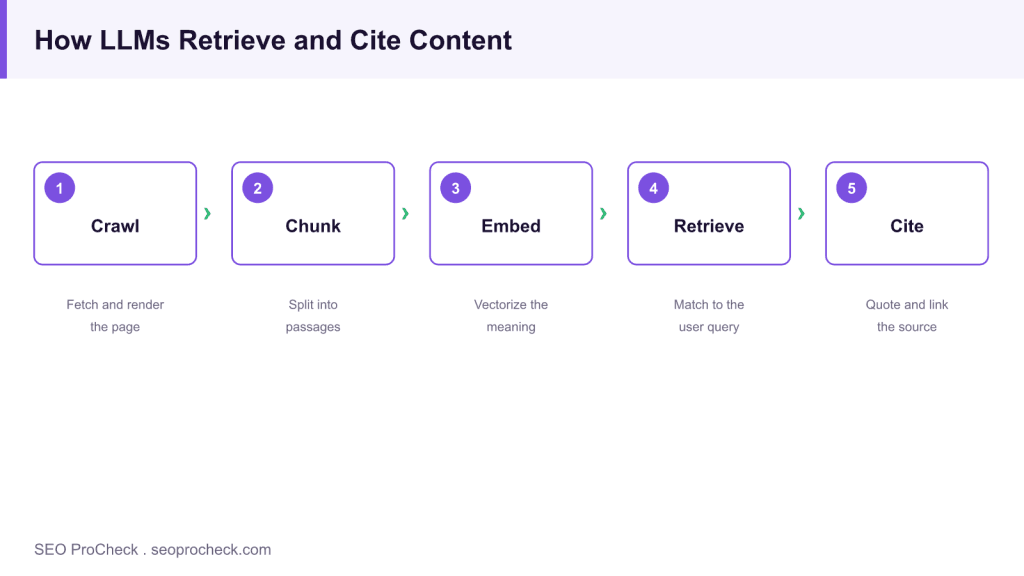
Most AI answer engines that cite the open web run a retrieval augmented pipeline rather than answering purely from memory. The page is fetched and, in some systems, rendered. Its text is split into passages of a few sentences each. Every passage is converted into a numeric vector that captures its meaning and stored in an index. When a user asks a question, the engine embeds the query, retrieves the passages whose vectors sit closest to it, and asks the model to write an answer grounded in those passages. The sources behind the winning passages become the citations. Understanding this flow tells you where to focus: the passage, not the whole page, is the unit that gets quoted.
The Retrieval Pipeline and What You Control
| Stage | What happens | What you can influence |
|---|---|---|
| Crawl | Fetch and sometimes render the page | Fast, indexable HTML, key text not locked behind scripts |
| Chunk | Split the page into passages | Clear headings and self-contained paragraphs |
| Embed | Convert passages to vectors | Precise wording and unambiguous entities |
| Retrieve | Match passages to the query | Headings that mirror how people ask |
| Cite | Quote the passage, attribute the page | Quotable claims with sources near the top |
What Makes a Passage Quotable
Retrieval rewards passages that stand on their own. Write sentences that state a complete claim without depending on the paragraph above, place definitions directly under the heading that asks for them, and attach a named source and date to any statistic. Structured lists and tables are easy to lift cleanly, so they are quoted often. The opposite patterns hurt: pronouns with unclear antecedents, claims split across several paragraphs, and key facts buried below long preambles all make a passage risky to quote, so engines skip them.
Practical Optimizations
Turn the pipeline into a checklist. Use H2 and H3 headings that mirror the exact questions people ask, and answer each one in the first sentence beneath it. Put a short direct answer near the top of the page so the strongest passage is easy to find. Keep factual density high and vague marketing language low. Ship clean, fast HTML and avoid locking essential content behind client side scripts that a retriever may not execute. Add schema so machines can parse entities, and consider an llms.txt file to point AI crawlers at your most useful pages. None of these are magic, but together they raise the odds that your passages are the ones retrieved and cited.
Related reading: align pages to the questions searchers actually ask with user intent mapping for content planning, apply the same freshness thinking to timely pages in news SEO and Google News optimization, and explore more in the AI and search library.
Understanding AI SEO
AI SEO represents a critical component of modern SEO strategy. As search engines continue to evolve and user expectations shift, understanding the nuances of ai seo becomes essential for maintaining and improving organic visibility. This guide covers the key concepts, implementation approaches, and strategic considerations that SEO practitioners need to master.
Key Considerations for How LLMs Process and Cite Web Content
When approaching ai seo, several factors require careful attention. Technical implementation must align with broader SEO objectives while maintaining site performance and user experience. The balance between optimization and over-optimization requires ongoing monitoring and adjustment based on performance data and algorithm changes. Industry benchmarks and competitor analysis provide context for evaluating your own implementation.
Implementation Best Practices
Successful implementation begins with thorough auditing of current state and clear goal definition. Document baseline metrics before making changes to enable accurate impact measurement. Prioritize changes based on potential impact and implementation effort, focusing on high-impact items first. Test changes in staging environments when possible, and monitor closely after deployment to production. Maintain documentation of changes for future reference and troubleshooting.
Common Mistakes to Avoid
Several patterns consistently cause problems in ai seo implementations. Rushing implementation without proper planning leads to errors that can be costly to fix. Ignoring the interplay between different SEO factors creates conflicts that undermine results. Failing to monitor and iterate based on performance data means missing optimization opportunities. Over-optimization signals can trigger algorithmic penalties that take months to recover from.
Measuring Success
Effective measurement requires defining appropriate KPIs aligned with business objectives. Track both leading indicators (rankings, impressions, technical metrics) and lagging indicators (traffic, conversions, revenue) to build a complete picture. Establish reasonable timeframes for evaluation, as SEO changes often take weeks or months to fully manifest in results. Compare performance against historical baselines and competitor benchmarks to contextualize results.
Strategic Recommendations
Approach ai seo as an ongoing program rather than a one-time project. Build processes for regular auditing, monitoring, and optimization. Stay current with industry developments and algorithm changes that may affect your strategy. Invest in education for team members to build internal capabilities. Consider how ai seo fits within your broader digital marketing and business strategy for maximum impact.
Frequently Asked Questions
How do AI answer engines choose which sources to cite?
Retrieval based systems split pages into passages, convert them to vectors, and match them against the user query. The passages that best answer the question get quoted, and the pages they come from get cited, so clear, self-contained passages win citations.
What is the difference between training data and retrieval?
Training data is baked into the model and is frozen at a cutoff date. Retrieval fetches live pages at query time and feeds relevant passages to the model. Citations almost always come from the retrieval step, which is the part you can influence with good content.
Does an LLM read my whole page?
Usually not. It works with the passages that its retriever selects, so the sentences around your headings and any summary near the top carry disproportionate weight. Front load the direct answer and keep each claim self-contained.
What makes a passage quotable by an AI engine?
Self-contained sentences that state a clear claim, definitions placed directly under a heading, statistics with a named source, and structured lists or tables. Ambiguous pronouns and claims that depend on earlier paragraphs are hard to quote cleanly.
Do I need llms.txt or schema for AI citations?
They help but are not required. Clean HTML, descriptive headings that mirror real questions, a summary near the top, and factual density do most of the work. Schema and an llms.txt file make your content easier to parse and attribute.
Take this with you
The assistant links open with a question about this page already written. Nothing is sent until you press enter.
Claude Vincent is a technical SEO consultant focused on crawlability, rendering, and AI-search visibility. He writes the field guides and case studies at SEO ProCheck, with a bias toward the durable, unglamorous work that decides whether search engines and AI answer engines can actually read and cite a site.
About SEO ProCheck
Technical SEO consulting and GEO strategy with 20 years of enterprise experience. Case studies, resources, and tools for search and AI visibility.
Work With Me
Technical SEO audits, GEO strategy, site migrations, and international SEO. Hourly consulting for teams who need hands-on support, not just reports.
Subscribe to our newsletter!








Recent Posts
- Most Top Sites Never Say Who They Are in Structured Data October 14, 2026
- Homepage Titles Are Mostly Too Short, Not Too Long October 8, 2026
- Who Actually Serves an llms.txt? 184 Top Sites Measured September 29, 2026