

AI Summary
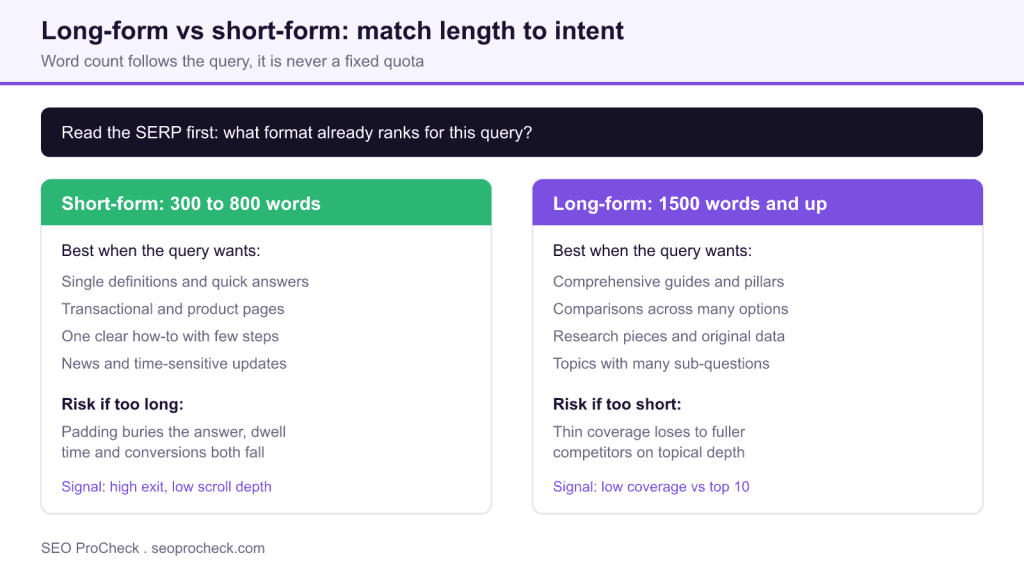
Content length is a decision you make per query by reading the SERP, not a fixed quota you apply site wide. Short-form wins when the intent is a quick answer or a transaction, and long-form wins when the query demands comprehensive coverage or comparison.
- Benchmark the median word count of the top 10 results before you write, then decide whether to match, undercut, or exceed it based on intent gaps.
- Short-form (roughly 300 to 800 words) fits definitions, product pages, and single-step how-to queries.
- Long-form (1500 words and up) fits pillar guides, multi-option comparisons, and research pieces.
- Measure success on intent match and engagement in Search Console and GA4, never on word count alone.

The long-form versus short-form debate is framed the wrong way most of the time. The real question is never "how many words should this page have," it is "what does someone searching this query actually need, and how much space does that need require." Length is an output of that answer, not an input you decide first. This guide gives you a repeatable way to make the call per page instead of applying a blanket rule that quietly hurts half your content.
Read the SERP before you write a single word
The search results for your target query are a live map of what Google already rewards for that intent. Before drafting, run the query in an incognito window and read the top 10 results for format, not just topic. Are they concise definition pages, long tutorials, comparison tables, or product listings? If nine of the ten results are 400 word answer pages and you ship a 3000 word essay, you have misread the intent and you will struggle regardless of quality.
Record three things for each ranking URL: the page type, the visible word count, and whether it fully answers the query or leaves obvious gaps. That last column is where opportunity lives. When the incumbents all answer the surface question but none address the follow-up questions, a more complete page can take the position even if it runs longer than the current leaders.
Benchmark word count with the median, not the average
Collect the word counts of the top 10 organic results and take the median. The median matters because a single 6000 word outlier will drag an average upward and push you toward padding. If the median of the top results is 950 words and one result is 5200, your target band is roughly 800 to 1200 words plus whatever unique value you add, not 5000.
| Intent signal in the SERP | Typical format that ranks | Starting length band |
|---|---|---|
| Definition or "what is" query | Concise answer page with a summary box | 300 to 700 words |
| Single how-to with clear steps | Step list with screenshots | 600 to 1200 words |
| Product or category page | Listing plus supporting copy | 300 to 800 words of copy |
| "Best" or comparison query | Ranked list with criteria table | 1500 to 3000 words |
| Broad guide or pillar topic | Sectioned long guide with anchors | 2000 words and up |
When short-form is the right call
Short-form content, roughly 300 to 800 words, wins when the searcher wants one thing and wants it fast. Definition pages, glossary entries, single-answer FAQ pages, product detail pages, and time-sensitive news all belong here. The failure mode for these pages is padding: introductions that restate the title three times, filler background, and "why this matters" sections that delay the answer. Padding a short-intent page pushes the answer below the fold, raises pogo-sticking back to the SERP, and depresses conversions on commercial pages.
A practical rule: on a short-form page, the direct answer should be visible within the first 100 words. If your draft buries it, cut until it surfaces. You can still add depth below the fold for readers who want it, but the fast answer comes first.
When long-form is the right call
Long-form content, 1500 words and up, earns its length when the query genuinely contains many sub-questions. Pillar guides, "best of" comparisons, buyer guides, and original research need the room to cover options, criteria, edge cases, and objections. Here the failure mode is the opposite: shipping a thin 700 word page into a SERP where every competitor covers ten subtopics you skipped. That page will look incomplete to both readers and to Google, and it is a prime candidate for content decay as fuller competitors overtake it.
Long-form only works if the added length is added coverage, not repetition. Every extra section should answer a distinct question a reader would plausibly ask next. A useful structure test: give each H2 a question it answers, and if two H2s answer the same question, merge them. Building genuine depth this way is also how you accumulate topical authority across a subject area rather than one lucky page.
A repeatable decision workflow
Turn the judgment into a checklist you run for every important page so the call does not depend on mood or habit:
- Search the target query in incognito and classify the dominant format in the top 10.
- Record each result word count and take the median as your reference band.
- List the subtopics the ranking pages cover, and mark gaps none of them fill.
- Decide: match the band and win on clarity, or exceed it to fill the gaps you found.
- Write the brief with the target band and required subtopics baked in, then hold the draft to it.
This is the same discipline that drives a good content brief and a sound content audit scoring methodology: decisions come from evidence about the query, not from a house style that says every page must hit 2000 words.
Measure whether the length decision worked
Record a baseline before you publish or rework a page: average position, impressions, clicks, and an engagement metric such as engaged sessions or average engagement time from GA4. After 4 to 8 weeks, compare. Rising impressions with a flat click-through usually means the length matched intent but the title or snippet needs work. Rising position with falling engagement time on a long page often means you padded past the point of usefulness and should trim. On a short page that ranks on page two for several unaddressed related queries, that is your signal to expand into long-form and cover them.
When the data says a page missed, you then face a separate choice between a light refresh and a full rebuild, which is its own decision covered in the content refresh versus rewrite framework. Catching underperformance early also feeds directly into content decay prevention before a page slides out of the top results.
Common mistakes to avoid
Three patterns cause most length mistakes. First, applying a site wide minimum word count, which forces padding onto pages that should be tight. Second, judging a page by its own length instead of against the SERP it competes in. Third, treating expansion as adding words rather than adding coverage, which produces long pages that still miss the subtopics readers wanted. Fix all three by anchoring every decision to the query and the results already ranking for it.
Frequently asked questions
Is longer content always better for SEO?
No. Length is a byproduct of covering a topic well, not a ranking factor on its own. When the query wants a fast answer, a tight 400 word page can outrank a padded 2500 word page because it satisfies intent faster and holds a lower bounce. Always benchmark against the pages already ranking rather than chasing a universal number.
How do I decide the right word count for a page?
Pull the top 10 ranking URLs for your target query, record each word count, and take the median rather than the average so one outlier does not skew the target. Then ask whether those pages fully answer the query. If they leave gaps, you can win with a shorter page that covers the intent more directly, or a longer one that adds the missing subtopics.
Does short-form content hurt topical authority?
Not if each short page owns a distinct query and links cleanly into a hub. Problems appear when several thin pages target the same intent and split signals, which is keyword cannibalization. Consolidate overlapping short pages into one stronger asset when they compete.
When should I expand a short page into long-form?
Expand when Search Console shows the page ranking on page two for several related queries it does not currently address, or when the top results are visibly more comprehensive. Add the missing subtopics as new sections rather than padding existing paragraphs.
Can one page rank for both quick answers and deep research intent?
Sometimes, using a summary answer near the top for skimmers and detailed sections below for researchers. This works when both intents share the same core query. When intents genuinely diverge, split them into two pages so each matches its own SERP.
How long before I know if a length decision worked?
Give a new or reworked page 4 to 8 weeks to settle, then compare average position, impressions, and engagement against the baseline you recorded before publishing. Judge on intent match and engagement, not the raw word count you shipped.
Claude Vincent is a technical SEO consultant focused on crawlability, rendering, and AI-search visibility. He writes the field guides and case studies at SEO ProCheck, with a bias toward the durable, unglamorous work that decides whether search engines and AI answer engines can actually read and cite a site.
About SEO ProCheck
Technical SEO consulting and GEO strategy with 20 years of enterprise experience. Case studies, resources, and tools for search and AI visibility.
Work With Me
Technical SEO audits, GEO strategy, site migrations, and international SEO. Hourly consulting for teams who need hands-on support, not just reports.
Subscribe to our newsletter!







Recent Posts
- Can AI Crawlers Actually Read Your Site? I Measured 400 of the Biggest September 5, 2026
- The Pre-Publish Quality Gate for AI-Assisted Content August 6, 2026
- AGENTS.md vs llms.txt vs llms-full.txt: Which Agent File Does What July 18, 2026