

AI Summary
Topical authority is earned by covering a subject comprehensively with interlinked content organized around a central pillar, so engines and readers see the site as a complete resource. It works through depth of coverage and internal linking, not publishing volume alone.
- A pillar page plus a cluster of internally linked supporting articles is the core structure.
- Cover the whole question space: definitions, how to, comparisons, troubleshooting and cost.
- Descriptive internal links pass context and help engines map the cluster.
- Author expertise, citations and timely updates reinforce authority signals.
Understanding Topical Authority
Topical Authority represents a significant aspect of SEO strategy that practitioners need to understand thoroughly. As search algorithms evolve and user behavior changes, staying current with best practices in this area becomes increasingly important. This guide provides comprehensive coverage of the key concepts and actionable recommendations.
Strategic Importance
The role of topical authority in overall SEO success cannot be understated. It influences multiple ranking factors and affects user experience. Sites that excel in this area typically see better organic performance across key metrics. Understanding the strategic implications helps prioritize efforts and allocate resources effectively.
Implementation Approach
Effective implementation requires a systematic approach. Begin with thorough assessment of your current state. Identify gaps and opportunities through analysis. Develop an action plan with clear priorities. Execute methodically while monitoring for issues. Iterate based on results and industry changes.
Best Practices
Industry best practices have evolved through collective experience and testing. Following established guidelines helps avoid common pitfalls and accelerates results. However, best practices should be adapted to your specific situation rather than applied blindly. Test and measure to confirm what works for your site.
Future Considerations
The landscape continues to evolve with new technologies and algorithm updates. Stay informed about developments that may affect your strategy. Build flexibility into your approach to accommodate changes. Focus on fundamentals that provide long-term value rather than short-term tactics that may become obsolete.
The pillar and cluster model
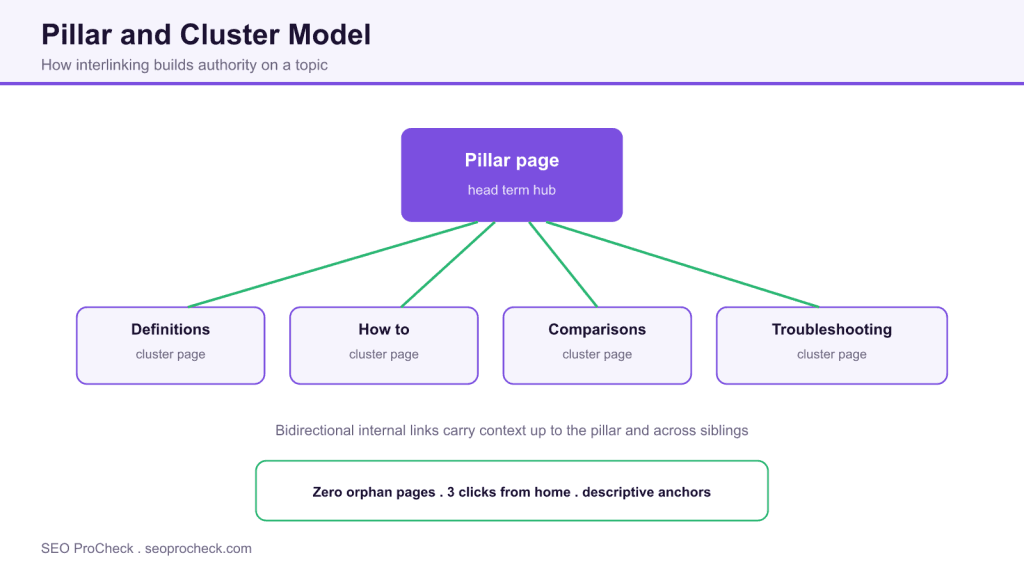
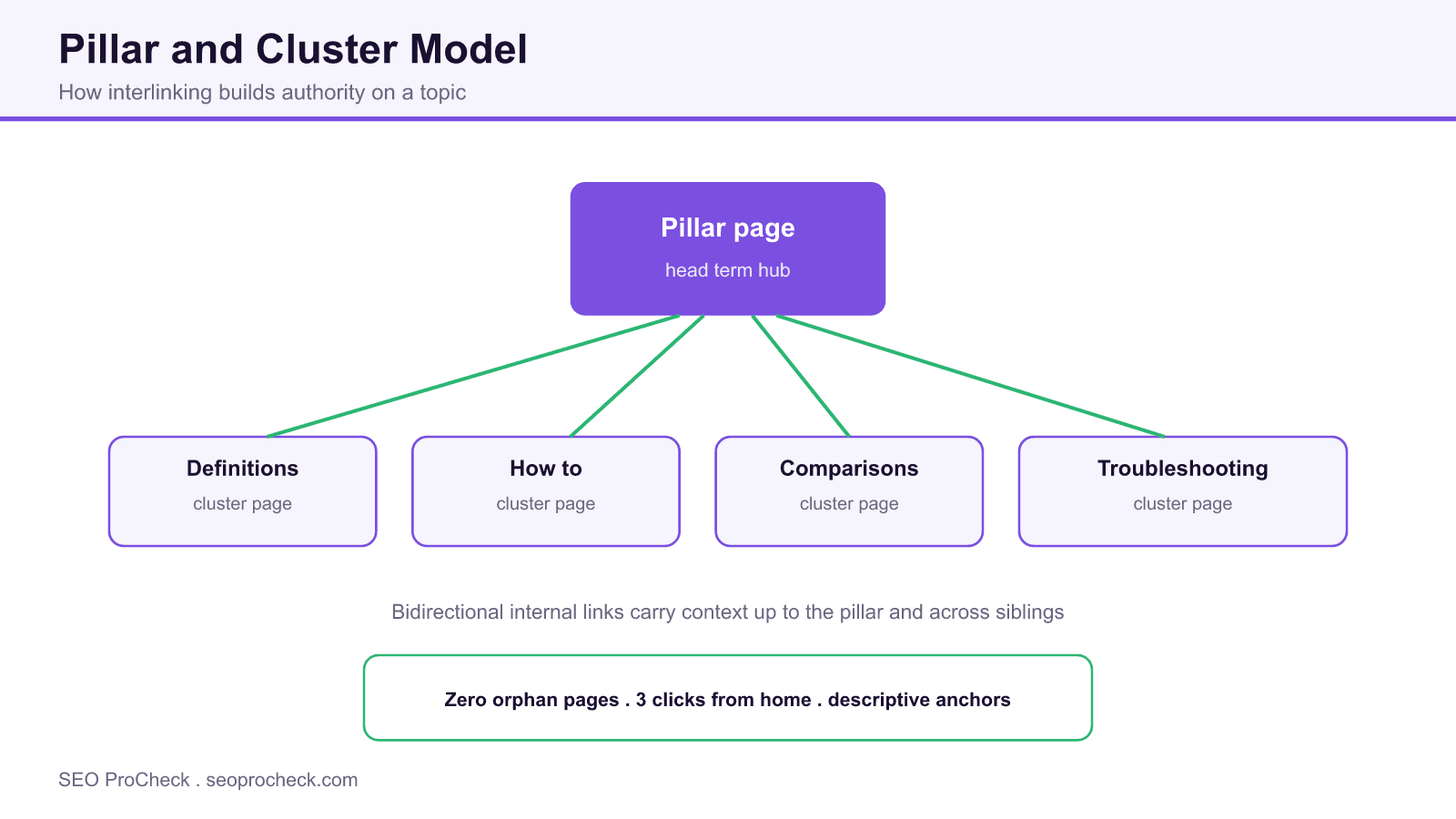
The proven structure is one pillar page that targets the broad head term and a set of cluster pages that each target a specific long tail subtopic. The pillar links down to every cluster page and each cluster page links back up to the pillar and across to relevant siblings. This bidirectional linking is what tells an engine the pages form a coherent, complete topic, and it is why volume alone never produces authority.
| Role | Targets | Depth | Links |
|---|---|---|---|
| Pillar page | Broad head term | Overview that frames the topic | Down to every cluster page |
| Cluster page | One specific subtopic | Deep, exhaustive on that slice | Up to pillar plus to siblings |
| Supporting asset | Data, tool or template | Practical resource | Cited from cluster pages |
Mapping the topic space
Before writing, map the full question space. Combine SERP analysis of the head term, the People Also Ask box, related searches, and Search Console query mining on any existing pages. List every subtopic a knowledgeable reader would expect, then prioritize the gaps you do not yet cover. The goal is completeness: if a reasonable question about the topic has no page, the cluster is incomplete.
Internal linking that builds authority
Internal links do the heavy lifting. Use descriptive anchor text that names the destination subject rather than generic click here. Link every cluster page to the pillar and to closely related siblings, keep orphan pages at zero, and keep important pages within roughly three clicks of the home page. A clean link graph lets engines crawl and understand the cluster as a unit.
Signals beyond content
Authority is reinforced by signals around the content: consistent on topic publishing, clear author bios and credentials, external citations to primary sources, and refreshing dated pages. Just as important, avoid thin, off topic pages that dilute the cluster. Experience, expertise, authoritativeness and trust (E-E-A-T) are cumulative, so a focused site of strong pages outranks a sprawling one of weak pages.
Measuring topical authority
Track share of voice across the topic cluster, the number of ranking keywords per cluster, the average position trend for the group, and internal link coverage (are any pages orphaned). Rising keyword count and improving average position across the whole cluster, not one lucky page, is the signature of growing authority.
Frequently asked questions
What is topical authority?
It is the degree to which a site is seen as a comprehensive, trustworthy resource on a subject. It comes from covering the full topic in depth with interlinked pages and credible expertise signals.
How many cluster pages do I need?
Enough to cover the real question space of the topic, not a fixed number. Map every subtopic a knowledgeable reader expects, then create a page for each meaningful gap.
Does publishing more content build authority?
Not by itself. Volume without depth, structure and internal linking dilutes a site. Authority comes from complete coverage of a focused topic, well interlinked, rather than raw output.
How do internal links help topical authority?
Descriptive internal links pass context between related pages and let engines map the cluster as a single topic. They also distribute crawl attention and keep important pages shallow in the site structure.
How long does it take to build topical authority?
It is gradual and depends on coverage, competition and existing trust. Expect steady movement over months as the cluster fills out and internal links and external citations accumulate.
Can off topic pages hurt authority?
Yes. Thin or unrelated pages dilute the topical focus and can weaken how clearly an engine associates the site with its core subject. Keep the cluster tight and prune or improve weak pages.
Keep going with link building analysis, answer optimization, and indexation of cluster pages.
Claude Vincent is a technical SEO consultant focused on crawlability, rendering, and AI-search visibility. He writes the field guides and case studies at SEO ProCheck, with a bias toward the durable, unglamorous work that decides whether search engines and AI answer engines can actually read and cite a site.
About SEO ProCheck
Technical SEO consulting and GEO strategy with 20 years of enterprise experience. Case studies, resources, and tools for search and AI visibility.
Work With Me
Technical SEO audits, GEO strategy, site migrations, and international SEO. Hourly consulting for teams who need hands-on support, not just reports.
Subscribe to our newsletter!







Recent Posts
- Can AI Crawlers Actually Read Your Site? I Measured 400 of the Biggest September 5, 2026
- The Pre-Publish Quality Gate for AI-Assisted Content August 6, 2026
- AGENTS.md vs llms.txt vs llms-full.txt: Which Agent File Does What July 18, 2026