

Expert Review Processes for YMYL Content
- January 20, 2025
- E-E-A-T Optimization, Content SEO
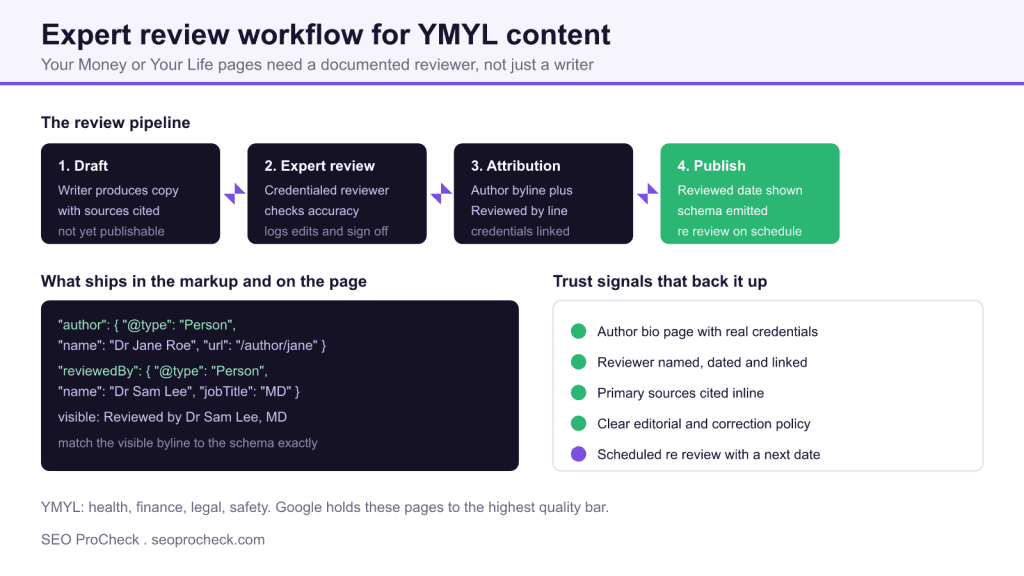
AI Summary
An expert review process for Your Money or Your Life content moves a page through draft, review by a credentialed expert, visible attribution, and publication with a dated reviewer, then repeats on a schedule. The goal is to prove experience, expertise, authoritativeness, and trust with a documented reviewer, matching schema, and cited primary sources rather than an anonymous byline.
- YMYL covers health, finance, legal, and safety pages that Google holds to the highest quality bar.
- The writer and the expert reviewer can be different people, both named on the page.
- Match the visible Reviewed by line to the author and reviewedBy schema exactly.
- Log every sign off and set a next review date so guidance stays current.
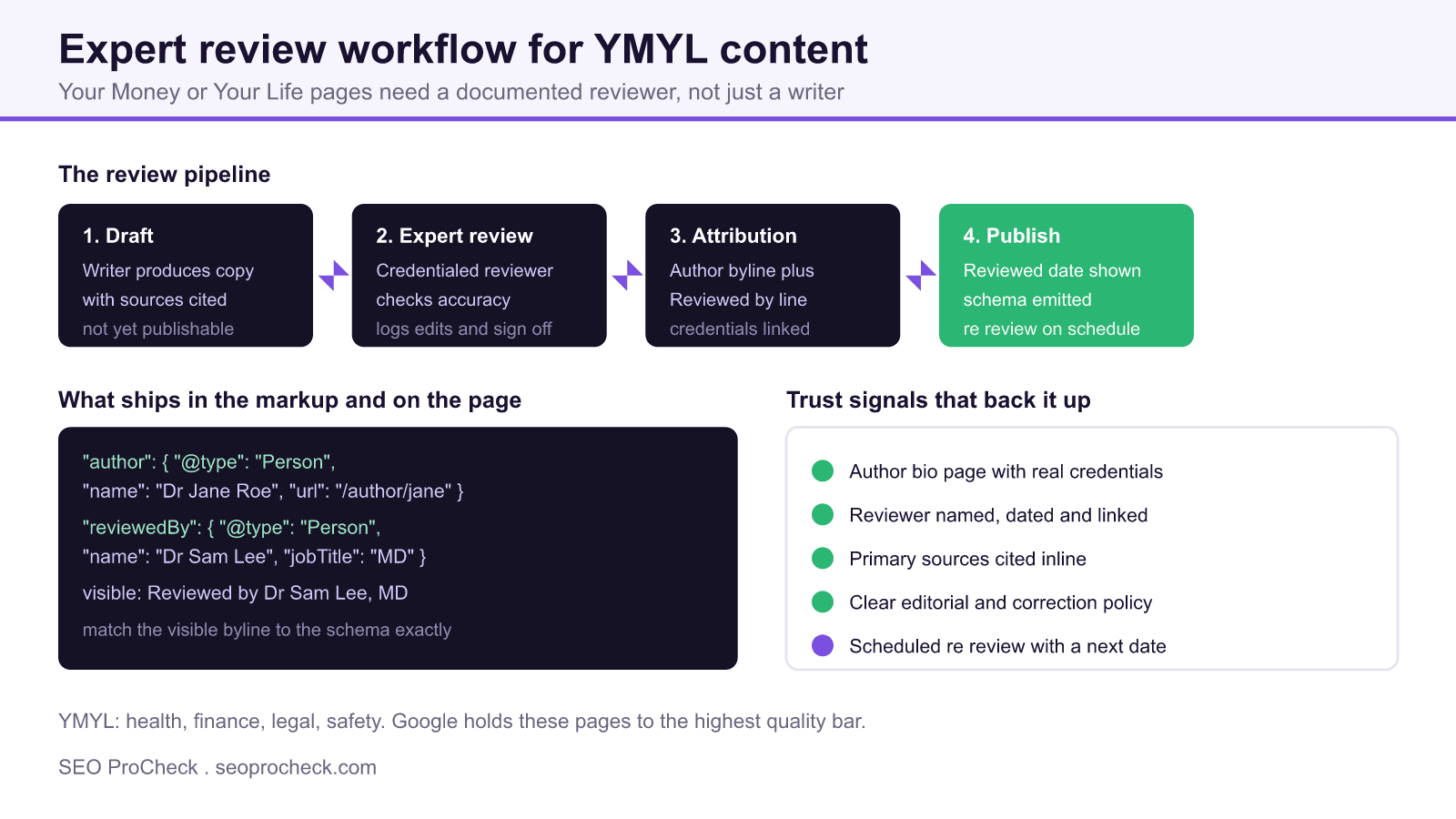
Why YMYL pages need a formal review step
Your Money or Your Life pages are the ones that can change a reader's health, finances, safety, or legal standing. A wrong dosage, a bad tax claim, or an unsafe instruction carries real consequences, so Google asks its quality raters to judge these pages against the highest standard of experience, expertise, authoritativeness, and trust. On an ordinary blog post an anonymous byline is a minor weakness. On a YMYL page it is a structural problem, because nothing on the page proves that a qualified person stands behind the claims.
An expert review process fixes that by turning quality into a repeatable workflow rather than a hope. Every page passes through the same stages, every reviewer sign off is recorded, and the finished page carries visible proof of who wrote it, who checked it, and when. The rest of this guide covers the stages, the markup, and the maintenance cadence.
The four stage pipeline
A workable pipeline has four stages. Keep each stage distinct so responsibility is clear and nothing ships without a check.
| Stage | Owner | Output |
|---|---|---|
| Draft | Writer | Copy with primary sources cited inline |
| Expert review | Credentialed reviewer | Verified claims plus a logged sign off |
| Attribution | Editor | Byline, Reviewed by line, linked bios |
| Publish and recheck | Editor | Dated page, schema, next review date |
Draft with sources, not opinion
The draft stage sets up everything that follows. Ask writers to cite a primary source for every material claim: a peer reviewed study, an official guideline, a regulator's page, or a manufacturer's documentation. Inline citations make the reviewer's job faster and give readers a way to verify the guidance themselves. A draft that leans on unsourced assertion should go back before it ever reaches the expert.
Expert review that leaves a record
The reviewer must be genuinely qualified for the topic: a licensed clinician for medical pages, a credentialed professional for finance or legal, someone with demonstrable hands on expertise for safety. Their job is to check accuracy, flag anything misleading, and either request edits or approve. Crucially, the review has to leave a trail. Keep an internal log for each page that records who reviewed it, the date, the sections verified, the corrections required, and the approval to publish.
Attribution the reader can check
Trust comes from what the reader can see, so the page must name real people with checkable credentials. Give the writer an author byline that links to a bio page, and add a separate Reviewed by line naming the expert with their qualification, also linked. Both bio pages should describe genuine credentials, affiliations, and experience. The reviewed date belongs near the byline so the reader knows the guidance is current.
Back the visible attribution with schema. Populate the author and reviewedBy properties and keep them identical to the visible bylines:
{
  "@context": "https://schema.org",
  "@type": "MedicalWebPage",
  "author": { "@type": "Person", "name": "Dr Jane Roe", "url": "https://example.com/author/jane-roe/" },
  "reviewedBy": { "@type": "Person", "name": "Dr Sam Lee", "jobTitle": "MD" },
  "lastReviewed": "2026-07-21"
}
Do not let the markup and the visible page disagree. If the schema names a reviewer who is not shown on the page, or shows a date that does not match, you undercut the very trust the review was meant to build.
Publish, then keep it current
Publication is not the end of the process for YMYL content. Fields move, guidelines change, and stale advice on a high stakes topic is a liability. Set a review cadence, often every six to twelve months for medical and financial pages, record a next review date in your calendar, and show a last reviewed date on the page. When the date arrives, the reviewer checks the page against current guidance, updates anything that has changed, and logs a fresh sign off. Over time this cadence, not any single publish, is what keeps the page trustworthy.
A practical checklist
Before any YMYL page goes live, confirm the following: every material claim has a primary source, a qualified reviewer has signed off in the log, the author and reviewer both have real linked bio pages, the visible bylines match the schema, a reviewed date is shown, and a next review date is scheduled. If any item is missing, the page is not ready.
Frequently asked questions
What counts as YMYL content?
YMYL stands for Your Money or Your Life, and it covers pages that could affect a person's health, financial stability, safety, or major life decisions. Medical advice, investment guidance, legal information, and safety instructions are the clearest examples. Google's quality raters hold these pages to the highest standard, so weak sourcing or an anonymous author does more damage here than on a low stakes topic.
Does an expert reviewer need to be the author?
No. The writer can produce the draft and a separately credentialed expert can review it for accuracy. This split is common and legitimate: name the writer as the author and the expert in a visible Reviewed by line. What matters is that a qualified person has verified the claims and that the page shows who they are, with credentials you can check.
What is the reviewedBy schema property?
reviewedBy is a property that names the Person or Organization that checked the content, and it can sit on Article and on medical schema types. Populate it with the reviewer's name and a link to their profile, and make sure the visible byline on the page matches it. The markup supports the claim, but the on page attribution is what readers and raters actually see.
How often should YMYL content be re reviewed?
Set a review cadence based on how fast the field changes. Medical and financial pages often warrant a check every six to twelve months, while stable reference material can go longer. Record a next review date in your content calendar and show a last reviewed date on the page so readers know the guidance is current.
Does expert review directly improve rankings?
There is no single ranking input labelled expert review. It strengthens the experience, expertise, authoritativeness, and trust that Google's systems and quality raters assess, which supports performance on high stakes queries over time. Treat it as raising the quality floor of the page rather than a switch that lifts a ranking overnight.
What should a reviewer sign off actually record?
Keep an internal log that captures who reviewed the page, the date, the specific claims or sections they verified, any corrections they required, and their approval to publish. This record protects you if a claim is later challenged and it makes the next scheduled review faster, because the reviewer can see what changed since last time.
Related reading
- The complete guide to E-E-A-T optimization
- Medical content E-E-A-T requirements
- Building author authority pages
- Person schema for author pages
Take this with you
The assistant links open with a question about this page already written. Nothing is sent until you press enter.
Claude Vincent is a technical SEO consultant focused on crawlability, rendering, and AI-search visibility. He writes the field guides and case studies at SEO ProCheck, with a bias toward the durable, unglamorous work that decides whether search engines and AI answer engines can actually read and cite a site.
About SEO ProCheck
Technical SEO consulting and GEO strategy with 20 years of enterprise experience. Case studies, resources, and tools for search and AI visibility.
Work With Me
Technical SEO audits, GEO strategy, site migrations, and international SEO. Hourly consulting for teams who need hands-on support, not just reports.
Subscribe to our newsletter!








Recent Posts
- Most Top Sites Never Say Who They Are in Structured Data October 14, 2026
- Homepage Titles Are Mostly Too Short, Not Too Long October 8, 2026
- Who Actually Serves an llms.txt? 184 Top Sites Measured September 29, 2026