Google Algorithm Updates FAQ: Understanding & Recovering from Changes
- December 14, 2019
- Tools and Analytics FAQ
AI Summary
Google makes thousands of changes a year, but the ones that move rankings broadly are the named core, helpful content, spam, and link spam updates. If traffic drops, confirm the timing against announced updates in Search Console, diagnose the affected pages, then improve genuine quality rather than chasing quick fixes.
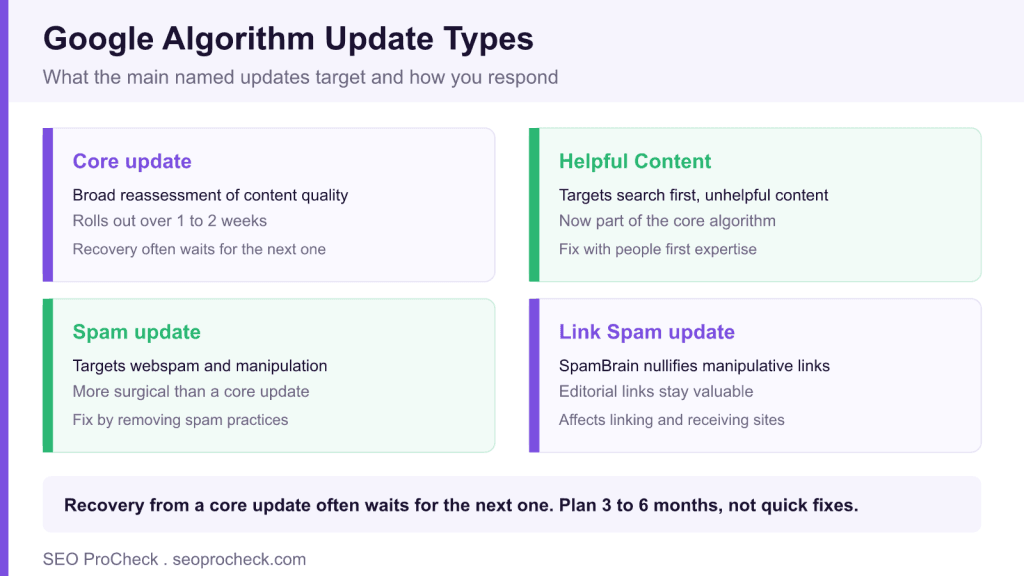
- Core updates reassess quality broadly and typically roll out over 1 to 2 weeks.
- Core update recovery often waits for the next core update, so plan for a 3 to 6 month horizon.
- Spam and link spam updates are more surgical and reward removing manipulative practices.
- The durable defense is genuine E-E-A-T, helpful content, and diversified traffic sources.

Complete guide to Google algorithm updates. Understanding core updates, recovering from traffic drops, and building a site that thrives through algorithm changes.
Table of Contents
- Algorithm Basics
- Core Updates
- Other Update Types
- Assessing Impact
- Recovery Strategies
- Monitoring & Preparation
Algorithm Basics
What is Google's search algorithm?
The complex system Google uses to rank search results. Includes hundreds of ranking factors and signals. Constantly updated to improve results quality. Major updates are announced; minor updates happen daily without notice. Understanding the algorithm helps create content that ranks.
How often does Google update its algorithm?
Google makes thousands of changes yearly. Most are minor refinements. Core updates happen several times per year (announced). Spam updates, helpful content updates, and other named updates occur periodically. Some days have multiple small updates. Change is constant.
What updates does Google confirm?
Core updates, spam updates, helpful content updates, product reviews updates, and page experience updates are typically announced. Google may confirm updates in response to speculation. Many changes go unannounced. Check Google Search Central blog for official announcements.
What are unconfirmed updates?
Ranking fluctuations detected by the SEO community without official Google announcement. May be algorithm tweaks, tests, or data refreshes. Tools like Semrush Sensor, Mozcast, and RankRanger track volatility. Not every fluctuation is an "update"; normal variation exists.
Why does Google make algorithm updates?
To improve search result quality, combat spam, reward good content, adapt to changing search behavior, and address new content types. Updates aim to better match user intent. Google's goal: deliver the most helpful, relevant results for every query.
Core Updates
What is a core update?
Broad changes to Google's main ranking algorithm affecting how content is evaluated overall. Not targeting specific sites or issues. Reassesses content quality holistically. Can significantly shift rankings across many queries. Typically takes 1-2 weeks to roll out fully.
How often do core updates happen?
Typically 3-4 times per year, though frequency varies. Named by month: "March 2024 Core Update." May combine with other updates (spam, reviews). Rollouts last 1-2 weeks. Impact may continue to settle for weeks after completion.
What causes core update ranking drops?
Core updates reassess content quality broadly. Drops often mean: competitors improved, quality standards rose, content became outdated, E-E-A-T signals insufficient, user experience issues, or content no longer matches intent. Not necessarily something "wrong"; relative positioning changed.
Can I recover from a core update drop?
Yes, but it takes time and effort. Improvements may be recognized in subsequent core updates. Focus on content quality, not quick fixes. Some recovery may happen between updates, but significant gains often coincide with next core update. Patience required.
How long does core update recovery take?
Often requires waiting for next core update (months). Improvements made between updates may not show full impact until next core update. Some gradual recovery possible. Plan for 3-6 month timelines minimum. Quick fixes rarely work for core update impacts.
Other Update Types
What is the Helpful Content Update?
Update targeting content created primarily for search engines rather than users. Integrated into core algorithm. Affects entire site if significant unhelpful content exists. Emphasizes original, people-first content demonstrating expertise and experience. Avoid content that feels written for SEO bots.
What is a spam update?
Updates targeting webspam: manipulative link building, cloaking, keyword stuffing, scraped content, spam links. More surgical than core updates. Targets specific spam techniques. Recovery requires removing spam practices and potentially disavowing links. Clear cause-and-effect relationship.
What is the Product Reviews Update?
Update targeting review content quality. Now integrated into core algorithm. Rewards in-depth reviews showing first-hand experience, evidence (photos, data), product comparisons, and unique insights. Surface-level reviews or affiliate-focused content may be demoted.
What is the Page Experience Update?
Update making Core Web Vitals and page experience signals ranking factors. Includes: LCP, FID (now INP), CLS, mobile-friendliness, HTTPS, no intrusive interstitials. Part of overall ranking, not standalone update anymore. Poor page experience can hurt rankings.
What is the Link Spam Update?
Updates targeting manipulative link building practices. Uses AI (SpamBrain) to detect link spam. Nullifies rather than penalizes many spammy links. Affects both linking and receiving sites. Natural, editorial links remain valuable. Manipulative link building becomes riskier.
Assessing Impact
How do I know if an update affected my site?
Check Google Search Console for traffic changes coinciding with update dates. Compare traffic patterns to announced update timelines. Use third-party tools showing update overlays. Correlation doesn't prove causation: other factors may explain changes. Look for significant, sustained shifts.
How do I identify which pages were affected?
In Search Console, compare performance by page before and after update. Identify pages with significant ranking or traffic changes. Segment by content type, topic, or template. Look for patterns: are certain sections more affected? This guides where to focus improvements.
How do I know if changes are algorithmic or something else?
Check for technical issues (indexing, crawling errors), manual actions, site changes coinciding with drops, seasonal patterns, or competitor movements. Algorithm impacts typically affect many queries and pages simultaneously. Isolated page drops more likely technical or content issues.
What if competitors gained when I lost?
Algorithm updates are zero-sum: someone gains when others lose. Analyze what competitors do better: content quality, freshness, E-E-A-T signals, user experience. Don't copy; improve. Their gains indicate what Google currently values. Use as improvement roadmap.
What if an update helped my rankings?
Analyze what you did right. Which content performed best? What signals might have helped? Document your practices. Don't become complacent: continue improving. Gains can reverse in future updates if you stop investing in quality. Celebrate briefly, then keep working.
Recovery Strategies
What should I do first after an algorithm drop?
Don't panic or make hasty changes. Assess impact scope (which pages, how much). Wait for update to complete (1-2 weeks for core updates). Research the update focus. Document everything. Then develop improvement plan based on likely causes.
How do I audit content after an update?
Review affected pages against Google's quality guidelines. Assess: E-E-A-T signals present? Content depth and accuracy? Outdated information? User experience quality? Intent alignment? Comparison to ranking competitors? Be honest about shortcomings.
What content improvements help recovery?
Add first-hand experience and expertise. Update outdated information. Deepen shallow content. Improve accuracy with sources. Enhance E-E-A-T signals (author bios, credentials). Remove or improve low-quality pages. Match content to user intent. Quality over quantity.
Should I check technical SEO after an update?
Yes, eliminate technical issues as contributing factors. Check Core Web Vitals, mobile usability, indexing, crawl errors. Technical problems can compound quality issues. Fix obvious problems, but don't expect technical fixes alone to recover from quality-focused updates.
Should I delete or noindex low-quality pages?
Possibly. The Helpful Content system evaluates site-wide quality. Significant amounts of unhelpful content can drag down the whole site. Options: improve content, consolidate thin pages, noindex, or delete. Prioritize improvement over deletion when content has potential value.
How patient should I be with recovery?
Very patient. Core update recovery often requires next core update. Improvements may take months to be recognized. Avoid constantly changing strategy. Make thoughtful improvements, then wait. Chasing every fluctuation wastes resources and creates instability.
Monitoring & Preparation
How do I stay informed about algorithm updates?
Follow Google Search Central blog and Twitter/X accounts. Monitor SEO news sites (Search Engine Land, Search Engine Journal). Use rank tracking tools that flag volatility. Join SEO communities. Don't obsess over every rumor; focus on confirmed updates and major volatility.
What tools track algorithm volatility?
Semrush Sensor, Mozcast, RankRanger, Advanced Web Ranking, Algoroo. These measure SERP fluctuations across many keywords. High volatility may indicate updates. Tool readings vary; use as indicators, not absolute truth. Your own data matters most.
How do I build an algorithm-resistant site?
Focus on genuine quality and user value. Build E-E-A-T continuously. Create original, helpful content. Maintain technical excellence. Earn natural links. Prioritize user experience. Sites aligned with Google's stated goals (helpful content for users) weather updates best.
Should I diversify beyond organic search?
Yes. Over-dependence on Google traffic is risky. Build email lists, social presence, direct traffic, referral relationships. Algorithm volatility is reduced when organic is one channel among several. Diversification is business resilience, not SEO defeatism.
How do I prepare for future updates?
Continuously improve content quality. Follow Google's quality guidelines. Monitor industry trends. Invest in E-E-A-T signals. Maintain technical health. Don't wait for drops to improve. Proactive quality investment beats reactive crisis management. Updates should be non-events for quality sites.
Update type reference
| Update | What it targets | Confirmed | Response |
|---|---|---|---|
| Core update | Overall content quality | Yes, named by month | Improve quality, wait for next core update |
| Helpful Content | Search first, unhelpful content | Yes, now in core | People first content with real expertise |
| Spam update | Webspam and manipulation | Yes | Remove spam practices, clean up links |
| Product Reviews | Thin, affiliate style reviews | Yes, now in core | Add first hand testing and evidence |
| Page Experience | Core Web Vitals and UX | Yes | Fix LCP, INP, CLS and mobile usability |
| Link Spam | Manipulative link building | Yes | Stop buying links, earn editorial ones |
Frequently Asked Questions
How often does Google update its algorithm?
Google makes thousands of changes each year, most of them minor refinements. Core updates happen several times a year and are announced, while spam, helpful content, and other named updates occur periodically. Many small changes go unannounced, so constant change is normal.
What is a core update?
A core update is a broad change to Google’s main ranking algorithm that affects how content is evaluated overall, rather than targeting specific sites or issues. It reassesses content quality holistically and can shift rankings across many queries. Rollouts typically take 1 to 2 weeks to complete.
What causes core update ranking drops?
Drops usually reflect a relative change: competitors improved, quality standards rose, content became outdated, E-E-A-T signals were insufficient, or the page no longer matched intent. It does not necessarily mean something is technically wrong. Your positioning relative to others changed.
How do I know if an update affected my site?
Check Search Console for traffic changes that coincide with announced update dates, and compare your patterns to the update timeline using tools that overlay update markers. Look for significant, sustained shifts across many pages, since correlation does not prove causation.
How long does core update recovery take?
Recovery often requires waiting for the next core update, which can be months away, because improvements made between updates may not show full impact until then. Some gradual recovery is possible, but plan for a 3 to 6 month horizon and avoid expecting quick fixes to work.
How do I build an algorithm resistant site?
Focus on genuine quality and user value: build E-E-A-T continuously, create original and helpful content, maintain technical excellence, earn natural links, and prioritize user experience. Diversifying beyond organic search also reduces the impact of any single update.
Related on SEO ProCheck
- Top SEO factors: the quality signals core updates reward.
- SEO audit FAQ: how to diagnose a site after a drop.
- Dwell time: a user signal tied to content quality.
- Duplicate content FAQ: a common quality drag to clean up.
Claude Vincent is a technical SEO consultant focused on crawlability, rendering, and AI-search visibility. He writes the field guides and case studies at SEO ProCheck, with a bias toward the durable, unglamorous work that decides whether search engines and AI answer engines can actually read and cite a site.
About SEO ProCheck
Technical SEO consulting and GEO strategy with 20 years of enterprise experience. Case studies, resources, and tools for search and AI visibility.
Work With Me
Technical SEO audits, GEO strategy, site migrations, and international SEO. Hourly consulting for teams who need hands-on support, not just reports.
Subscribe to our newsletter!