

Little Things Matter in SEO: How a Favicon Change Boosted CTR from Google by 6.5%
- December 17, 2024
- General
AI Summary
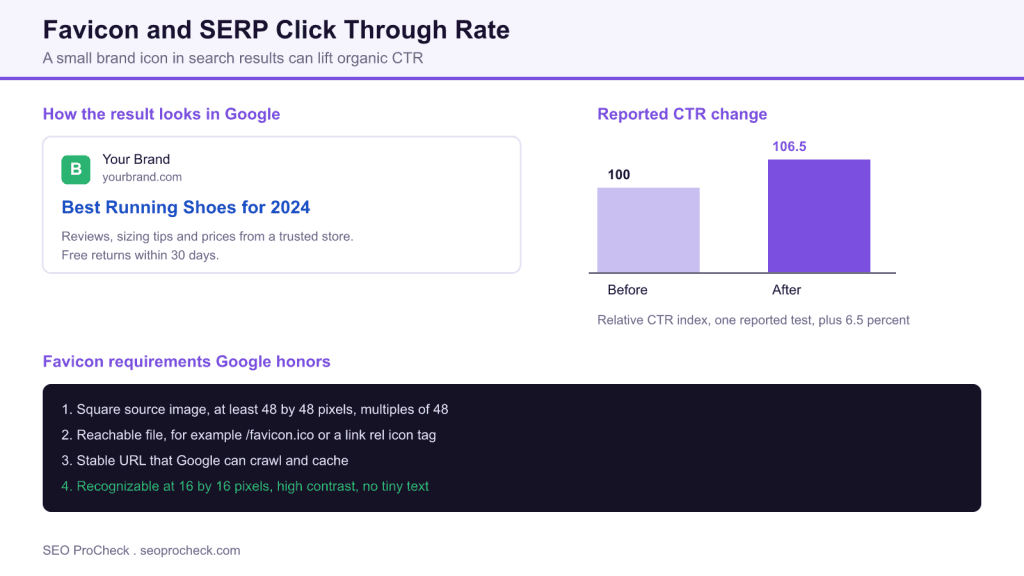
A favicon is the small square icon Google shows next to your result on mobile and increasingly on desktop. In one widely shared test, adding a clean, high contrast favicon was associated with roughly a 6.5 percent lift in organic click through rate, because the icon adds brand recognition and visual weight to the listing.
- Google displays a favicon beside the site name in mobile search results and in many desktop layouts.
- The reported 6.5 percent CTR gain is a single practitioner test, not a Google ranking factor, so treat it as directional.
- Google needs a square (1:1) icon of at least 8 by 8 pixels, and recommends larger than 48 by 48 pixels, reachable at a stable, crawlable URL.
- A favicon does not change rankings directly, but a higher CTR on the same position can compound traffic over time.

This page expands on a practitioner report that a favicon change was associated with a 6.5 percent increase in click through rate from Google. Below we explain what a favicon is, why Google shows it, what the reported result really means, and exactly how to implement one that Google will display.
What a favicon is and why it appears in search
A favicon (favorite icon) is the small brand image a browser shows in the tab, the bookmark bar, and now in search results. Since 2019 Google has shown favicons on mobile organic results, and it has steadily widened where the icon appears, including many desktop layouts and the site name row. The icon sits directly beside your domain, so it is one of the few visual signals you control in an otherwise text heavy result.
Because searchers scan a results page quickly, a recognizable icon gives your listing extra visual weight. That is the mechanism behind the reported CTR lift: the result is easier to spot and looks more trustworthy, so a slightly larger share of people who see it choose to click.
What the 6.5 percent result actually tells you
The headline number comes from a single before and after observation, not a controlled split test across many sites. That does not make it worthless, but it does mean you should read it as directional. Click through rate on a query is influenced by ranking position, the title, the meta description, rich results, seasonality, and brand demand. A favicon is one small lever among those. Treat 6.5 percent as evidence that the lever exists, not as a guaranteed return for your own site.
To measure your own effect, isolate it. Note the date you ship the favicon, then compare average CTR for a stable set of queries in Search Console for the 28 days before and the 28 days after, holding position roughly constant. If position moved, the CTR change is confounded and you cannot attribute it to the icon.
Google favicon requirements at a glance
| Requirement | Detail | Why it matters |
|---|---|---|
| Shape | Square, 1:1 aspect ratio | Google resizes down, so supply a larger square |
| Minimum size | At least 8 by 8 pixels, larger than 48 by 48 recommended | Smaller icons may be ignored |
| Location | link rel="icon" in the head, or /favicon.ico | Google must find it during a normal crawl |
| Stability | Keep the URL constant | A changing URL delays recrawl and display |
| Legibility | Clear at 16 by 16 pixels, high contrast | Tiny text or thin lines vanish when shrunk |
How to implement a favicon Google will show
Add a link element in the head of every page, pointing at a square icon:
<link rel="icon" href="https://example.com/favicon.png" sizes="48x48" type="image/png">
Ship a single source image that is at least 48 by 48 pixels and looks clean at 16 by 16 pixels. Keep the file path stable, confirm it returns HTTP 200, and make sure robots rules do not block it. After deployment, use the URL Inspection tool in Search Console to request a recrawl of the home page so Google refreshes the icon sooner. Display can take days to weeks, so do not judge the result the same afternoon.
The favicon is a companion to your other SERP levers. If you are also tuning how your listing reads, see our notes on whether title tags impact rankings, a practical title tag testing case study, and evidence on adding ratings to meta descriptions.
What has changed since the original report
Since the favicon first appeared in mobile results, Google has expanded icon display to the site name treatment and to more desktop result types, which raises the practical value of a clean icon. Google also refreshed its favicon documentation, which now asks for a square icon of at least 8 by 8 pixels and recommends larger than 48 by 48 pixels. None of this makes the favicon a ranking factor. It remains a presentation detail that can influence how many people click a result you already rank for.
Frequently Asked Questions
Does a favicon improve Google rankings?
No. A favicon is a presentation element, not a ranking signal. It can raise click through rate on results you already rank for, and higher engagement on the same position can indirectly bring more traffic, but it does not move you up the results page by itself.
What favicon size does Google require?
Google needs a square icon that is at least 8 by 8 pixels, and it recommends larger than 48 by 48 pixels. Supply a larger square such as 96 or 144 pixels so it stays sharp, and confirm it still reads clearly when shrunk to 16 by 16 pixels.
Why is my favicon not showing in search results?
The most common causes are an icon smaller than 8 by 8 pixels, a blocked or non square file, a favicon URL that Google has not recrawled yet, or robots rules that block the file. Confirm the file returns HTTP 200, then request a recrawl of the home page in Search Console.
How long does it take for a favicon to appear?
Display depends on when Google next crawls and processes your home page, which can range from a few days to a few weeks. Requesting indexing of the home page usually shortens the wait.
How can I measure the CTR effect of a favicon?
Record the deployment date, then compare average CTR for a fixed set of queries in Search Console across equal windows before and after, while checking that average position stayed roughly the same. If position shifted, the CTR change is confounded.
Can any image be used as a favicon?
It should be a simple, high contrast mark that stays legible at 16 by 16 pixels. Detailed logos, thin strokes, or small text turn into an unreadable blob when scaled down, which defeats the purpose of the icon.
Take this with you
The assistant links open with a question about this page already written. Nothing is sent until you press enter.
Claude Vincent is a technical SEO consultant focused on crawlability, rendering, and AI-search visibility. He writes the field guides and case studies at SEO ProCheck, with a bias toward the durable, unglamorous work that decides whether search engines and AI answer engines can actually read and cite a site.
About SEO ProCheck
Technical SEO consulting and GEO strategy with 20 years of enterprise experience. Case studies, resources, and tools for search and AI visibility.
Work With Me
Technical SEO audits, GEO strategy, site migrations, and international SEO. Hourly consulting for teams who need hands-on support, not just reports.
Subscribe to our newsletter!








Recent Posts
- Most Top Sites Never Say Who They Are in Structured Data October 14, 2026
- Homepage Titles Are Mostly Too Short, Not Too Long October 8, 2026
- Who Actually Serves an llms.txt? 184 Top Sites Measured September 29, 2026