

AI Summary
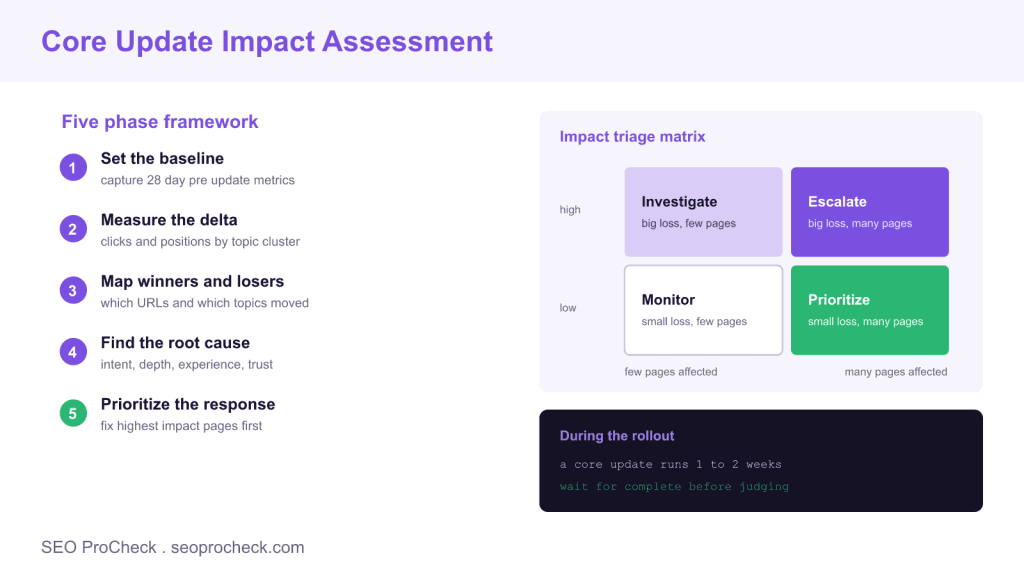
A core update impact assessment framework baselines your metrics before the update, quantifies the change once the rollout completes, maps which pages and topics moved, and triages the response by loss severity and breadth. It replaces panic with a repeatable process you can run at every core update.
- Capture a 28 day baseline before the update and wait for the rollout to complete before judging.
- Measure the delta in clicks and positions by topic cluster, not just sitewide.
- Triage pages on a severity by breadth matrix: monitor, investigate, prioritize, or escalate.
- Core updates are quality reassessments, not penalties, so recovery comes from genuine improvement.
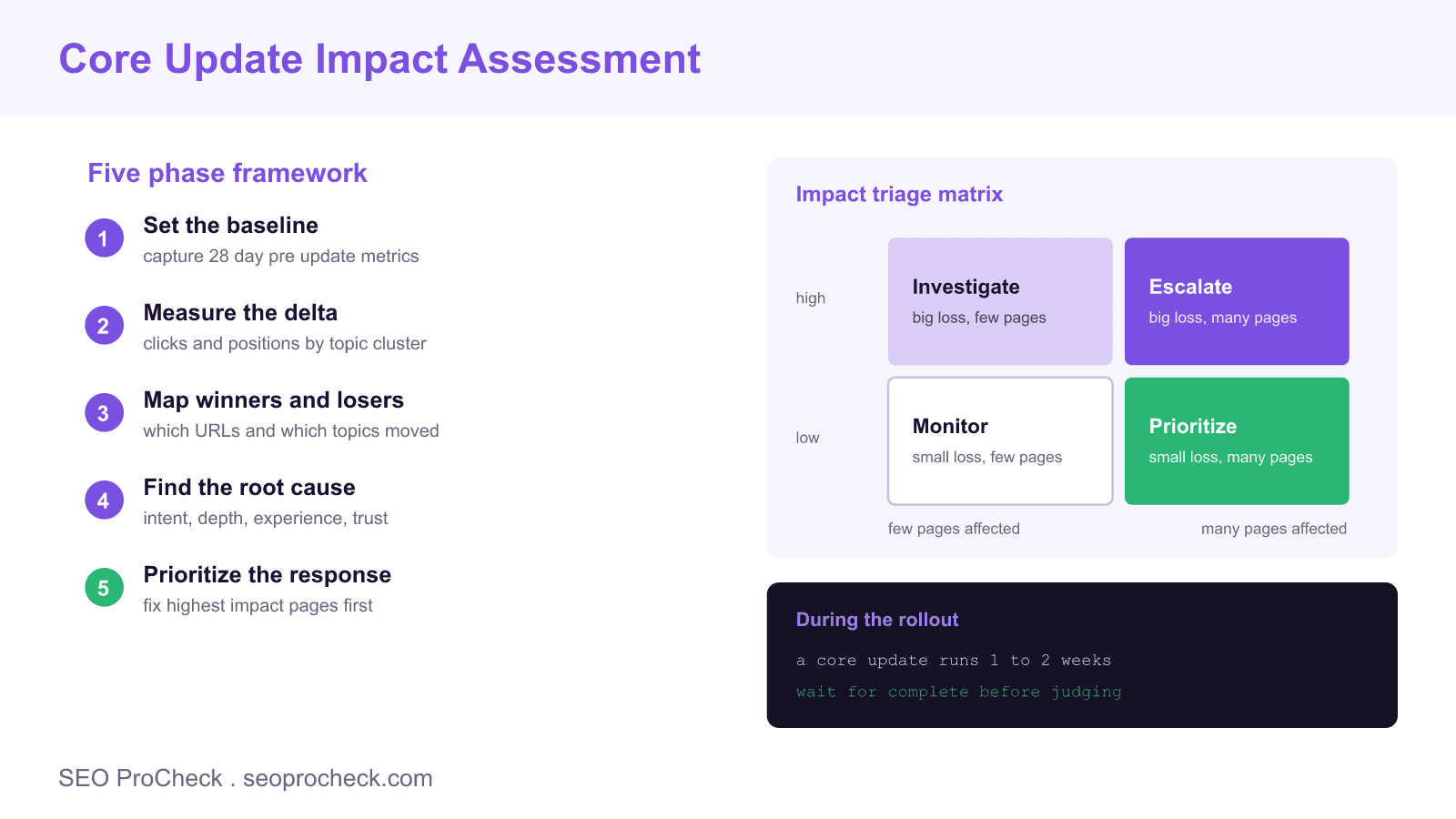
Google core updates are broad reassessments of relevance and quality, not targeted penalties. When one lands, the wrong move is to react to a single sitewide number and start changing things at random. The right move is a repeatable assessment: baseline your metrics before the update, quantify the change once the rollout completes, map exactly which pages and topics moved, diagnose why, and triage the response by impact. This framework gives you that process so you can act on evidence instead of anxiety.
Phase 1: set the baseline
You cannot measure impact without a before picture, so capture one the moment a core update is announced. Export the trailing 28 days of Search Console data at the query and page level, record GA4 organic sessions and conversions, and snapshot rankings for your priority terms. Save these as a dated file so the comparison later is exact. If you assess core updates regularly, keep a rolling baseline export so you are never caught without a reference window.
Phase 2: measure the delta
Once Google confirms the rollout is complete, compare the same window after the update to your baseline. Work at the topic cluster level, not just sitewide, because a flat total can hide one cluster collapsing while another rises. In Search Console, compare the periods, add the Page dimension, and sort by click difference to surface the biggest movers in both directions. Record the delta for each cluster:
cluster            clicks_before   clicks_after   delta
buyer guides           4200           2600        -38%
comparison pages       1800           1750         -3%
glossary terms         2100           2450        +17%
These illustrative rows show the pattern to look for: concentrated loss in one cluster, stability in another, and even gains elsewhere. That distribution is the story a sitewide percentage would erase. For a worked example of reading a specific rollout, see our breakdown of the most recent Google core update.
Phase 3: map winners and losers
Now zoom to the URL level within each affected cluster. List the pages that lost the most clicks and positions, and the ones that gained. Look at what the winners have in common, both your own winning pages and the competitor pages that replaced you in the results. This comparison is where the diagnosis begins: it tells you what Google now rewards for that intent, whether that is deeper coverage, firsthand experience, clearer structure, or stronger trust signals.
Phase 4: find the root cause
Core updates reassess quality, so root cause work centers on helpfulness and trust rather than technical toggles. For each losing page, ask whether it satisfies the intent completely, whether it demonstrates real experience and expertise, whether the information is accurate and current, and whether the page earns trust through authorship, sourcing, and a good experience. Weak signals such as pogo sticking can corroborate a quality problem, which we cover in the click pattern that decides rankings. Historical algorithm context helps too, since patterns from earlier systems like Panda still echo in how quality is judged today.
Phase 5: triage and prioritize the response
Not every drop deserves the same effort. Plot affected pages on a matrix of loss severity against breadth, then act by quadrant. This keeps limited time on the work that recovers the most value.
| Quadrant | Pattern | Response |
|---|---|---|
| Escalate | Large loss across many pages | Rework the cluster now, senior review |
| Investigate | Large loss on a few key pages | Deep audit each page, then rebuild |
| Prioritize | Small loss across many pages | Batch improvements for aggregate value |
| Monitor | Small loss on a few pages | Watch, act only if the trend holds |
Make substantive changes, document what and when, then measure against your baseline at the next core update, because that is typically when reassessment is recognized. If part of the loss turns out to be measurement rather than ranking, our guide to diagnosing traffic drops after updates walks the confirmation checks. Run this framework the same way every time and each core update becomes a measured exercise rather than a fire drill.
Frequently asked questions
What is a core update impact assessment?
It is a structured way to measure how a Google core update changed your search performance, isolate which pages and topics moved, and decide where to act. Rather than reacting to a single number, you baseline before the update, quantify the delta, and triage pages by how much they lost and how many were affected.
When should I start assessing a core update?
Wait until Google confirms the rollout is complete before drawing conclusions, since rankings swing for one to two weeks during a core update. You can capture your baseline and watch daily movement during the rollout, but hold major judgments and content changes until the update finishes.
How do I know a core update caused my change?
Look for three signals together: the change begins on a confirmed core update date, it spans many pages within a topic rather than one template, and competitors move at the same time. If the change instead aligns with a deploy date or hits one template, the cause is more likely technical.
What should I fix first after a negative core update?
Triage by impact. Use a matrix of loss severity against breadth of pages affected. Pages with a large loss across many URLs get escalated first, small losses on many pages get prioritized for aggregate value, isolated big losses get investigated, and minor isolated dips are simply monitored.
Do core updates come with penalties I can remove?
No. Core updates are broad relevance and quality reassessments, not manual actions, so there is nothing to submit for reconsideration. Recovery comes from genuinely improving content helpfulness, depth, and trust over time, and results usually appear at the next core update rather than immediately.
How long does core update recovery take?
Recovery is rarely instant. Because Google reassesses quality broadly, improvements are often recognized at a later core update, which can be weeks or months away. Make substantive changes, document them, keep publishing quality work, and measure against your baseline at each subsequent update.
Take this with you
The assistant links open with a question about this page already written. Nothing is sent until you press enter.
Claude Vincent is a technical SEO consultant focused on crawlability, rendering, and AI-search visibility. He writes the field guides and case studies at SEO ProCheck, with a bias toward the durable, unglamorous work that decides whether search engines and AI answer engines can actually read and cite a site.
About SEO ProCheck
Technical SEO consulting and GEO strategy with 20 years of enterprise experience. Case studies, resources, and tools for search and AI visibility.
Work With Me
Technical SEO audits, GEO strategy, site migrations, and international SEO. Hourly consulting for teams who need hands-on support, not just reports.
Subscribe to our newsletter!








Recent Posts
- Most Top Sites Never Say Who They Are in Structured Data October 14, 2026
- Homepage Titles Are Mostly Too Short, Not Too Long October 8, 2026
- Who Actually Serves an llms.txt? 184 Top Sites Measured September 29, 2026