

AI Summary
SEO for a product launch is won before launch day. Reserve the final URL early, research real demand, publish a teaser so the page builds authority and gets indexed, then use launch day to trigger fast discovery and post launch to gather reviews and protect the URL.
- Create the final URL weeks ahead and link to it from strong pages.
- Add Product schema with an Offers block for price and availability.
- On launch day, submit through the sitemap, IndexNow, and Search Console.
- After launch, collect reviews and keep out of stock URLs live at 200.

Why launches are won before launch day
The instinct on a product launch is to flip the page live at the announcement and hope it ranks. That is the slowest possible path, because a brand new URL has no history, no internal links, and no authority. Search engines have to discover it, crawl it, and decide it is worth ranking, all while competitors who planned ahead are already visible. The teams that rank a product on day one did the SEO work in the weeks before, so the page is already indexed and connected when demand spikes.
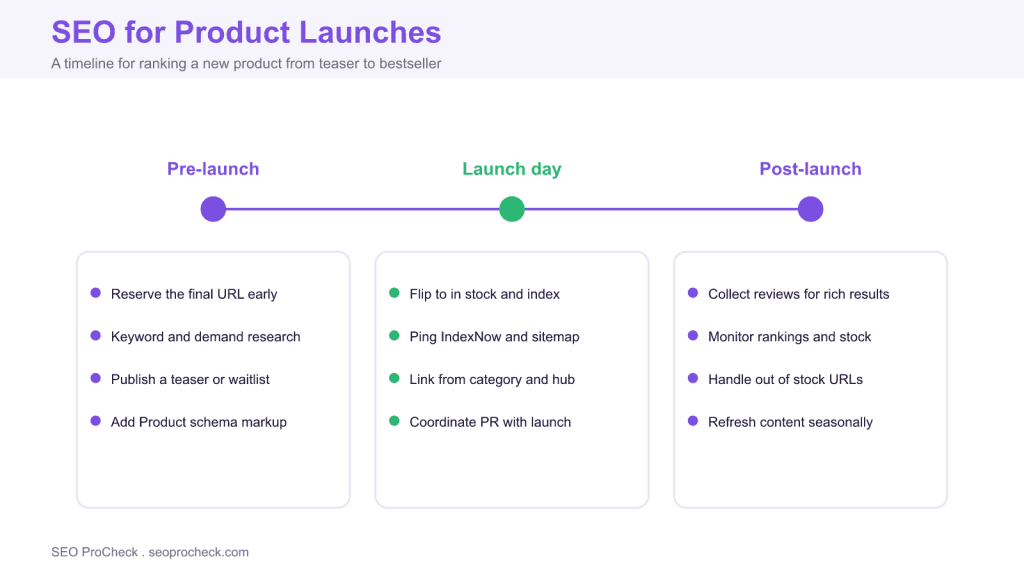
Treat the launch as three phases: pre-launch to build the foundation, launch day to trigger fast discovery, and post launch to compound the gains. Each phase has a short, concrete task list, and skipping the first one is what quietly costs the most.
Pre-launch: reserve, research, and warm up the URL
Decide the final URL early and publish something at it, even a teaser or waitlist page, so the address gets discovered and indexed ahead of time. Do genuine demand research: what are people actually searching for around this product, which terms have volume, and how are competitors framing their pages? Build the page to answer that intent, and add Product schema from the start with name, image, description, brand, and an Offers block. During the warm up period, link to the new URL from strong category and hub pages so it inherits authority and crawlers reach it through your existing structure. If the product replaces an older one, plan the 301 redirect from the retired URL so its equity flows to the new page.
Launch day: trigger fast discovery
On launch day the page should already exist and simply switch to a purchasable, in stock state. Confirm it returns a clean 200 with no stray noindex, then make sure it is in your XML sitemap and submit it through Search Console and IndexNow so participating engines fetch it quickly. The single biggest accelerator is not a ping but a prominent internal link: a slot on the homepage or the top of the relevant category passes real authority and gets the page crawled within hours. Coordinate any PR or launch coverage so external links land while interest is high.
Managing availability states
Launches sell out, restock, and eventually retire, and each state has a correct SEO handling. The wrong move, deleting a URL the moment it goes out of stock, throws away rankings and links you spent months earning.
| Product state | HTTP status | Recommended action | Schema availability |
|---|---|---|---|
| Available | 200 | Standard product page | InStock |
| Temporarily out of stock | 200 | Keep live, show restock date and alternatives | OutOfStock or BackOrder |
| Discontinued, replacement exists | 301 | Redirect to the replacement product | Not applicable |
| Discontinued, no replacement | 200 with alternatives, or 410 | Keep with related items, or retire cleanly | Discontinued |
Post-launch: compound the momentum
Once the product is live, the job shifts to compounding. Start collecting genuine reviews immediately, because AggregateRating and Review markup can unlock rating stars in the results and lift click through before you reach the top spot. Monitor rankings, stock status, and the health of the URL, and watch that seasonal or high demand launches do not slip into faceted navigation traps that spawn thin, duplicate variant URLs. Refresh the copy as the product matures, adding real usage details, comparisons, and answers to the questions buyers keep asking.
A repeatable launch checklist
Turn this into a template you run every time. Pre-launch: reserve the URL, research demand, publish a teaser, add Product schema, link from strong pages. Launch day: confirm 200 and no noindex, update the sitemap, submit through IndexNow and Search Console, place a prominent internal link, time the PR. Post launch: gather reviews, monitor rankings and stock, handle availability states correctly, and refresh content on a schedule. A launch that follows this sequence ranks in days rather than months, because the foundation was already in place when the product went live.
Frequently asked questions
When should I create the product URL for a launch?
Reserve the final URL weeks before launch, not on the day. Publishing early, even as a teaser or waitlist page, lets the URL get discovered, indexed, and start earning internal links and authority, so it ranks faster once the product goes live.
Should I launch a product on a brand new URL?
A fresh URL starts with no authority, so it struggles at first. Publish it early to build history, and link to it from strong category and hub pages. If you are replacing an older product, redirect the retired URL with a 301 so the new page inherits its equity.
What structured data does a product page need?
Use Product schema with name, image, description, brand, and an Offers block carrying price, currency, and availability. Add AggregateRating and Review once you have genuine reviews. Valid Product markup makes the page eligible for price, rating, and stock rich results.
How do I get a new product indexed quickly?
On launch day, make sure the page is in the XML sitemap and returns a clean 200 with no noindex, then submit it through IndexNow and Search Console. Strong internal links from the homepage or category page speed up discovery more than any single ping.
How should I handle an out of stock product after launch?
Keep the URL live at 200 rather than deleting it, show a restock date or alternatives, and set the schema availability to OutOfStock or BackOrder. Only 301 redirect when a product is permanently gone and has a clear replacement.
How do reviews help product launch SEO?
Genuine reviews add fresh, unique content, build trust, and unlock rating stars in the results through AggregateRating markup. Start collecting them immediately after launch, because the rating snippet can lift click through well before the page ranks at the top.
Take this with you
The assistant links open with a question about this page already written. Nothing is sent until you press enter.
Claude Vincent is a technical SEO consultant focused on crawlability, rendering, and AI-search visibility. He writes the field guides and case studies at SEO ProCheck, with a bias toward the durable, unglamorous work that decides whether search engines and AI answer engines can actually read and cite a site.
About SEO ProCheck
Technical SEO consulting and GEO strategy with 20 years of enterprise experience. Case studies, resources, and tools for search and AI visibility.
Work With Me
Technical SEO audits, GEO strategy, site migrations, and international SEO. Hourly consulting for teams who need hands-on support, not just reports.
Subscribe to our newsletter!








Recent Posts
- Most Top Sites Never Say Who They Are in Structured Data October 14, 2026
- Homepage Titles Are Mostly Too Short, Not Too Long October 8, 2026
- Who Actually Serves an llms.txt? 184 Top Sites Measured September 29, 2026