

Comment détenir les vrais secrets du référencement ? - Webmaster Hub
- March 28, 2020
- General
AI Summary
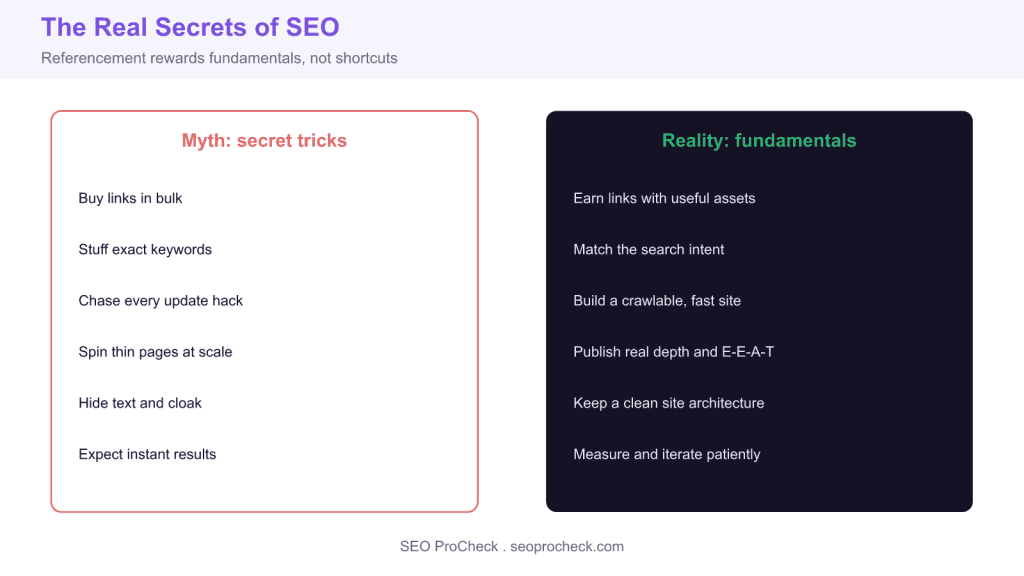
The real secret of referencement is that there is no secret: durable rankings come from crawlability, intent matched content, clean architecture, earned authority, and technical health. Shortcut tactics such as bulk link buying and keyword stuffing deliver short term gains and long term penalties.
- Every so called secret is either a known best practice or a doomed manipulation.
- Five fundamentals move rankings: crawlability, intent, architecture, authority, technical health.
- SEO fundamentals are identical for French and English sites, only the content differs.
- AI search rewards the same fundamentals, so the discipline has not changed.
The linked Webmaster Hub thread poses a question that never stops being asked in French SEO circles: how do you uncover the real secrets of referencement, the French word for search engine optimization? It is a fair question, and the honest practitioner answer is uncomfortable. There are no secrets. The techniques that move rankings durably are published, well understood, and unglamorous. What separates sites that rank from sites that do not is disciplined execution of fundamentals, not access to a hidden method.
Why the search for secrets usually backfires
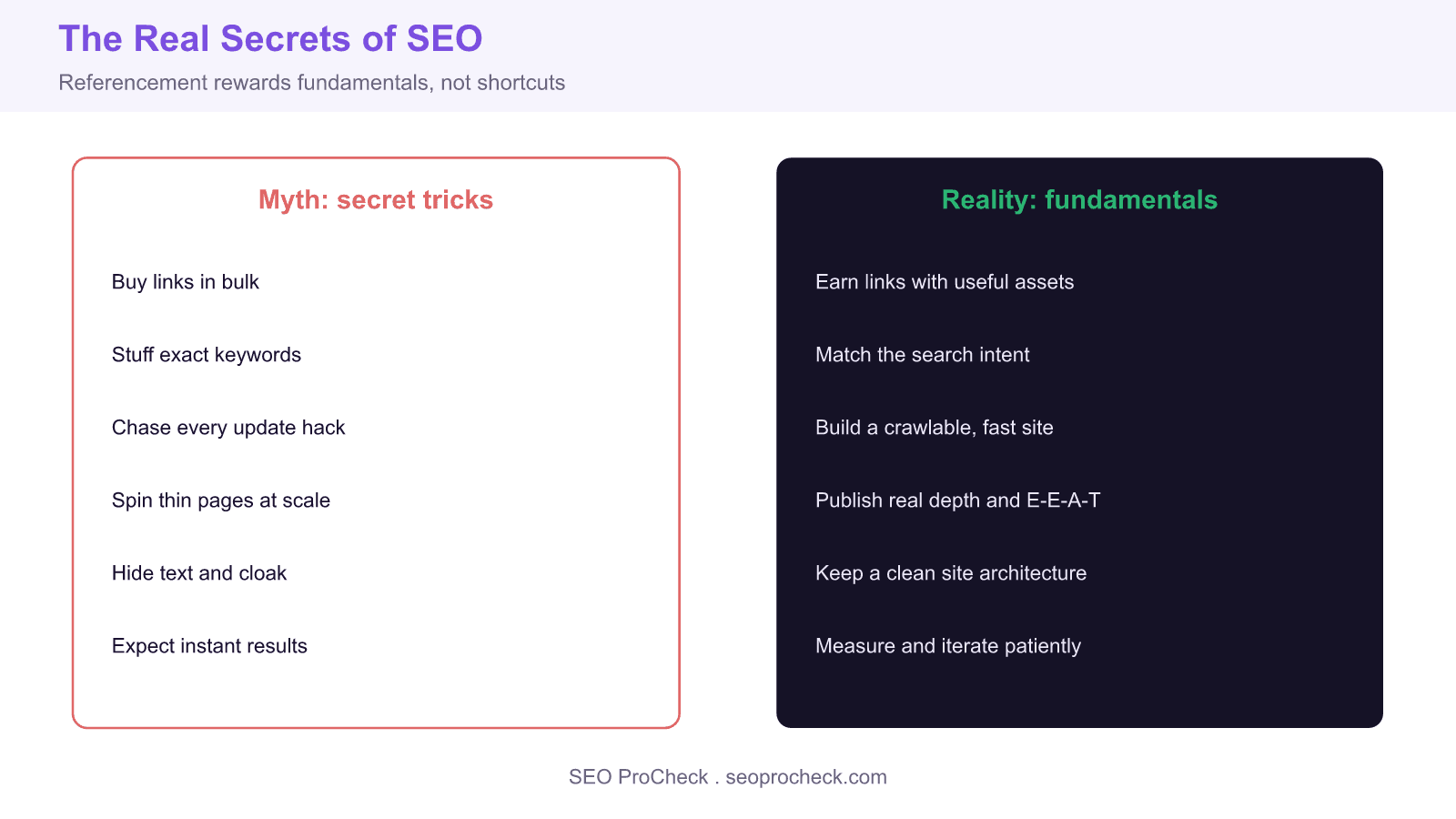
Every so called secret technique falls into one of two buckets. Either it is a genuine best practice that is simply not widely applied, or it is a manipulation that works until the next algorithm update neutralises it. Historically, bulk link buying, keyword stuffing, cloaking, and doorway pages all delivered short term gains and then long term penalties. Chasing the next loophole keeps you permanently exposed to updates. Building on fundamentals keeps you resilient, because the fundamentals are exactly what Google is trying to reward.
The fundamentals that actually move rankings
Five durable levers do most of the work. A crawlable and indexable site so search engines can reach every page you care about. Content that matches search intent, answering the query the searcher actually has rather than the keyword in isolation. A clear site architecture with descriptive internal links that spread authority and help discovery. Earned authority from credible sources rather than purchased links. And technical health, meaning fast, secure, mobile ready pages with valid structured data. Master those five and you are ahead of most competitors, in any language.
A short French to English SEO glossary
Because the source thread is in French, it helps to line up the vocabulary. French SEO discussion uses its own established terms, and mapping them to their English equivalents removes a lot of confusion when you read across both communities. The table below covers the words that come up most often in threads like this one.
A durable playbook you can run in any market
Turn the fundamentals into a routine. Start with a technical audit using a crawler and Search Console, and clear anything that blocks crawling or indexing. Map your priority keywords to intent, and make sure each cluster has a dedicated page. Strengthen internal linking so your most important pages are the easiest to reach. Publish genuinely useful content that shows first hand experience, then earn links to it through outreach and quality rather than purchase. Finally, measure in Search Console and GA4, and iterate. This playbook works identically for a French site and an English one, because search engines evaluate the same signals in every language.
What has changed since this thread
Forum threads asking about SEO secrets have run for two decades, and the fundamentals in them have aged well. What is new is the rise of AI powered results, Google AI Overviews and assistants such as ChatGPT and Perplexity, which increasingly summarise answers directly. This has created a new practice, sometimes called generative engine optimization, focused on being cited by those systems. Reassuringly, the requirements overlap almost completely with classic SEO: crawlable pages, clear structure, factual depth, and a trustworthy source reputation. The secret, still, is that there is no secret.
French SEO terms and their English equivalents
| French term | English equivalent | What it means |
|---|---|---|
| Referencement naturel | Organic SEO | Earning unpaid search visibility |
| Referencement payant | Paid search, SEA | Ads such as Google Ads |
| Maillage interne | Internal linking | Links between your own pages |
| Netlinking | Link building | Earning links from other sites |
| Balise title | Title tag | The clickable headline in results |
| Mot cle | Keyword | A query you want to rank for |
| Contenu duplique | Duplicate content | Repeated text across URLs |
Related reading
- The complete guide to internal linking, or maillage interne
- How SEO, AEO, and GEO fit together
- Getting your title tag, the balise title, right
Frequently asked questions
Are there real secrets to SEO?
No. The techniques that move rankings durably are well documented and widely taught. What varies is execution, most sites simply do not apply the fundamentals consistently. Anyone promising a hidden method is usually selling a manipulation that the next update will neutralise.
What does referencement mean?
Referencement is the French term for search engine optimization. Referencement naturel means organic SEO, the unpaid results, while referencement payant means paid search such as Google Ads. The underlying practices are the same as English language SEO.
Do SEO fundamentals differ between French and English sites?
No. Search engines evaluate the same signals, crawlability, matched intent, architecture, authority, and technical health, regardless of language. Only the keyword research and content are language specific, so a French site follows the same playbook as an English one.
Why do shortcut SEO tactics stop working?
Manipulative tactics exploit gaps that Google actively works to close. Bulk link buying, keyword stuffing, and cloaking all delivered short term gains before triggering penalties. Because updates target exactly these patterns, building on fundamentals is the only strategy that compounds instead of collapsing.
What is netlinking?
Netlinking is the French term for link building, the practice of earning links from other websites. Quality netlinking focuses on relevant, credible sources that link because your content is genuinely useful, rather than links bought in bulk, which carry real risk.
Does AI search change the SEO fundamentals?
Not the fundamentals themselves. AI Overviews and assistants pull from pages they can crawl, parse, and trust, so crawlable structure, factual depth, and a strong source reputation still decide whether you are cited. The channels expanded, but the underlying discipline is unchanged.
Take this with you
The assistant links open with a question about this page already written. Nothing is sent until you press enter.
Claude Vincent is a technical SEO consultant focused on crawlability, rendering, and AI-search visibility. He writes the field guides and case studies at SEO ProCheck, with a bias toward the durable, unglamorous work that decides whether search engines and AI answer engines can actually read and cite a site.
About SEO ProCheck
Technical SEO consulting and GEO strategy with 20 years of enterprise experience. Case studies, resources, and tools for search and AI visibility.
Work With Me
Technical SEO audits, GEO strategy, site migrations, and international SEO. Hourly consulting for teams who need hands-on support, not just reports.
Subscribe to our newsletter!
Recent Posts
- Most Top Sites Never Say Who They Are in Structured Data October 14, 2026
- Homepage Titles Are Mostly Too Short, Not Too Long October 8, 2026
- Who Actually Serves an llms.txt? 184 Top Sites Measured September 29, 2026