

AI Summary
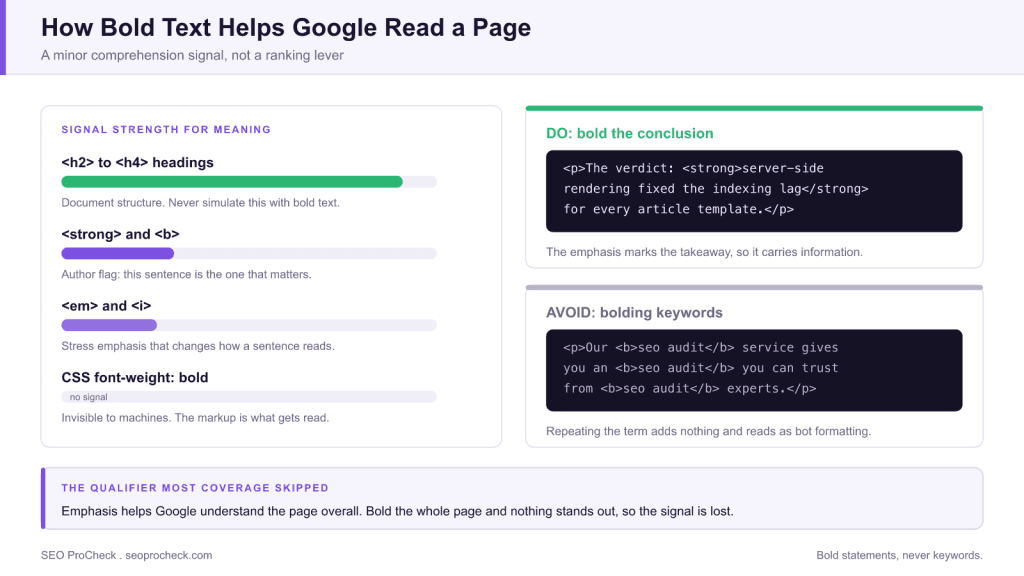
Bolding genuinely important words or phrases can help your SEO, but only as a minor semantic signal. Google's John Mueller confirmed in a November 2021 Search Central office-hours session that bolding key points helps Google understand what a paragraph, and the page, is about.
- It is a comprehension aid, not a ranking lever you can stack.
- Bold conclusions and key figures, never keyword repetitions.
- Bold the whole page and nothing stands out, so the signal disappears entirely.
<strong>and<b>are treated similarly by Google, but CSSfont-weightalone carries no signal at all.
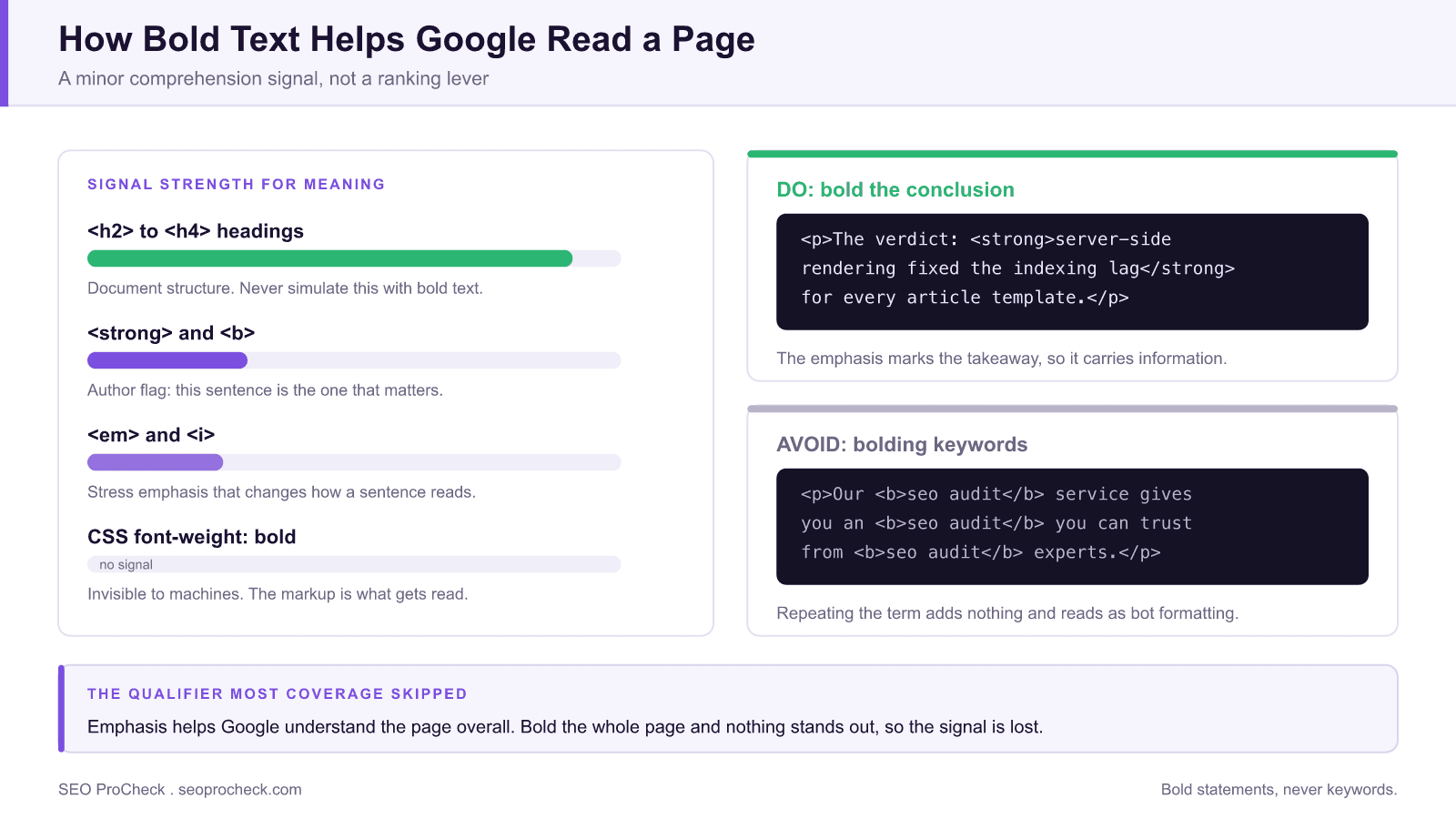
Quick answer: Yes, bolding genuinely important words or phrases can help your SEO, but only as a minor semantic signal. Google's John Mueller confirmed in a November 2021 Search Central office-hours session that bolding key points in a paragraph helps Google understand what that paragraph, and the page, is about. It is a comprehension aid, not a ranking lever: bolding everything, or bolding keywords mechanically, cancels the effect entirely.
What Google Actually Said
The statement came from John Mueller during a Google Search Central SEO office-hours hangout in November 2021, covered by Search Engine Journal (linked below). Paraphrasing the substance: text emphasized with bold carries slightly more weight when Google evaluates what a page is about, because emphasis is a signal from the author about which parts matter. Mueller also made two qualifiers that most coverage skipped past: the benefit applies to Google's understanding of the page overall, not to boosting a specific keyword's ranking, and if you bold an entire page (or most of it), nothing stands out and the signal is lost.
How to Actually Apply This
Treat bold as an editorial tool that happens to have a small machine-readability side effect. A practical workflow:
- Bold conclusions, not keywords. In each major section, emphasize the one sentence or phrase a skimming reader must not miss: the recommendation, the number, the verdict. If what you bolded reads like a keyword list, undo it.
- Keep density low. A useful ceiling is one bolded phrase per two or three paragraphs. Emphasis is relative; the more you use it, the less any instance means.
- Use
<strong>for importance. In HTML semantics,<strong>means "this content is important," while<b>is purely stylistic attention-drawing with no added importance. Google has said it treats them roughly equivalently for ranking purposes, but<strong>is the correct element for the "this matters" signal, and screen readers can convey it. - Pair emphasis with structure. Bold works alongside, never instead of, headings, lists, and short paragraphs. Do not use a bolded paragraph as a fake heading; that is a job for
<h2>to<h4>, which carry far stronger structural signals. Our on-page SEO elements guide covers that hierarchy.
Emphasis Elements Compared
| Element | Semantic meaning | Practical SEO effect |
|---|---|---|
<strong> | Strong importance | Minor comprehension signal per Mueller; correct choice for key points |
<b> | Stylistic offset, no importance implied | Treated similarly to <strong> by Google; weaker semantic case |
<em> | Stress emphasis (changes sentence meaning) | Same family of minor emphasis signals; use for spoken-stress emphasis |
<i> | Alternate voice: titles, foreign terms | No importance signal; fine for its intended uses |
<h2> to <h4> | Document structure | Much stronger signal than bold; never simulate with bold text |
CSS font-weight: bold | None (visual only) | No semantic signal at all: the markup is what machines read |
The Common Misread
Within days of the 2021 statement, "bold your keywords" advice resurfaced, a revival of a 2000s-era tactic where pages bolded every occurrence of a target term. That is precisely the pattern Mueller's qualifier rules out. Bolding a keyword five times adds no importance information (it just restates the term), makes the page look formatted for bots, and degrades readability, which shows up in engagement. If a page could rank by self-declaring its important words, the signal would be worthless; it works only because most authors use emphasis honestly. Stay in that group.
A Quick Self-Audit for Any Page
You can check a page in about two minutes without a tool. Run these four passes in order, and fix what fails before moving on:
| Check | How to run it | Fail condition | Fix |
|---|---|---|---|
| Squint test | Zoom the page out until words blur, then look at what still stands out | Bold blobs scattered evenly through every paragraph | Cut emphasis back to one phrase per two or three paragraphs |
| Read-the-bold test | Read only the bolded fragments, in order, top to bottom | It reads as a keyword list rather than a summary of the page | Re-bold complete claims: the verdict, the number, the recommendation |
| Markup test | Inspect element on a bold phrase in DevTools | It is a span with a CSS font-weight and no strong or b | Use real markup so the emphasis is machine-readable |
| Fake heading test | Look for bolded lines that sit alone above a block of text | A bolded paragraph is doing a heading's job | Promote it to a real <h2> or <h3> in the outline |
The fake heading test catches the most damaging pattern of the four. A bolded pseudo-heading looks identical to a reader but is invisible to the document outline, so it contributes nothing to how a crawler, a screen reader, or an answer engine segments the page. Converting those lines into real headings usually improves a page more than any amount of bolding ever will.
What's Changed Since 2021
The statement still holds in 2026, but the payoff has quietly shifted from ranking to extraction. Featured snippets, Google's AI Overviews, and LLM-based answer engines all lift concise, clearly-flagged statements out of pages, and a well-bolded key sentence inside a scannable section is exactly the shape of content these systems quote. That makes disciplined emphasis a small but real asset for answer-engine visibility, not just classic rankings; see our guide to featured snippet optimization for the fuller pattern (question-shaped heading, direct answer, supporting detail). The other change is proportion: with entity understanding and passage ranking, Google needs author emphasis less than it did, so think of bold as the last 1% of on-page work, worth doing correctly and never worth engineering.
FAQ
Not directly. Google has said emphasis helps it understand what a page is about, which can help the page rank for the right things, but it is a comprehension signal, not a ranking boost you can stack.
Google treats them about the same for search. The strong element is semantically correct for important content and better for accessibility, so use it when importance is what you mean.
No. Bold complete statements a reader needs: conclusions, recommendations, key figures. Mechanical keyword bolding adds no information and pattern-matches to outdated over-optimization.
If more than roughly one phrase per two or three paragraphs is bolded, emphasis stops discriminating. Mueller specifically noted that bolding a whole page eliminates the benefit.
Indirectly, yes. Extraction systems favor concise, clearly-marked answer statements, and a bolded direct answer near a matching heading is a common trait of quoted passages.
No. Styling text bold purely with CSS conveys nothing in the markup. Use a strong element (or a b element) if you want the emphasis to be machine-readable.
This resource contributes to the knowledge base SEO practitioners need for effective optimization in an evolving search landscape.
Source: https://www.searchenginejournal.com/google-bolded-text-can-help-your-seo/427044/
Take this with you
The assistant links open with a question about this page already written. Nothing is sent until you press enter.
Claude Vincent is a technical SEO consultant focused on crawlability, rendering, and AI-search visibility. He writes the field guides and case studies at SEO ProCheck, with a bias toward the durable, unglamorous work that decides whether search engines and AI answer engines can actually read and cite a site.
About SEO ProCheck
Technical SEO consulting and GEO strategy with 20 years of enterprise experience. Case studies, resources, and tools for search and AI visibility.
Work With Me
Technical SEO audits, GEO strategy, site migrations, and international SEO. Hourly consulting for teams who need hands-on support, not just reports.
Subscribe to our newsletter!








Recent Posts
- Most Top Sites Never Say Who They Are in Structured Data October 14, 2026
- Homepage Titles Are Mostly Too Short, Not Too Long October 8, 2026
- Who Actually Serves an llms.txt? 184 Top Sites Measured September 29, 2026