


AI Summary
IndexNow is a push protocol that lets your site notify participating search engines the instant a URL is added, updated or removed, instead of waiting for the next crawl. In late 2021 Google said it would test IndexNow to weigh its efficiency benefits; the practical takeaway today is that Bing, Yandex, Seznam and Naver act on the ping while Google has not adopted it for Google Search.
- IndexNow replaces slow pull crawling with an instant push notification for changed URLs.
- A single ping is shared across every participating engine, so you submit once.
- A key file at your site root verifies ownership of the URLs you submit.
- Google evaluated it but is not a member, so keep a healthy sitemap for Google either way.
Google Will Be Testing IndexNow provides valuable insights for SEO practitioners. This resource examines approaches and considerations that can improve organic search performance.
IndexNow is a simple idea with a big implication for how quickly your content reaches search engines. Instead of waiting for a crawler to wander back to your site and notice a change, your site tells the search engine the moment something happens. Microsoft Bing and Yandex launched the open protocol in October 2021, and the news that prompted the original article below was Google announcing, in late 2021, that it would test IndexNow to measure whether a push model could make crawling more efficient and less wasteful. This piece explains what IndexNow does, what happened with Google's test, and how to use it sensibly today.
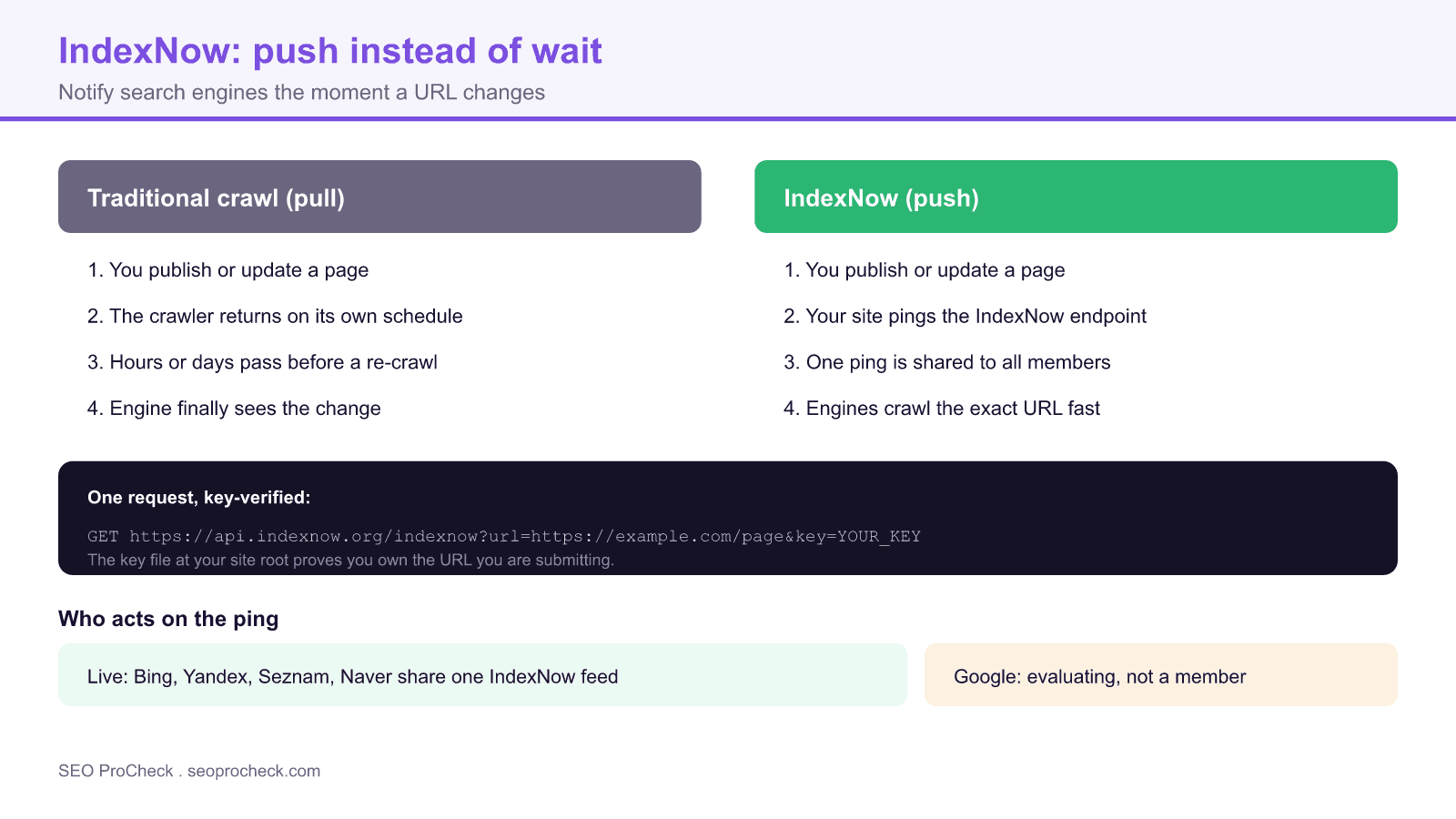
Pull crawling versus push notification
Traditional discovery is a pull model. A search engine decides when to revisit each URL based on how often it has changed before, how important it judges the page, and how much crawl budget it wants to spend on your site. For a small or infrequently updated site, that revisit can be hours or days after you publish. During that gap, your fresh or corrected page is invisible to search.
IndexNow inverts that. When you add, update or delete a URL, your site sends one lightweight request to the IndexNow endpoint naming the changed URL. The receiving engine then knows exactly which URL to look at and can crawl it promptly rather than rediscovering it by chance. Crucially, the protocol is shared: a single submission to one participating engine is distributed to all of them, so you notify Bing, Yandex, Seznam and Naver with one call rather than integrating with each separately.
How the submission and key verification work
The mechanics are deliberately minimal, which is much of the appeal. You generate a key, host it as a text file at your site root, and include that key when you submit a URL. The key file is how the engine confirms you actually control the site you are submitting for, which stops anyone from spamming submissions for domains they do not own.
# Single URL, simplest form
GET https://api.indexnow.org/indexnow?url=https://example.com/page&key=YOUR_KEY

# The key file lives here and contains only the key
https://example.com/YOUR_KEY.txt

# Many URLs at once, POST a JSON body
POST https://api.indexnow.org/indexnow
{"host":"example.com","key":"YOUR_KEY","urlList":["https://example.com/a","https://example.com/b"]}
You rarely write this by hand. Cloudflare can enable IndexNow for a zone with a toggle, and SEO plugins such as Rank Math submit URLs automatically when you publish or update a post in WordPress. That automation is the point: once wired up, freshness signals fire without anyone remembering to send them.
Which engines act on the ping
This is the part that has changed the least and matters the most for setting expectations. The table separates what IndexNow reliably does today from what it does not.
| Engine | Acts on IndexNow | What to rely on |
|---|---|---|
| Bing | Yes, a founding member | IndexNow plus Bing Webmaster Tools |
| Yandex | Yes, a founding member | IndexNow |
| Seznam, Naver | Yes, participating | IndexNow |
| Evaluated it, not a member | XML sitemap and normal crawling |
What has changed since Google announced the test
The headline that prompted the original article was that Google would test IndexNow. Reading it years later, the useful update is what came of that test. Google ran its evaluation focused partly on the sustainability angle, the idea that pushing changes wastes fewer crawl resources than repeatedly polling unchanged pages. As of this writing, Google has not adopted IndexNow as a discovery mechanism for Google Search. Google discovery still runs on its own crawling, your XML sitemap, and internal links, and the fastest manual nudge for Google remains the URL Inspection tool in Search Console rather than IndexNow.
That non adoption does not make IndexNow pointless. Bing has grown in relevance as the index behind a wave of AI answer engines, and getting your changes into Bing quickly has knock on value for those surfaces. The honest framing today is that IndexNow is close to free to enable, genuinely helps on the engines that support it, and costs you nothing on Google because you keep your sitemap and normal crawlability healthy regardless. For a deeper reference on the protocol itself, see the IndexNow glossary entry.
A practical stance for SEO teams
Treat IndexNow as a low effort addition, not a replacement for the fundamentals. Enable it through Cloudflare or your SEO plugin so submissions happen automatically on publish and update. Keep submitting only real, canonical, indexable URLs, because pinging thin, duplicate or noindexed pages just wastes the signal. Continue to maintain a clean XML sitemap and solid internal linking, since those are what Google relies on and what every engine falls back to. Used this way, IndexNow shortens the gap between publishing and being seen on the engines that honour it, while your Google strategy stays exactly where it should be.
Frequently asked questions
Google announced in late 2021 that it would test IndexNow, but as of this writing it has not adopted the protocol for Google Search. Google still discovers and refreshes pages through its own crawling, your XML sitemap and internal links. For a fast manual nudge on Google, use the URL Inspection tool in Search Console rather than IndexNow.
IndexNow is an open protocol that lets your website notify participating search engines the instant a URL is added, updated or removed. Your site sends a small request naming the changed URL along with a key that proves you own the site. One submission is shared across all participating engines, so you notify them with a single call instead of integrating separately.
Microsoft Bing and Yandex launched it and are founding members, and Seznam and Naver also participate. Because the network shares submissions, a single ping reaches all of them. Google evaluated the protocol but is not a member, so for Google you continue to rely on normal crawling and your sitemap.
For most sites, yes, because it is close to free to enable and speeds up the engines that do support it. Bing in particular now feeds several AI answer engines, so faster Bing indexing has extra value. You lose nothing on Google, since you keep your sitemap and crawlability healthy either way, and you gain quicker pickup elsewhere.
The simplest routes are enabling IndexNow in Cloudflare if your site sits behind it, or using an SEO plugin such as Rank Math that submits URLs automatically when you publish or update content. Both handle the key file and the submissions for you, so once configured the freshness signal fires without manual effort.
The key file is a small text file hosted at your site root that contains your IndexNow key. When you submit a URL you include the same key, and the engine checks that the file exists and matches. This confirms you actually control the domain, which prevents anyone from submitting URLs for sites they do not own.
Source: https://www.searchenginejournal.com/google-will-be-testing-indexnow/426602/
Take this with you
The assistant links open with a question about this page already written. Nothing is sent until you press enter.
Claude Vincent is a technical SEO consultant focused on crawlability, rendering, and AI-search visibility. He writes the field guides and case studies at SEO ProCheck, with a bias toward the durable, unglamorous work that decides whether search engines and AI answer engines can actually read and cite a site.
About SEO ProCheck
Technical SEO consulting and GEO strategy with 20 years of enterprise experience. Case studies, resources, and tools for search and AI visibility.
Work With Me
Technical SEO audits, GEO strategy, site migrations, and international SEO. Hourly consulting for teams who need hands-on support, not just reports.
Subscribe to our newsletter!








Recent Posts
- Most Top Sites Never Say Who They Are in Structured Data October 14, 2026
- Homepage Titles Are Mostly Too Short, Not Too Long October 8, 2026
- Who Actually Serves an llms.txt? 184 Top Sites Measured September 29, 2026