

AI Summary
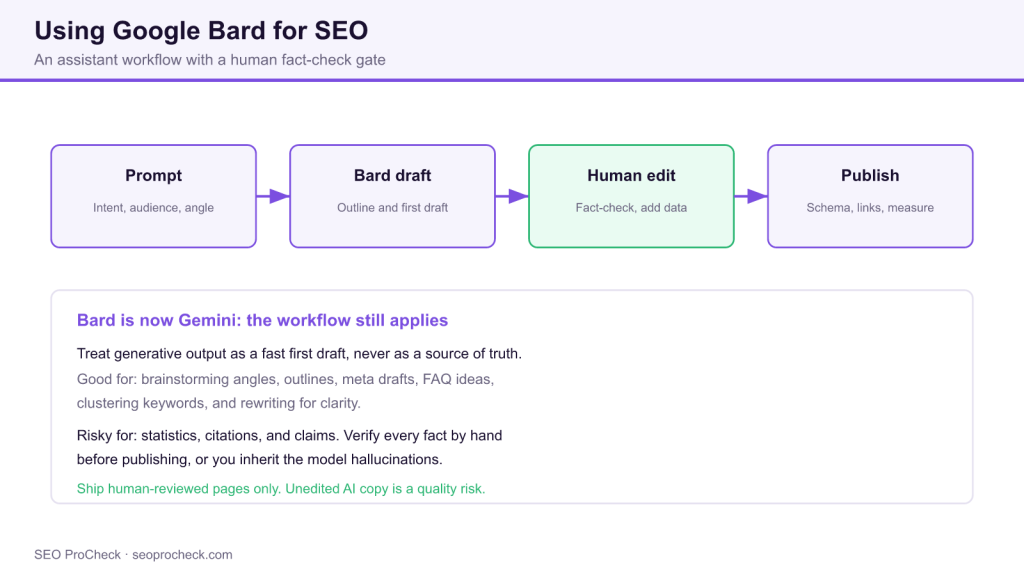
Google Bard, the assistant that Google rebranded as Gemini in early 2024, can speed up SEO work such as brainstorming angles, drafting outlines, clustering keywords, and writing first drafts. Treat its output as a fast first draft that a human must fact check and edit, never as a source of truth, because it can state wrong facts and citations with total confidence.
- Bard was renamed Gemini in February 2024; the assistant workflow in this article still applies.
- Good uses: outlines, angle brainstorming, meta drafts, FAQ ideas, keyword clustering, rewriting.
- Risky uses: statistics, citations, and factual claims, all of which need human verification.
- Publish only human reviewed pages; unedited AI copy is a quality and accuracy risk.
How to use Google Bard for better SEO provides valuable insights for SEO practitioners. This resource examines approaches and considerations that can improve organic search performance.
Key Concepts
Understanding the fundamental principles behind this topic helps inform strategic decisions. Whether optimizing for traditional search or emerging AI platforms, foundational concepts remain relevant. This resource covers the essential knowledge practitioners need.
Implementation Considerations
Moving from concept to execution requires understanding practical constraints and opportunities. Different situations call for different approaches. This resource provides guidance for applying concepts in real-world contexts.
Measuring Impact
SEO efforts require measurement to demonstrate value and guide optimization. Identifying appropriate metrics, establishing baselines, and tracking progress enables data-driven improvement. This resource addresses how to evaluate success.
This resource contributes to the knowledge base SEO practitioners need for effective optimization in an evolving search landscape.
Source: https://searchengineland.com/use-google-bard-seo-433357
Practitioner commentary: use it as a drafting tool, not an oracle
The useful mental model for any generative assistant in SEO is a fast, tireless junior who is great at structure and terrible at being sure. Bard, and now Gemini, shines at the early, divergent parts of the work: generating twenty angle ideas for a topic, turning a messy brief into a clean outline, drafting meta descriptions to react against, clustering a keyword list into themes, or rewriting a clunky paragraph for clarity. Those tasks reward speed and breadth, and a wrong answer costs you nothing because you were going to edit heavily anyway.
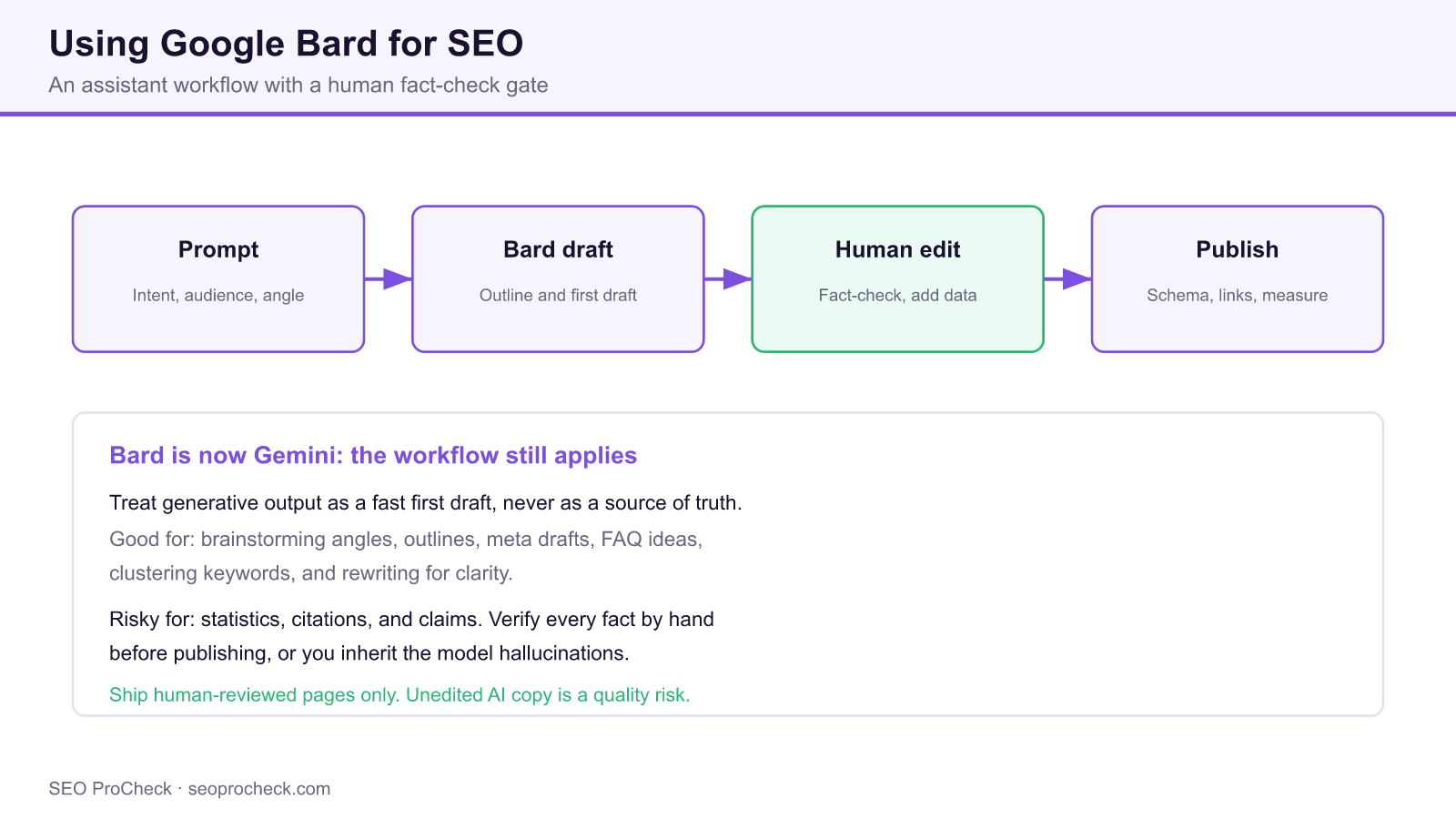
The danger is the convergent, factual work. Ask a model for a statistic, a study, a legal detail, or a citation and it will often produce something that looks perfect and is simply invented. In SEO that failure mode is expensive twice over: it can mislead readers, and after Google's helpful content work, publishing unreliable, unedited AI text at scale is a quality risk that can suppress a whole site. The workflow that keeps you safe is simple and non negotiable: prompt, AI draft, human fact check and edit, then publish. The human gate is the point, not a formality.
Where an assistant helps and where it hurts
| SEO task | Fit for an AI assistant | Why |
|---|---|---|
| Brainstorming angles | Strong | Volume and variety are the goal; you filter later |
| Outlining a page | Strong | Structure is easy to review and correct |
| Drafting meta and FAQ ideas | Good | A starting point you refine, not final copy |
| Keyword clustering | Good | Fast grouping that a human sanity checks |
| Writing factual claims | Weak | Confident hallucinations are common |
| Sourcing statistics and citations | Avoid | Fabricated references look real; verify by hand |
A safe prompting workflow
- Brief with intent. Give the assistant the audience, the search intent, and the angle. Vague prompts produce generic copy.
- Generate a draft, not a final. Ask for an outline or a first pass, then treat every claim as unverified.
- Fact check every number and citation. Replace anything you cannot confirm from a primary source. This step is where the value is protected.
- Add real experience and data. Insert the specifics, examples, and voice a model cannot invent, which is also what differentiates the page.
- Finish for search. Add schema, internal links, and a clear structure before publishing, then measure.
How AI assistants change search itself is a related topic worth reading: our overview of SEO versus AEO versus GEO maps the new answer surfaces, and agents.md versus llms.txt covers how you signal to AI crawlers. For more practical guides, see the general SEO articles.
What's changed since this article was published
The biggest change is the name. In February 2024 Google retired the Bard brand and folded the assistant into Gemini, its family of models and apps, so if you follow this guide today you are using Gemini rather than Bard. The capabilities grew alongside the rebrand: larger context windows, image understanding, and tighter integration with Google's own products. The separate but related shift is on the search side, where Google's Search Generative Experience became AI Overviews and rolled out widely, changing how often an assistant style answer appears above the classic results. None of this changes the core advice. A generative model is a drafting accelerator with a fact checking gate, and the gate is what separates a quality page from a liability.
Frequently asked questions
Can Google Bard help with SEO?
Yes, for the right tasks. It speeds up brainstorming angles, outlining pages, drafting meta descriptions and FAQ ideas, clustering keywords, and rewriting for clarity. It should not be trusted for facts, statistics, or citations without human verification.
Is Google Bard the same as Gemini?
Effectively yes. Google renamed Bard to Gemini in February 2024, so the assistant described in older Bard guides is now accessed as Gemini. The workflow for using it in SEO is unchanged even though the brand and models have moved on.
Is it safe to publish content written by Bard or Gemini?
Only after a human fact checks and edits it. Unverified AI text often contains confident but wrong claims, and publishing unreliable content at scale is a quality risk that can suppress a site, so the human review gate is essential.
What SEO tasks should you not use an AI assistant for?
Avoid relying on it for statistics, studies, legal details, and citations, which it can fabricate convincingly. Those need a primary source and human verification, not a generated answer that merely looks authoritative.
How do you prompt an AI assistant for better SEO drafts?
Give it the audience, the search intent, and the angle, ask for an outline or first draft rather than final copy, then fact check every claim and add real examples and data. Specific briefs produce far more useful output than vague ones.
Does using Bard or Gemini hurt SEO?
Using it as a drafting tool does not, provided a human verifies and improves the output. What hurts SEO is publishing unedited, unreliable AI text at scale, which Google's core ranking systems are designed to discount and its scaled content abuse policy treats as spam.
Take this with you
The assistant links open with a question about this page already written. Nothing is sent until you press enter.
Claude Vincent is a technical SEO consultant focused on crawlability, rendering, and AI-search visibility. He writes the field guides and case studies at SEO ProCheck, with a bias toward the durable, unglamorous work that decides whether search engines and AI answer engines can actually read and cite a site.
About SEO ProCheck
Technical SEO consulting and GEO strategy with 20 years of enterprise experience. Case studies, resources, and tools for search and AI visibility.
Work With Me
Technical SEO audits, GEO strategy, site migrations, and international SEO. Hourly consulting for teams who need hands-on support, not just reports.
Subscribe to our newsletter!








Recent Posts
- Most Top Sites Never Say Who They Are in Structured Data October 14, 2026
- Homepage Titles Are Mostly Too Short, Not Too Long October 8, 2026
- Who Actually Serves an llms.txt? 184 Top Sites Measured September 29, 2026