

Python SEO Script: Top Keyword Opportunities Within Striking Distance
- November 2, 2021
- General
AI Summary
Striking distance keywords are terms where your pages already rank near the bottom of page one or the top of page two, roughly positions 11 to 20, so a small push can move them into visible traffic. This guide keeps the original Search Engine Journal reference and adds a practitioner workflow for finding and prioritizing those keywords with a short Python script over Search Console data.
- Striking distance usually means positions 11 to 20, where demand exists but you are just off page one.
- Rank candidates by impressions, so you fix the terms with the most upside first.
- Map every keyword to one target URL and resolve cannibalization before optimizing.
- Refreshing depth, titles and internal links is what actually moves a page from position 12 to position 8.
Python SEO Script: Top Keyword Opportunities Within Striking Distance provides valuable insights for SEO practitioners. This resource examines approaches and considerations that can improve organic search performance.
What striking distance means
A striking distance keyword is one where you already rank, but just outside the traffic zone. Positions 11 to 20 are the classic band: Google already considers your page relevant enough to show, users just rarely scroll to page two. Because the page is already indexed and ranking, the work is refinement rather than starting from zero, which is why this is one of the highest return activities in SEO.
The workflow behind the Python script
The script referenced below automates a simple loop you could also run by hand. The value of the code is speed and repeatability, not magic.
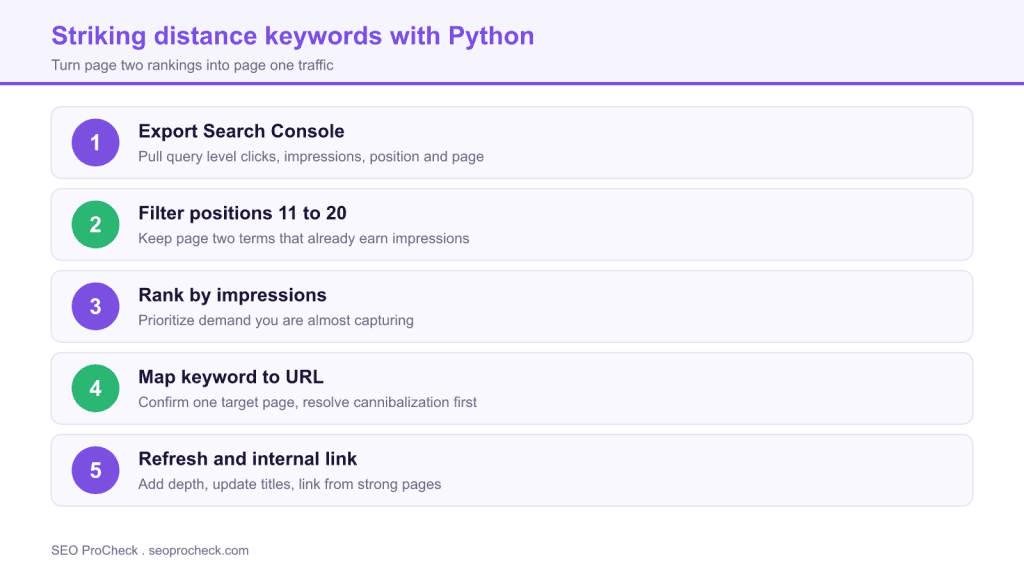
1. Export Search Console query data
Pull query level data with clicks, impressions, average position and the landing page. The Search Console API or a bulk export gives you far more rows than the interface, which matters because the long tail is where striking distance opportunities hide.
2. Filter to positions 11 to 20
Keep only queries whose average position falls between 11 and 20. These are terms Google already associates with your site. A term at position 45 needs a different, heavier investment, so it does not belong in this list.
3. Rank by impressions
Sort the filtered list by impressions. High impressions at position 14 means real demand you are almost capturing. This is where a title rewrite or a content refresh pays back fastest.
4. Map keyword to URL and fix cannibalization
Group by landing page. If two of your URLs rank for the same striking distance term, you have cannibalization: consolidate or clearly differentiate them before optimizing, or you will split signals. This same discipline shows up when you audit enterprise SEO problems on larger sites.
5. Refresh, then internal link
For each priority page, improve depth against the query intent, tighten the title and headings, and add internal links from strong related pages. Small, honest improvements are what move a page from position 12 to the visible half of page one.
Position band and the right action
| Average position | What it means | Best next action |
|---|---|---|
| 1 to 3 | Already winning | Protect the page, watch for decay |
| 4 to 10 | On page one, below the fold | Improve title and snippet to lift click rate |
| 11 to 20 | Striking distance | Refresh content, fix intent match, add internal links |
| 21 to 50 | Relevant but weak | Rework the page or build supporting content |
| 51 and beyond | Barely ranking | Reassess intent, this may need a new page |
What has changed since this script was published
The striking distance idea is as useful as ever, but two things evolved. Search Console now offers longer date ranges and better API access, so you can smooth out noise before deciding a keyword is worth the effort. And with AI overviews absorbing some clicks, impressions at positions 11 to 20 do not always convert to the traffic they once did, so pair the impression sort with a quick check of whether the query still returns ten classic blue links. Terms that keep a traditional result set remain the safest striking distance bets.
Key Concepts
Understanding the fundamental principles behind this topic helps inform strategic decisions. Whether optimizing for traditional search or emerging AI platforms, foundational concepts remain relevant. This resource covers the essential knowledge practitioners need.
Implementation Considerations
Moving from concept to execution requires understanding practical constraints and opportunities. Different situations call for different approaches. This resource provides guidance for applying concepts in real-world contexts.
Measuring Impact
SEO efforts require measurement to demonstrate value and guide optimization. Identifying appropriate metrics, establishing baselines, and tracking progress enables data-driven improvement. This resource addresses how to evaluate success.
This resource contributes to the knowledge base SEO practitioners need for effective optimization in an evolving search landscape.
Frequently asked questions
What are striking distance keywords?
They are keywords where your page already ranks just outside the traffic zone, usually positions 11 to 20, so a small improvement can move them onto the visible part of page one.
Why positions 11 to 20 specifically?
Because Google already considers those pages relevant enough to rank, the work is refinement rather than starting over, which makes the return on effort much higher than chasing brand new terms.
Do I need Python to find them?
No. Python just automates the export, filter and sort so you can repeat it quickly. You can do the same thing manually in Search Console or a spreadsheet for a smaller site.
How do I prioritize which striking distance keywords to work on?
Sort by impressions. High impressions at a position in the teens signals real demand you are almost capturing, so those terms usually deliver the fastest gains.
What actually moves a page from page two to page one?
Better intent match and depth, a clearer title and headings, resolved cannibalization, and internal links from strong related pages. Genuine improvement, not tricks.
Does keyword cannibalization affect striking distance work?
Yes. If two of your URLs rank for the same term you split signals, so consolidate or clearly differentiate them before optimizing either page.
Source: https://www.searchenginejournal.com/python-seo-striking-distance/423009/#close
Take this with you
The assistant links open with a question about this page already written. Nothing is sent until you press enter.
Claude Vincent is a technical SEO consultant focused on crawlability, rendering, and AI-search visibility. He writes the field guides and case studies at SEO ProCheck, with a bias toward the durable, unglamorous work that decides whether search engines and AI answer engines can actually read and cite a site.
About SEO ProCheck
Technical SEO consulting and GEO strategy with 20 years of enterprise experience. Case studies, resources, and tools for search and AI visibility.
Work With Me
Technical SEO audits, GEO strategy, site migrations, and international SEO. Hourly consulting for teams who need hands-on support, not just reports.
Subscribe to our newsletter!








Recent Posts
- Most Top Sites Never Say Who They Are in Structured Data October 14, 2026
- Homepage Titles Are Mostly Too Short, Not Too Long October 8, 2026
- Who Actually Serves an llms.txt? 184 Top Sites Measured September 29, 2026