

AI Summary
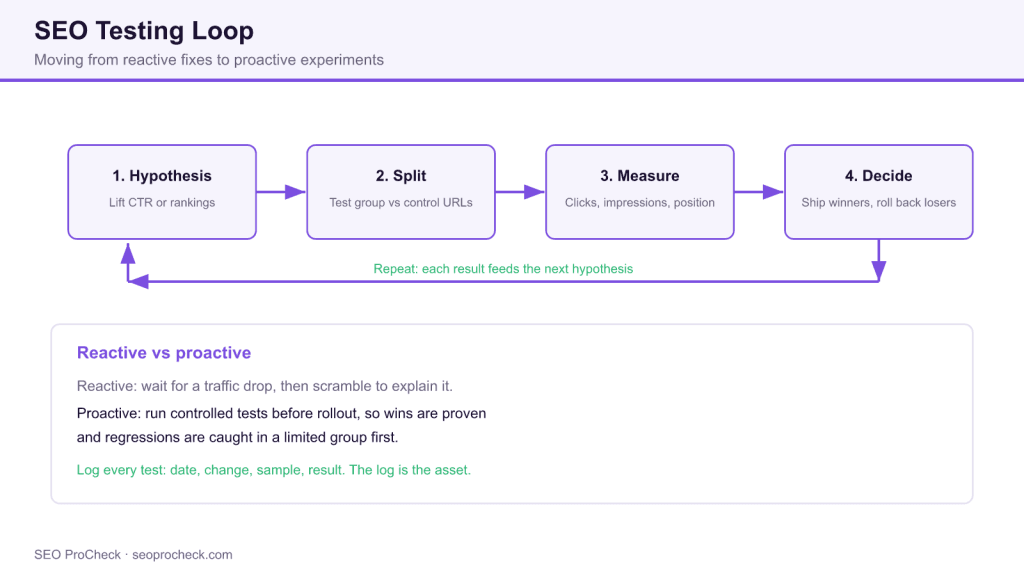
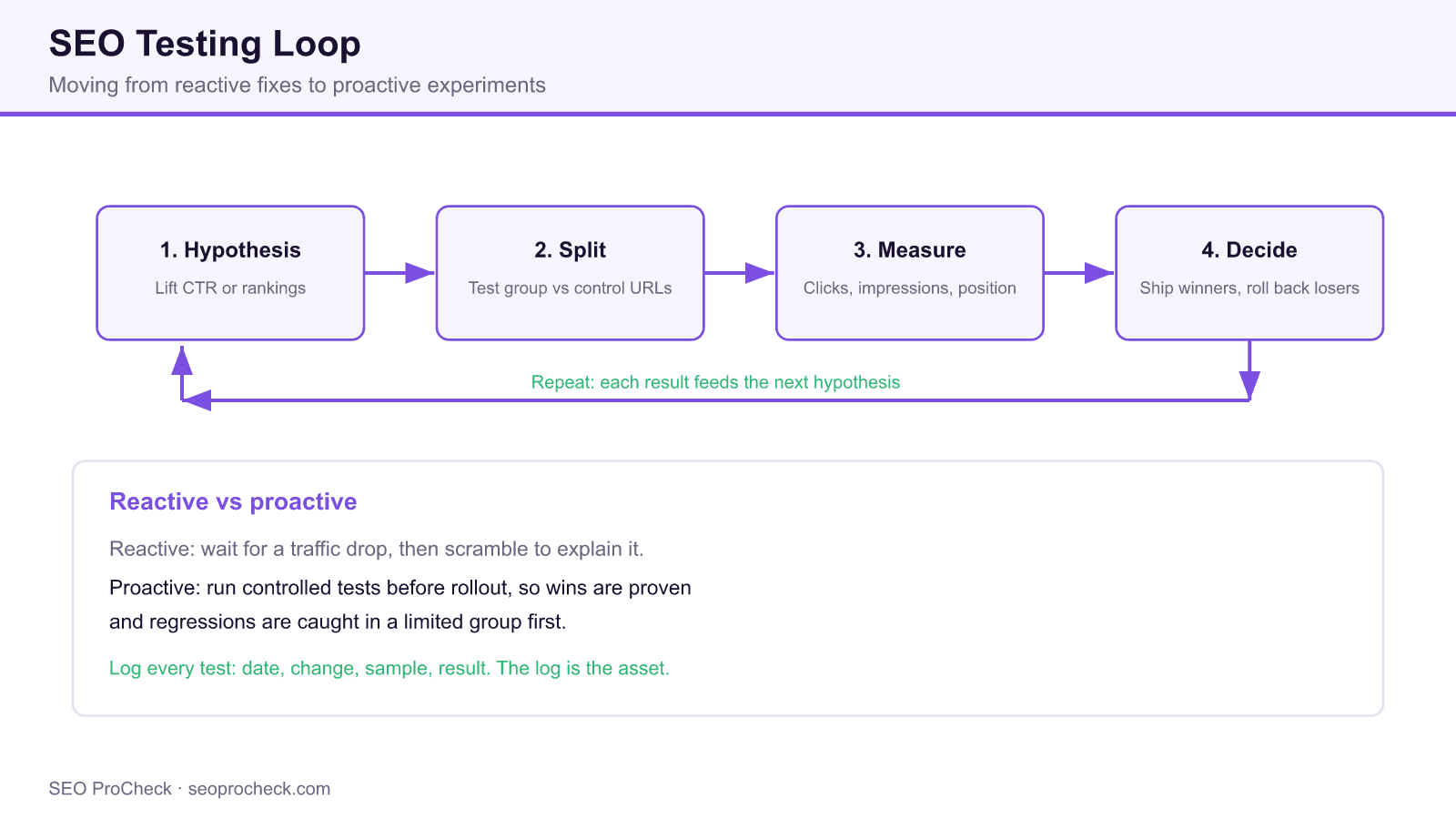
Proactive SEO testing means running controlled experiments before a change ships site wide, so wins are proven and regressions are caught in a limited group first. It replaces the reactive habit of waiting for a traffic drop and then scrambling to explain it after the damage is done.
- A test needs a hypothesis, a control group, a measurement window, and a decision rule.
- On large template driven sites, split testing groups of similar URLs isolates the effect of a change.
- The log of every test, what changed and what resulted, becomes a durable strategy asset.
- AI Overviews and folded reporting make clean measurement harder, so test design matters more.
SEO testing: Shifting from reactive to proactive strategies provides valuable insights for SEO practitioners. This resource examines approaches and considerations that can improve organic search performance.
Key Concepts
Understanding the fundamental principles behind this topic helps inform strategic decisions. Whether optimizing for traditional search or emerging AI platforms, foundational concepts remain relevant. This resource covers the essential knowledge practitioners need.
Implementation Considerations
Moving from concept to execution requires understanding practical constraints and opportunities. Different situations call for different approaches. This resource provides guidance for applying concepts in real-world contexts.
Measuring Impact
SEO efforts require measurement to demonstrate value and guide optimization. Identifying appropriate metrics, establishing baselines, and tracking progress enables data-driven improvement. This resource addresses how to evaluate success.
This resource contributes to the knowledge base SEO practitioners need for effective optimization in an evolving search landscape.
Source: https://searchengineland.com/seo-testing-proactive-strategies-438389
Practitioner commentary: designing a test that survives scrutiny
The shift this article describes, from reactive to proactive SEO, is really a shift in when you gather evidence. Reactive teams change a title template, push it everywhere, and only look at the data if something breaks. Proactive teams treat the same change as an experiment: a clear hypothesis, a control group that does not get the change, an agreed measurement window, and a decision rule written down before the numbers arrive. That last part matters most, because it stops the after the fact rationalization that turns noise into a false win.
On a small site you rarely have the traffic for a clean split, so you lean on before and after comparisons with seasonality controls and a healthy dose of caution. On a large template driven site, product pages or location pages that share a layout, you can split a homogeneous set of URLs into a test group and a control group, apply the change to one, and watch the gap. This is the model that dedicated SEO testing platforms formalize, and it is the only way to attribute a ranking or click change to a specific edit rather than to an algorithm update that happened the same week.
Reactive versus proactive at a glance
| Dimension | Reactive approach | Proactive approach |
|---|---|---|
| Trigger | A traffic or ranking drop | A hypothesis worth testing |
| Evidence | Gathered after the fact | Gathered by design, with a control |
| Risk exposure | Full site at once | Limited to a test group first |
| Attribution | Confounded by other changes | Isolated by the control group |
| Output | An explanation for a decline | A repeatable, logged decision |
What to measure and what fools you
Pick the metric that matches the hypothesis. A title change targets click through rate, so impressions and CTR from Search Console are the signal, not raw clicks, which also move with impressions. A content change aimed at rankings watches average position for the target query cluster. Always define the window in advance, usually two to four weeks per side, and account for weekly seasonality by comparing like periods. The behavior that decides a lot of tests, whether users bounce straight back to the results page, is worth understanding through our note on pogosticking.
What's changed since this piece was published
Measurement got harder, which raises the value of disciplined testing. AI Overviews now sit above classic results on many informational queries, and Search Console folds those impressions into overall Search with no separate filter, so a position one page can lose clicks without any ranking change you can see. That makes naive before and after reads riskier and controlled splits more valuable, because a matched control group absorbs the same AI Overview effect that your test group experiences. The tooling also matured: automated SEO split testing is now mainstream for enterprise sites, and lightweight teams increasingly script their own comparisons using the crawl and log workflows we document. For a broader library of experiments to try, browse the general SEO articles.
Frequently asked questions
What is proactive SEO testing?
It is running controlled experiments before a change ships site wide. You form a hypothesis, hold back a control group, set a measurement window, and decide by a rule agreed in advance, so wins are proven and regressions are contained.
How is reactive SEO different from proactive SEO?
Reactive SEO responds to a traffic drop after it happens and tries to explain it. Proactive SEO tests changes deliberately with a control group, so the effect of each change is isolated and understood before full rollout.
Do I need a lot of traffic to run SEO tests?
For a clean split test across a group of similar URLs, yes, higher volume gives cleaner signals. Smaller sites can still test with careful before and after comparisons that control for seasonality, but they must treat single results with more caution.
How long should an SEO test run?
Commonly two to four weeks per side, matched to whole weeks so weekly seasonality cancels out. The window should be set before the test starts and long enough to gather a stable sample, not stopped early the moment a result looks good.
Why is a control group important in SEO testing?
Because algorithm updates, seasonality, and AI Overviews affect all pages at once. A matched control group experiences those same forces, so the difference between test and control isolates the effect of your specific change.
Can I still measure SEO tests now that AI Overviews exist?
Yes, but naive before and after reads are riskier because AI Overview impressions are folded into Search Console with no filter. A matched control group absorbs that shared effect, which is exactly why controlled splits beat single page comparisons today.
Take this with you
The assistant links open with a question about this page already written. Nothing is sent until you press enter.
Claude Vincent is a technical SEO consultant focused on crawlability, rendering, and AI-search visibility. He writes the field guides and case studies at SEO ProCheck, with a bias toward the durable, unglamorous work that decides whether search engines and AI answer engines can actually read and cite a site.
About SEO ProCheck
Technical SEO consulting and GEO strategy with 20 years of enterprise experience. Case studies, resources, and tools for search and AI visibility.
Work With Me
Technical SEO audits, GEO strategy, site migrations, and international SEO. Hourly consulting for teams who need hands-on support, not just reports.
Subscribe to our newsletter!








Recent Posts
- Most Top Sites Never Say Who They Are in Structured Data October 14, 2026
- Homepage Titles Are Mostly Too Short, Not Too Long October 8, 2026
- Who Actually Serves an llms.txt? 184 Top Sites Measured September 29, 2026