

AI Summary
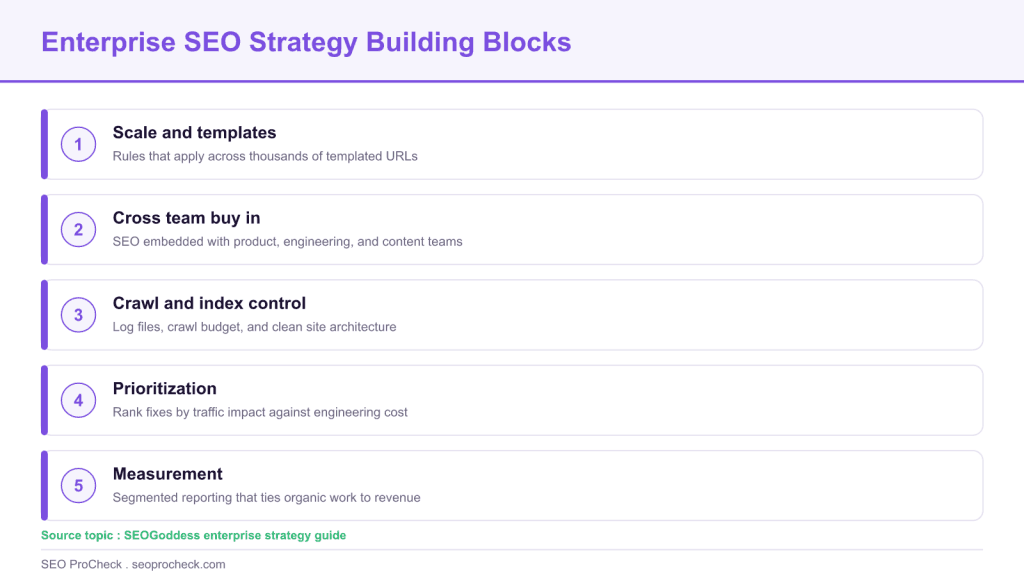
Enterprise SEO strategy is about winning at scale: setting rules that apply across thousands of templated URLs, embedding SEO in product and engineering workflows, and controlling crawl and index behavior. Success comes from prioritizing fixes by impact and cost, then proving the results with segmented reporting tied to revenue.
- Enterprise SEO optimizes patterns and templates, not one page at a time.
- Cross team buy in with product, engineering, and content decides what actually ships.
- Crawl budget, log analysis, and clean architecture keep large sites indexable.
- Prioritize by traffic impact against engineering cost, then report against revenue.
Enterprise SEO is a different discipline from small site SEO. On a site with hundreds of thousands of URLs, you rarely optimize a single page. You change a template, adjust a rule, or fix a crawl pattern, and the effect ripples across the whole site at once. That leverage is the opportunity and the risk: a good template change lifts thousands of pages, a bad one buries them.
The building blocks
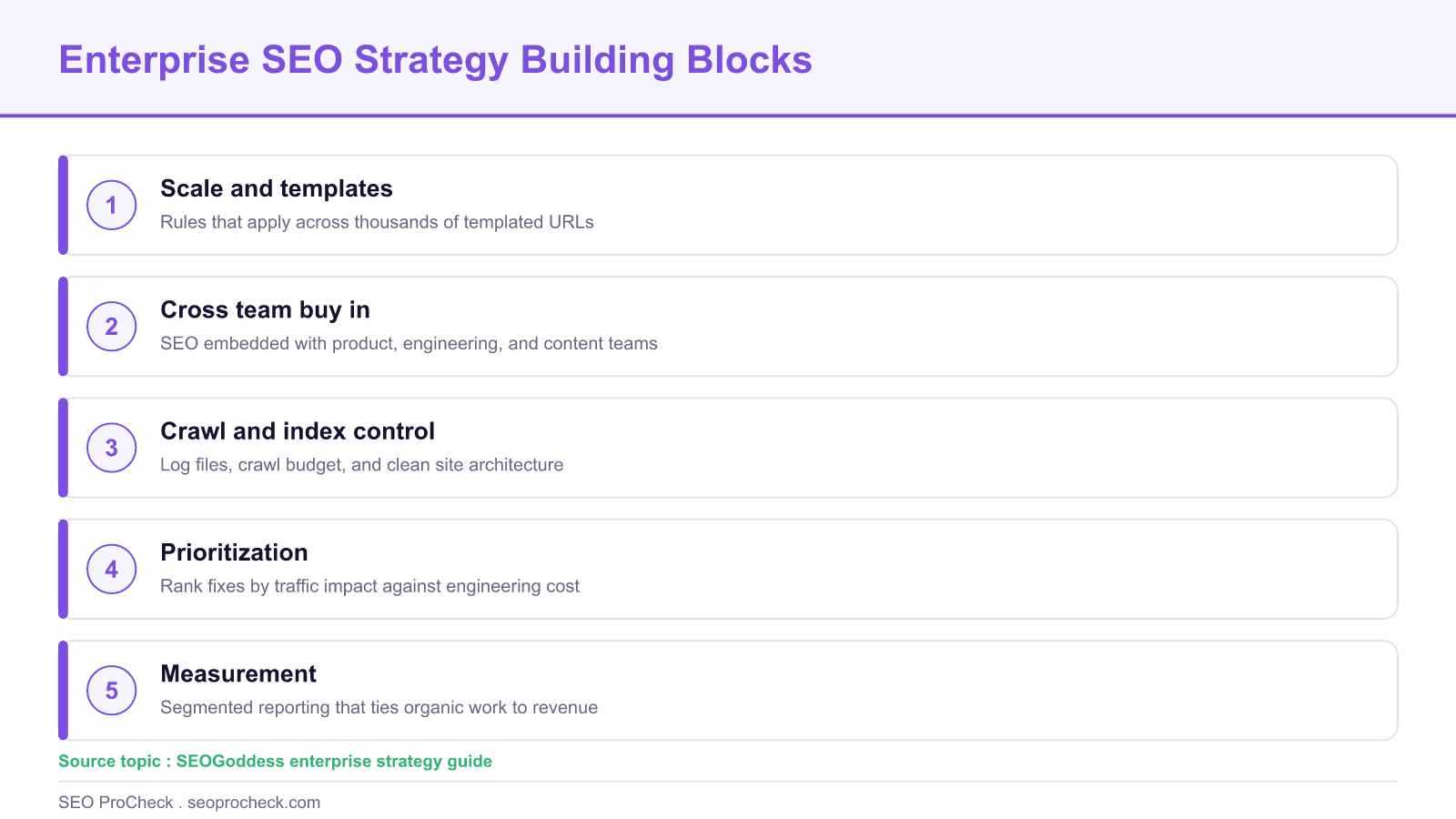
Scale through templates. Define title, heading, internal link, and schema rules at the template level so quality is enforced by the system rather than by manual edits. When you improve the product page template, every product benefits.
Cross team buy in. At enterprise scale, SEO does not own the code, the content, or the roadmap. Wins depend on embedding requirements into product and engineering workflows so changes ship with SEO baked in rather than bolted on later.
Crawl and index control. Large sites waste crawl budget on parameters, filters, and duplicate paths. Reading server logs shows where Googlebot actually spends time, and a clean architecture points it at the pages that matter. The log file analysis guide covers how to run this.
Prioritization. Every fix competes for the same engineering time, so rank work by expected traffic impact against build cost and ship the high leverage items first.
Measurement. Segmented reporting, by template, directory, or business line, ties organic performance to revenue and keeps leadership funding the work.
A simple prioritization model
| Initiative | Traffic impact | Engineering cost | Priority |
|---|---|---|---|
| Fix indexable faceted URLs draining crawl budget | High | Medium | Do first |
| Improve title and schema rules in the main template | High | Low | Do first |
| Rewrite internal linking across category pages | Medium | Medium | Schedule next |
| Redesign a low traffic template | Low | High | Defer |
Sort by impact divided by cost and the roadmap almost writes itself. Support it with a technical SEO audit framework so nothing structural is missed.
Architecture and governance
Two systems keep an enterprise site healthy over time. The first is internal linking that routes authority from strong hubs to money pages and keeps important content within a few clicks of the home page. The second is a content governance process: a recurring content audit that finds pages to update, consolidate, or retire before they decay into dead weight. Governance is what stops a large site from slowly bloating.
What has changed since this guide
Two shifts matter for enterprise teams. Generative results and AI Overviews now sit above classic listings for many queries, so authority signals and structured data feed answer engines as well as rankings. And crawl efficiency has grown more valuable as sites scale, because wasted crawl on junk URLs directly limits how fast new and updated pages get seen. The strategic principles below still apply, the reporting simply has to include AI visibility now.
Related content strategy principles
Content strategy determines what you create, why, and how it serves both users and business objectives. This resource examines approaches for developing content that performs well in search while delivering genuine value.
Understanding User Intent
Effective content addresses what users actually need when they search. Analyzing search intent, understanding user questions, and mapping content to the user journey ensures content serves real needs. Intent alignment has become as important as keyword targeting.
Quality and Comprehensiveness
Search engines increasingly reward comprehensive, authoritative content over thin pages targeting specific keywords. Building topical depth through thorough coverage of subjects establishes expertise. Quality signals including E-E-A-T factors influence how content is evaluated.
Content Lifecycle Management
Content requires ongoing maintenance to remain competitive. Regular audits identify content needing updates, consolidation, or removal. Fresh, accurate content maintains rankings while outdated content decays. Building content refresh into ongoing processes sustains performance.
This resource provides strategic guidance for content programs that drive sustainable organic growth.
Source: https://docs.google.com/document/d/1DDIXVi3hTKasGIKG0spRdkuCK2UYbSYpC2YBX2ub360/edit#
Frequently Asked Questions
What makes enterprise SEO different from regular SEO
Scale and process. On an enterprise site you optimize templates, rules, and crawl patterns that affect thousands of pages at once rather than editing pages individually. Success depends as much on cross team coordination with product and engineering as on the SEO tactics themselves.
How do you prioritize SEO work at enterprise scale
Rank each initiative by expected traffic impact against the engineering cost to build it, then ship the highest ratio items first. A template level fix that touches thousands of pages usually beats a one off page change. Keeping a scored backlog stops the roadmap from being driven by whoever shouts loudest.
Why does crawl budget matter for large sites
Search engines allocate a finite amount of crawling to each site, and large sites easily waste it on parameters, filters, and duplicate URLs. When crawl budget is wasted, new and updated pages get discovered more slowly. Log file analysis shows where Googlebot actually spends its time so you can redirect it to valuable pages.
How should enterprise SEO be measured
Use segmented reporting that breaks performance down by template, directory, or business line, then tie it to revenue rather than raw traffic. Segmentation isolates which changes drove which results. Reporting in business terms is also what keeps leadership funding the program.
How do you get engineering to prioritize SEO
Embed SEO requirements into the product and engineering workflow so they ship as part of normal releases, and bring impact estimates in business terms to planning. When SEO shows the revenue at stake and the cost to build, it competes fairly for roadmap slots. Retrofitting fixes later is always more expensive.
Does AI search change enterprise SEO strategy
It adds a layer rather than replacing the fundamentals. Structured data, authority, and clean architecture now feed AI Overviews and assistants as well as classic rankings. Enterprise teams should extend reporting to track visibility inside generated answers, not only blue link positions.
Take this with you
The assistant links open with a question about this page already written. Nothing is sent until you press enter.
Claude Vincent is a technical SEO consultant focused on crawlability, rendering, and AI-search visibility. He writes the field guides and case studies at SEO ProCheck, with a bias toward the durable, unglamorous work that decides whether search engines and AI answer engines can actually read and cite a site.
About SEO ProCheck
Technical SEO consulting and GEO strategy with 20 years of enterprise experience. Case studies, resources, and tools for search and AI visibility.
Work With Me
Technical SEO audits, GEO strategy, site migrations, and international SEO. Hourly consulting for teams who need hands-on support, not just reports.
Subscribe to our newsletter!








Recent Posts
- Most Top Sites Never Say Who They Are in Structured Data October 14, 2026
- Homepage Titles Are Mostly Too Short, Not Too Long October 8, 2026
- Who Actually Serves an llms.txt? 184 Top Sites Measured September 29, 2026