

AI Summary
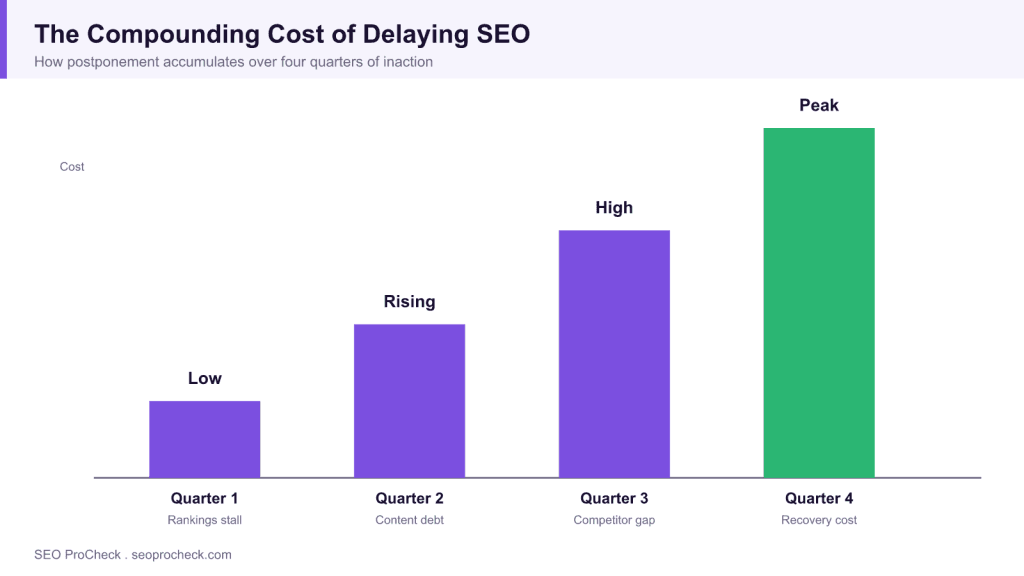
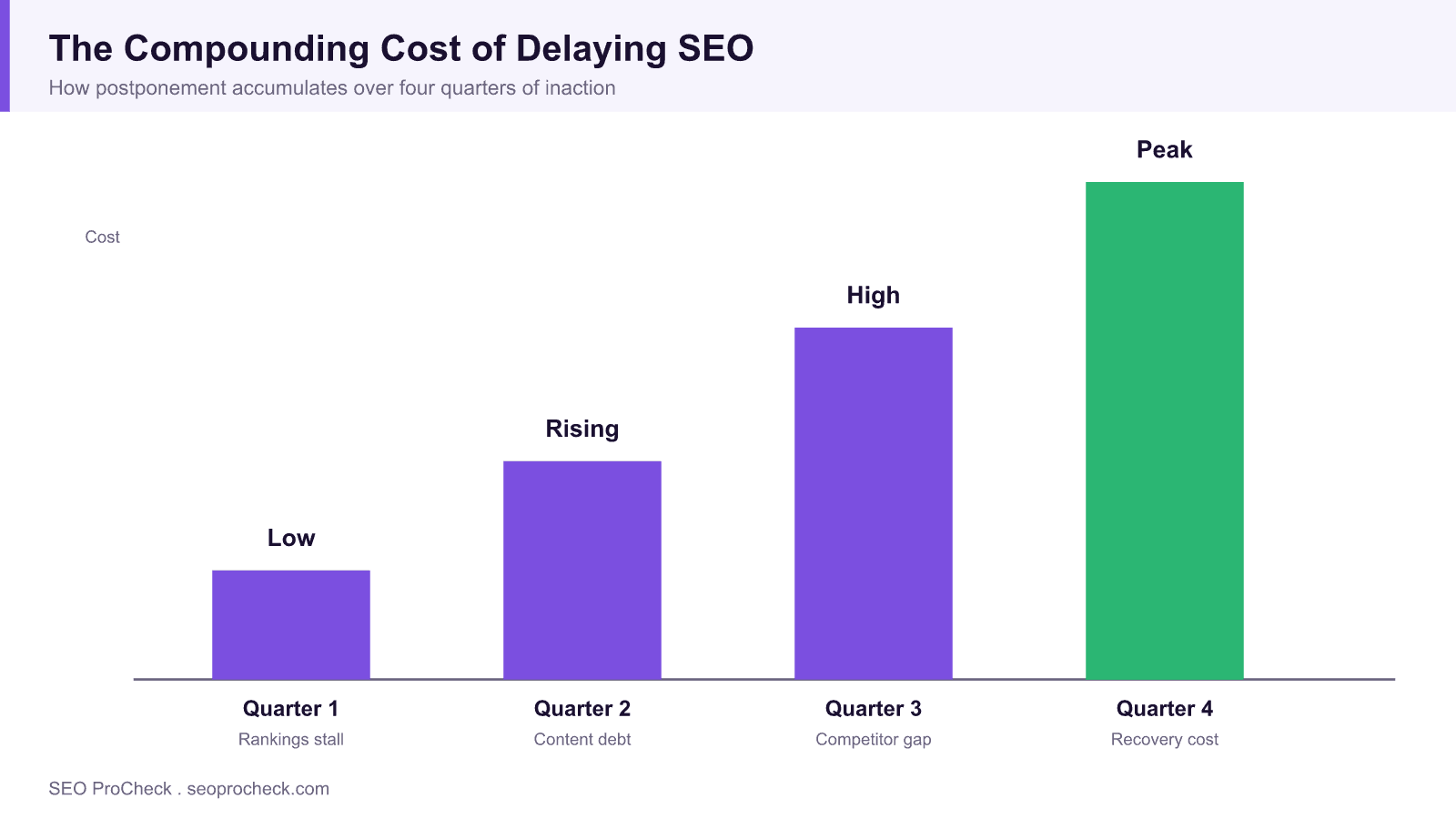
Delaying a modern SEO strategy is rarely a saving, it is a deferred and growing bill. Because rankings, links, and content authority compound slowly, every quarter of inaction widens the gap a competitor builds and raises the eventual cost of catching up.
- SEO gains lag effort by months, so the cost of a late start is paid twice: in the wait and in the lost compounding.
- Competitors who publish and earn links while you wait create a moat of topical authority that is expensive to overtake.
- Deferred technical fixes and content decay turn into remediation debt that costs more than prevention.
- A simple cost of delay model turns "later" into a number leadership can weigh against the cost of acting now.
Why delay is the most expensive SEO decision
Search visibility behaves like a slow compounding asset, not a switch you flip. When a page first ranks, it earns clicks, those clicks and the engagement behind them feed ranking systems, and stronger rankings earn more clicks. Skipping a quarter does not just pause that loop, it removes a base that the next quarter would have compounded on. This is why a six month delay usually costs far more than six months of budget: you lose the results of the delayed period and the growth those results would have seeded afterward.
The practical mistake is treating SEO as a discretionary line item that can wait for a calmer quarter. In competitive niches the calmer quarter never arrives, and the sites that started earlier keep extending their lead. The question worth answering is not "can we afford to start now" but "what does each month of waiting add to the eventual invoice".
Modeling the cost of delay
You can make the abstract concrete with a lightweight cost of delay estimate that any stakeholder can follow. Take the incremental monthly organic revenue a project is expected to reach at maturity, call it V. Estimate the ramp, the number of months M before the program reaches a steady state. The cost of delaying the start by one month is not one month of V, it is one month of V plus the shift of the entire ramp one month into the future.
Worked example without inventing outcomes: if a program is modeled to add 40,000 dollars per month in organic revenue at maturity, and you postpone the start by three months, you forgo three months near the top of the ramp and you push every later month back by three. Even conservative ramps make the deferred total dwarf the three months of agency or headcount cost you thought you were saving. Put the model in a shared sheet, label the assumptions, and let leadership adjust V and M rather than argue about whether SEO matters.
What actually compounds while you wait
Three assets move in the wrong direction during a delay. First, topical authority: competitors publish, earn internal and external links, and become the reference for queries you wanted. Second, technical health: unresolved canonical conflicts, slow templates, and crawl waste accumulate as the site grows, so the fix that was a one hour change becomes a migration. Third, data: you cannot optimize what you never measured, and every month without proper analytics and Search Console history is a month of missing baselines you can never recreate.
The reverse is also true and it is the argument for starting small immediately. Even a modest program that ships two strong pages a month, fixes the worst technical issues, and instruments measurement begins compounding at once. The first pages are the cheapest to rank because you are entering the topic before rivals harden their position.
Cost of delay by area
| Area | What accrues during delay | Cost when you finally act |
|---|---|---|
| Content authority | Competitors own the queries and internal links you wanted | Longer time to rank against entrenched pages |
| Backlinks | Editorial links flow to whoever published first | More outreach and digital PR to close the gap |
| Technical health | Canonical, speed, and crawl issues scale with the site | Larger remediation project instead of small fixes |
| Measurement | No analytics or Search Console baseline is captured | Blind optimization and no historical trend to learn from |
| Brand demand | Category searchers meet rivals, not you | Paid spend needed to buy visibility you could have earned |
A first 90 days that stops the bleeding
You do not need a finished strategy to start reducing the cost of delay, you need momentum. In the first thirty days, instrument measurement: verify Google Search Console, confirm analytics captures organic sessions and conversions, and export a baseline of current rankings. In days thirty to sixty, fix the highest leverage technical issues, indexation and canonical conflicts first, since those quietly cap everything else. In days sixty to ninety, ship the first cluster of genuinely useful pages targeting intents you can realistically win, and set a publishing cadence you can sustain.
Run a proper content audit early so effort goes to pages that can move traffic rather than to net new pages that duplicate what you already have. Deciding where SEO budget compounds fastest, technical versus content, is itself a strategic call worth making deliberately rather than by default.
The original resource
Content strategy determines what you create, why, and how it serves both users and business objectives. This resource examines approaches for developing content that performs well in search while delivering genuine value.
Understanding User Intent
Effective content addresses what users actually need when they search. Analyzing search intent, understanding user questions, and mapping content to the user journey ensures content serves real needs. Intent alignment has become as important as keyword targeting.
Quality and Comprehensiveness
Search engines increasingly reward comprehensive, authoritative content over thin pages targeting specific keywords. Building topical depth through thorough coverage of subjects establishes expertise. Quality signals including E-E-A-T factors influence how content is evaluated.
Content Lifecycle Management
Content requires ongoing maintenance to remain competitive. Regular audits identify content needing updates, consolidation, or removal. Fresh, accurate content maintains rankings while outdated content decays. Building content refresh into ongoing processes sustains performance.
This resource provides strategic guidance for content programs that drive sustainable organic growth.
Source: https://profoundstrategy.com/blog/cost-delaying-seo
Frequently asked questions
How long before SEO pays back if we start now?
Most programs show early movement on low competition terms within a few months, with meaningful compounding traffic emerging over six to twelve months. The exact ramp depends on your starting authority, competition, and publishing cadence, which is why modeling V and M for your own site beats generic timelines.
Is it cheaper to wait until we have more budget?
Usually no. Waiting forfeits the results of the delayed period and pushes the entire ramp later, so the total forgone value grows faster than the budget you defer. Starting small and compounding beats starting big and late.
We were burned by SEO before, why try again?
Past disappointment often traces to tactics that chased algorithms rather than user value, or to programs that stopped before compounding began. A modern approach grounded in intent, quality, and measurement is more durable and easier to defend to leadership.
Can paid search replace organic while we delay?
Paid can buy immediate visibility, but the moment you stop paying the traffic stops, whereas organic keeps returning value after the work is done. They complement each other, and delaying organic simply raises how much paid coverage you must buy in the meantime.
What should we do first if resources are tight?
Instrument measurement, fix indexation and canonical issues, and publish a small cluster of high intent pages you can realistically rank. These three moves start the compounding loop at minimal cost and give you data to justify further investment.
How do we convince leadership to prioritize SEO now?
Translate the decision into money with a cost of delay model they can adjust, then pair it with a 90 day plan that shows early wins. Numbers plus a concrete near term deliverable move budget faster than a case for SEO in the abstract.
Related reading on seoprocheck.com
- How to run a content audit that actually moves traffic
- Technical SEO vs content SEO: where the money actually is
- E-E-A-T: what it is and how to demonstrate it
- Building algorithm resistant content
Take this with you
The assistant links open with a question about this page already written. Nothing is sent until you press enter.
Claude Vincent is a technical SEO consultant focused on crawlability, rendering, and AI-search visibility. He writes the field guides and case studies at SEO ProCheck, with a bias toward the durable, unglamorous work that decides whether search engines and AI answer engines can actually read and cite a site.
About SEO ProCheck
Technical SEO consulting and GEO strategy with 20 years of enterprise experience. Case studies, resources, and tools for search and AI visibility.
Work With Me
Technical SEO audits, GEO strategy, site migrations, and international SEO. Hourly consulting for teams who need hands-on support, not just reports.
Subscribe to our newsletter!







Recent Posts
- Finding a Competitor's Sitemap, and Turning It Into a Change Log September 15, 2026
- AI Crawler User Agents: The Current Names, and Which Ones Sites Actually Block September 9, 2026
- Can AI Crawlers Actually Read Your Site? I Measured 400 of the Biggest September 5, 2026