

Case Study: Reaching Google's Top 10 with Internal Linking - Inlinks
- May 20, 2020
- Website Architecture
AI Summary
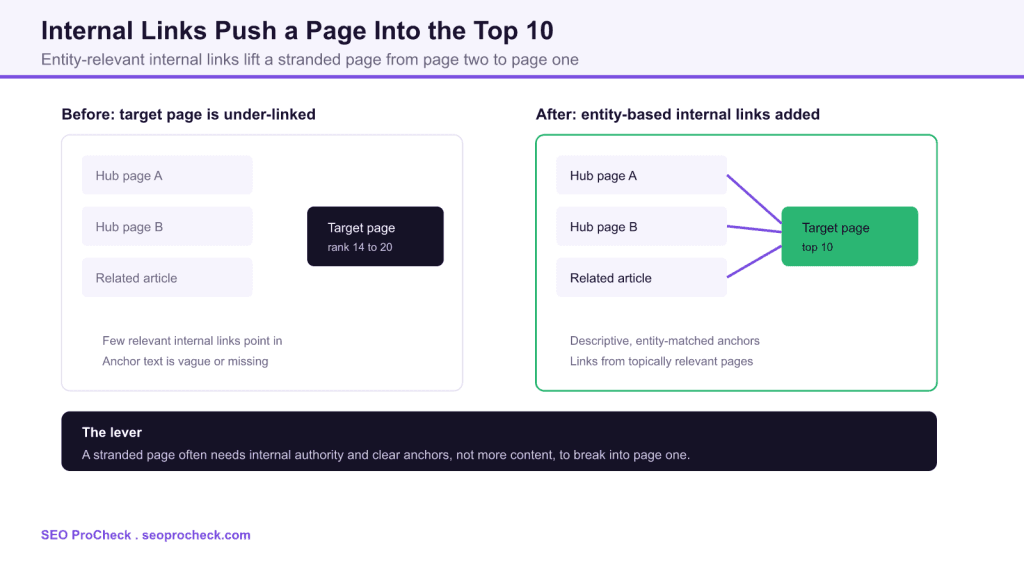
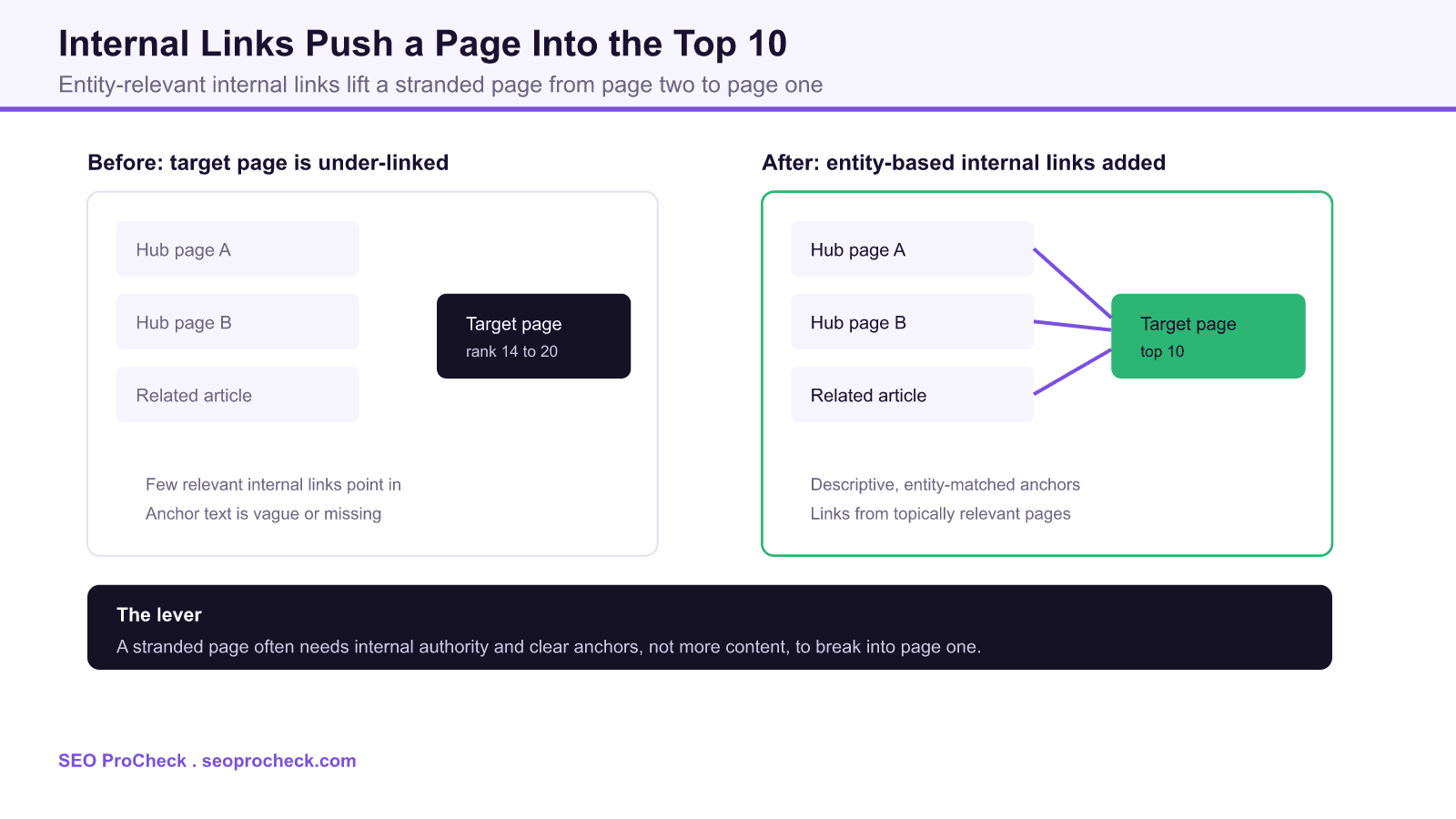
This InLinks case study shows that a good page stuck just outside the top 10 often needs internal authority and clear anchors, not more content. Adding relevant, entity matched internal links from topical, higher-traffic pages channels PageRank and reinforces relevance, which can lift a page from page two into page one.
- Target pages ranking 11 to 20 with steady impressions; they need the smallest push.
- Add three to six in-content internal links from related, higher-traffic pages.
- Use descriptive, entity matched anchor text, not read more or the raw title.
- Internal linking works best for pages that are already close, paired with content and authority work for the rest.
Link acquisition remains a critical ranking factor. This case study documents effective approaches to earning links that improved domain authority and supported ranking growth.
Link Building Context
Every link building initiative operates within specific constraints: industry, resources, existing authority, and competitive landscape. This case study establishes the context that shaped link building strategy and tactics.
Strategy and Tactics
Sustainable link building requires approaches that earn editorial links rather than manufacture artificial signals. This case study details the specific tactics employed: content-driven outreach, digital PR, resource creation, or relationship building.
Outreach and Execution
Link building requires efficient outreach processes and compelling value propositions. This case study documents outreach methodology, response rates, and relationship development approaches that yielded results.
Impact Assessment
Link building value manifests in domain authority growth, ranking improvements for target keywords, and referral traffic from acquired links. This case study quantifies the impact of link building efforts and their contribution to overall SEO success.
Link building case studies help practitioners understand effective approaches in an increasingly sophisticated link landscape.
Source: https://inlinks.net/p/insight/case-study-reaching-googles-top-10-with-internal-linking/
Why a stranded page needs internal authority, not more words
This InLinks case study speaks to a situation every SEO recognizes: a page that is genuinely good, targets a clear query, and yet sits stuck at the bottom of page one or the top of page two. The instinct is to rewrite it, add word count, or chase backlinks. Often the real problem is simpler. The page is under-linked from within its own site, so it never accumulates the internal authority and topical context that would let it compete. The fix is to point relevant internal links at it, using anchor text that names the topic clearly, from pages that Google already understands to be about the same subject.
InLinks approaches internal linking through an entity lens. Rather than matching links only on exact keywords, it maps the entities and topics a page covers and suggests internal links that connect pages sharing those entities. In practice that means a target page about a specific subject receives links from other pages that mention the same entities, with anchors that reflect the relationship. This does two things at once: it channels internal PageRank toward the target, and it reinforces the topical signal that tells Google what the page should rank for.
The mechanism that moves a page into the top 10
Internal links influence rankings through two connected channels. The first is authority flow. Links from pages that themselves attract traffic and links pass equity to the target, which can be the marginal push a page needs to cross from position 14 into the top 10. The second is relevance. Descriptive anchor text and links from topically related pages help Google associate the target with the right query cluster, which improves how well it matches intent. A stranded page frequently lacks both: it has too few internal links, and the ones it has use vague anchors like read more or the page title with no keyword signal.
How to run this play on your own site
Start by finding your stranded pages. In Google Search Console, filter for queries where a page ranks in positions 11 to 20 with real impressions but few clicks. Those are pages Google already considers relevant but not quite good enough to promote. For each one, identify three to six existing pages on your site that cover related topics and already earn traffic. Add a contextual internal link from each of those pages into the target, placed within the body content rather than in a footer, and write anchor text that includes the target topic naturally. Record the date, then watch the average position for that page over the following weeks. Pages sitting just outside the top 10 tend to respond fastest because they need the smallest push.
| Signal on the stranded page | What it usually means | Internal linking fix |
|---|---|---|
| Ranks 11 to 20 with steady impressions | Relevant but lacks the final push | Add links from related high-traffic pages |
| Very few internal links point in | Page is nearly orphaned | Build in-content links from topical hubs |
| Anchors say read more or the raw title | Weak topical signal | Rewrite anchors to name the target topic |
| Links come only from low-value pages | Little authority is flowing in | Link from pages that already rank and earn traffic |
Where this play helps most and where it does not
Internal linking is powerful when a page is already close, but it is not a substitute for content that matches intent or for genuine external authority on highly competitive terms. If a page ranks on page five, internal links alone rarely carry it to the top 10; the content or the external signals usually need work too. Use internal linking as the precise lever for pages that are close, and pair it with content and authority work for pages that are far. For the foundations, see our internal linking complete guide and the practical walkthrough in how to use internal linking for SEO. To get anchors right, read anchor text best practices, and to find pages that receive too few links, use our guide to finding and fixing orphan pages.
Frequently Asked Questions
Can internal linking really move a page into Google's top 10?
Yes, when the page is already close, typically ranking in positions 11 to 20 with steady impressions. Adding relevant internal links from topical, higher-traffic pages channels authority and clarifies relevance, which can supply the final push. It is far less effective for pages ranking on page four or five.
What is entity-based internal linking?
It is linking pages based on the shared entities and topics they cover rather than only exact keyword matches. Tools like InLinks map those entities and suggest internal links between pages about the same subject, which strengthens both authority flow and topical relevance to the target.
How many internal links does a stranded page need?
There is no fixed number, but three to six contextual links from genuinely related, higher-traffic pages is a sensible starting point. Quality and relevance matter more than volume, and the links should sit in the body content rather than in a footer or sidebar.
Where should the internal links be placed on the page?
In the main body content, close to relevant text, rather than in navigation, footers, or sidebars. In-content links carry stronger topical and authority signals than boilerplate links that repeat across every page.
What anchor text should I use for these links?
Use descriptive anchors that name the target page topic naturally, rather than generic phrases like read more or the raw page title. Clear anchors reinforce the relevance signal that helps Google match the page to the right query.
How do I find stranded pages to target?
In Google Search Console, filter by query and page for URLs ranking in positions 11 to 20 that earn impressions but few clicks. Those pages are relevant enough to appear near the top but need an extra internal authority and relevance boost to break through.
Take this with you
The assistant links open with a question about this page already written. Nothing is sent until you press enter.
Claude Vincent is a technical SEO consultant focused on crawlability, rendering, and AI-search visibility. He writes the field guides and case studies at SEO ProCheck, with a bias toward the durable, unglamorous work that decides whether search engines and AI answer engines can actually read and cite a site.
About SEO ProCheck
Technical SEO consulting and GEO strategy with 20 years of enterprise experience. Case studies, resources, and tools for search and AI visibility.
Work With Me
Technical SEO audits, GEO strategy, site migrations, and international SEO. Hourly consulting for teams who need hands-on support, not just reports.
Subscribe to our newsletter!







Recent Posts
- Finding a Competitor's Sitemap, and Turning It Into a Change Log September 15, 2026
- AI Crawler User Agents: The Current Names, and Which Ones Sites Actually Block September 9, 2026
- Can AI Crawlers Actually Read Your Site? I Measured 400 of the Biggest September 5, 2026