

AI Summary
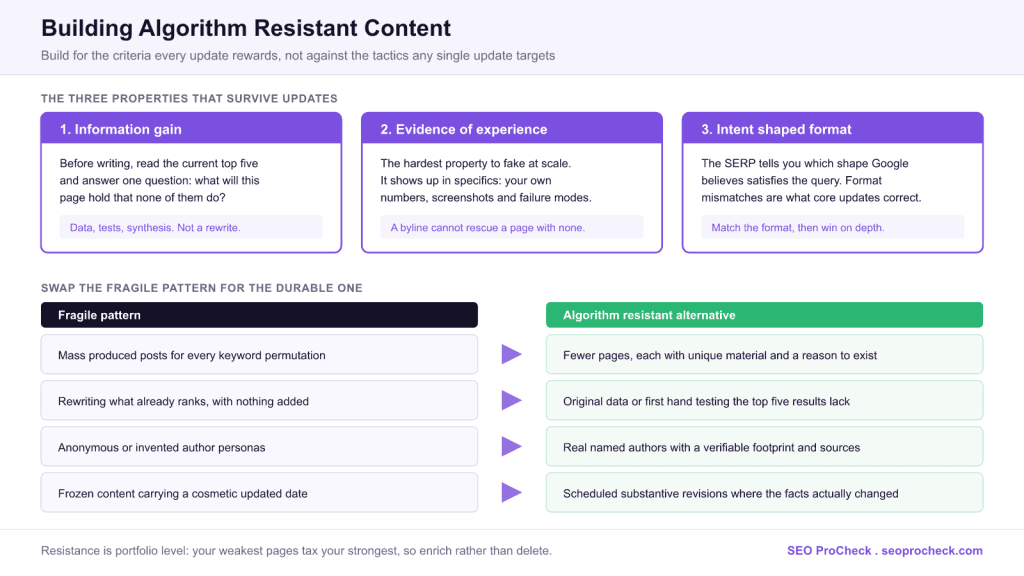
Algorithm resistant content is built for the criteria every Google update rewards, demonstrated first hand experience, genuine information gain, and a page shape that matches search intent, rather than for the tactics any single update targets. You cannot make a page immune to volatility, but you can make it the kind of page that updates consistently push up rather than down.
- The honest test: if this page lost all its rankings tomorrow, would anything of value be lost from the web?
- State the information gain in one sentence before the brief is approved. If you cannot, do the work that creates one or skip the topic.
- Resistance is portfolio level. A large volume of thin pages can suppress an entire domain, so enrich weak sections rather than deleting them.
- Judge resistance across update windows: content that holds or gains through three consecutive core updates is resistant by demonstration.
Algorithm-resistant content is content built to satisfy the stable criteria every Google update rewards (demonstrated first-hand experience, genuine information gain over what already ranks, and a page shape that matches search intent) rather than the tactics any single update targets. You cannot make a page immune to ranking volatility, but you can make it the kind of page that updates consistently push up rather than down. The practical test: if this page lost all its rankings tomorrow, would anything of value be lost from the web? If the honest answer is no, it is not algorithm-resistant.
Understanding Content Quality as Google Actually Evaluates It
Content quality represents a critical component of modern SEO strategy. As search engines continue to evolve and user expectations shift, understanding the nuances of content quality becomes essential for maintaining and improving organic visibility. The stable reference points are public: Google's helpful content guidance, the "Who, How, Why" self-assessment questions, and the Search Quality Rater Guidelines' E-E-A-T framework (Experience, Expertise, Authoritativeness, Trust). None of these are direct ranking factors; they describe what Google's classifiers are trained to approximate. Chasing individual updates is a losing game (the March 2024 core update alone deprecated whole tactic families overnight) but the direction of travel across every update since Panda has been identical: reward pages made by someone who knows the subject, for the reader; demote pages made primarily to occupy a SERP. This guide covers the key concepts, implementation approaches, and strategic considerations that SEO practitioners need to master.
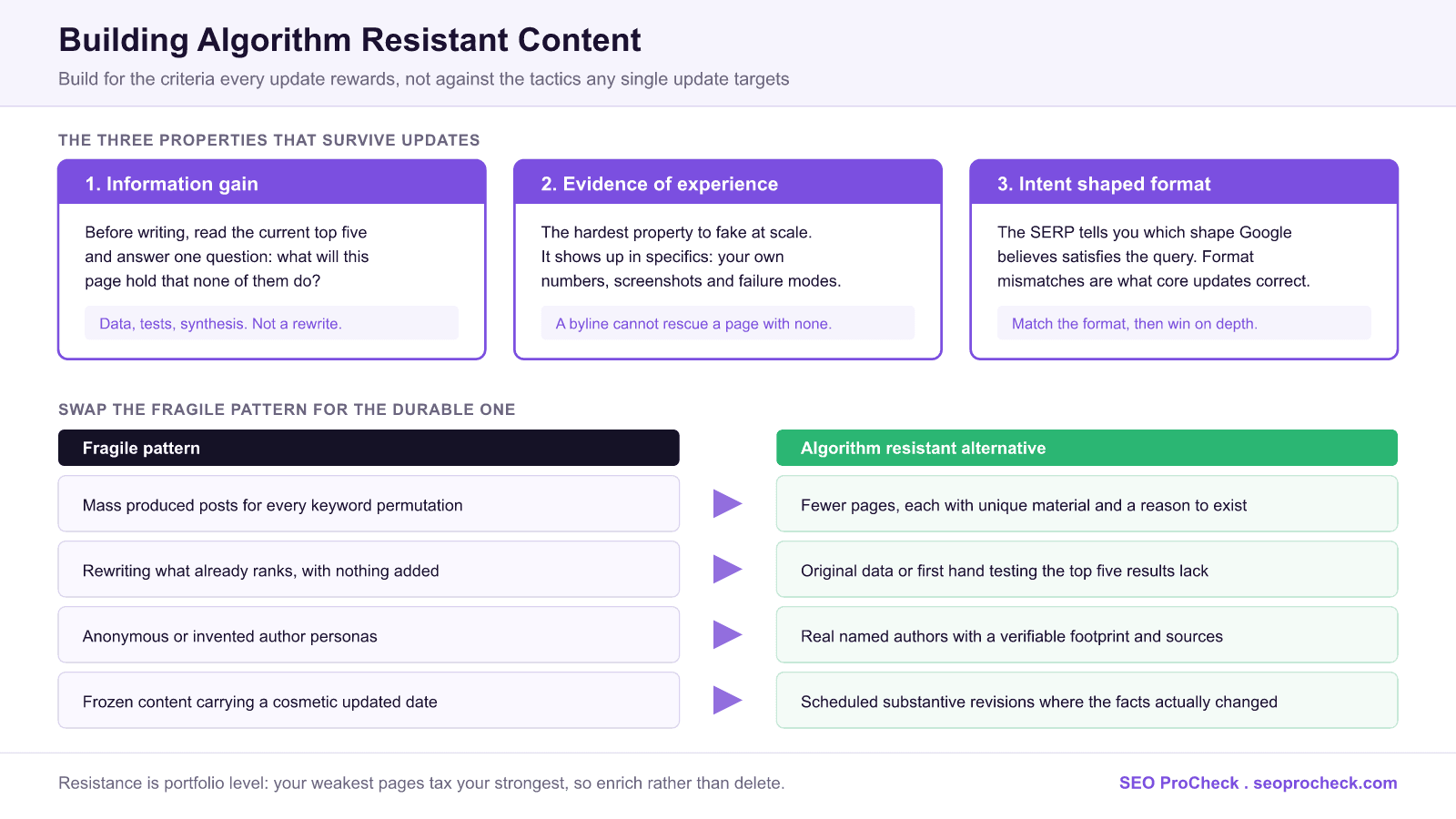
The Three Properties That Survive Updates
1. Information gain
Before writing, read the current top five results and answer one question: what will this page contain that none of them do? Acceptable answers include original data, first-hand testing, a named author's documented experience, a contrarian position you can defend, worked examples from real projects, or genuinely better synthesis. "The same points, rewritten" is not an answer: that is precisely the pattern scaled-content classifiers are built to catch. If you cannot articulate the delta, either do the work that creates one or skip the topic.
2. Evidence of experience
Experience is the E Google added to E-A-T in December 2022, and it is the hardest property to fake at scale. It shows up in specifics: screenshots of your own dashboards, numbers from your own tests, the failure modes you hit that tutorials never mention, opinions with reasoning attached. A page can demonstrate experience without a famous byline; a famous byline cannot rescue a page with none.
3. Intent-shaped format
The SERP tells you what format Google believes satisfies the query: comparison tables, step-by-step tutorials, short definitional answers, tools. Publishing a 3,000-word essay against a query where every ranking page is a 400-word answer with a table is a format mismatch, and format mismatches are what "relevance re-evaluations" in core updates quietly correct. Match the format, then win on depth within it.
Fragile Patterns vs. Resistant Alternatives
| Fragile pattern | Which updates hit it | Algorithm-resistant alternative |
|---|---|---|
| Mass-produced posts targeting every keyword permutation | Helpful content system; scaled content abuse policy (March 2024) | Fewer pages, each with a stated reason to exist and unique material; consolidate overlapping URLs |
| Rewriting what already ranks ("skyscraper" without new substance) | Core updates (relevance/quality re-evaluation) | Original data, tests, or first-hand experience the top five results lack |
| Anonymous or fake-persona content in YMYL niches | Core updates weighting E-E-A-T proxies | Real named authors with verifiable footprints; cite primary sources; show credentials where they exist |
| Publishing outside your site's demonstrated topical scope for traffic | Site reputation abuse policy; helpful content classifiers | Stay inside (or deliberately, gradually expand) the topic set you can cover credibly |
| Exact-match keyword repetition and doorway-style near-duplicates | Every relevance system since Panda/Penguin era | One canonical page per intent; write in the vocabulary of practitioners, not of keyword tools |
| Content frozen since publication with fake "updated" dates | Freshness systems; trust erosion with raters | Scheduled substantive revisions where facts changed; leave evergreen pieces honestly dated |
| Ad/affiliate density that buries the answer | Page experience weighting in core updates; reviews system | Answer first, monetise second; disclose relationships plainly |
Key Considerations for Building Algorithm-Resistant Content
When approaching content quality, several factors require careful attention. Technical implementation must align with broader SEO objectives while maintaining site performance and user experience. The balance between optimization and over-optimization requires ongoing monitoring and adjustment based on performance data and algorithm changes. Industry benchmarks and competitor analysis provide context for evaluating your own implementation. Two considerations deserve special weight. First, sitewide classifiers mean your worst pages tax your best: since the helpful content system was folded into core updates (March 2024), a large volume of thin pages can suppress an entire domain, so pruning-by-enrichment of weak sections is part of protecting strong ones. Second, resistance is portfolio-level. A site where 80% of pages demonstrate experience can carry some purely functional pages; a site that is 80% commodity content gets no protection from its few good pieces.
Implementation Best Practices
Successful implementation begins with thorough auditing of current state and clear goal definition. Document baseline metrics before making changes to enable accurate impact measurement. A workable production gate: before any brief is approved, the writer must state the information gain in one sentence, name the evidence of experience the piece will include, and identify the dominant SERP format. Prioritize changes based on potential impact and implementation effort, focusing on high-impact items first. Test changes in staging environments when possible, and monitor closely after deployment to production. Maintain documentation of changes for future reference: a changelog of what was published and enriched, mapped against update dates, is the fastest way to diagnose which content cohort an update rewarded or punished.
Common Mistakes to Avoid
Several patterns consistently cause problems in content quality implementations. Rushing implementation without proper planning leads to errors that can be costly to fix. Ignoring the interplay between different SEO factors creates conflicts that undermine results. Failing to monitor and iterate based on performance data means missing optimization opportunities. Over-optimization signals can trigger algorithmic suppressions that take months to recover from, and recovery from a sitewide quality classification typically requires demonstrating improvement across the site over multiple crawl cycles, not fixing a handful of pages. The most expensive mistake in 2024 to 2026 specifically: reacting to an update by mass-deleting or noindexing content. Removal destroys any accumulated signals; enriching weak pages into genuinely useful ones preserves the URL, its links, and its history while fixing the quality problem.
Measuring Success
Effective measurement requires defining appropriate KPIs aligned with business objectives. Track both leading indicators (rankings, impressions, technical metrics) and lagging indicators (traffic, conversions, revenue) to build a complete picture. For algorithm resistance specifically, the metric that matters is behaviour across update windows: annotate every confirmed Google update in your analytics (Search Status Dashboard dates), then compare clicks in the 28 days before versus after per content cohort. Content that gains or holds through three consecutive core updates is resistant by demonstration. Establish reasonable timeframes for evaluation, as SEO changes often take weeks or months to fully manifest in results. Compare performance against historical baselines and competitor benchmarks to contextualize results.
Strategic Recommendations
Approach content quality as an ongoing program rather than a one-time project. Build processes for regular auditing, monitoring, and optimization. Stay current with industry developments and algorithm changes that may affect your strategy, but treat update chatter as weather reports, not strategy. Invest in education for team members to build internal capabilities. Diversify discovery surfaces as well: content with real experience and structured, quotable answers is also what AI Overviews and LLM search tend to cite, which hedges against SERP-layout volatility that no on-page work can prevent. Consider how content quality fits within your broader digital marketing and business strategy for maximum impact.
Frequently Asked Questions
It means content aligned with the criteria that persist across updates (experience, information gain, intent match, trust) instead of tactics that exploit a temporary gap. Resistant pages still fluctuate during updates; the difference is that their multi-update trend is flat or up, because each re-evaluation keeps concluding the page deserves its position.
No. Updates change SERP layouts, intent interpretations, and result mixes in ways that can cost traffic even when your page remains the best on the topic: an AI Overview or a video carousel can absorb clicks you used to get. Resistance minimises downside and speeds recovery; it does not eliminate volatility, which is why traffic diversification remains part of the strategy.
Google's stated position is that it rewards quality "however it is produced," and it has removed earlier anti-AI phrasing from its guidance. In practice, undisclosed mass AI generation converges on exactly the pattern the scaled content abuse policy targets: high volume, low information gain, no experience. AI-assisted drafting with human expertise, editing, and original inputs added sits on the safe side of that line; unedited bulk output does not.
Check timing first: in Search Console, compare performance for the 28 days around each date on Google's Search Status Dashboard. An update hit shows as a broad, sitewide (or template-wide) decline beginning within the rollout window, with pages typically slipping positions rather than deindexing. A technical problem shows up in the Page Indexing report as indexation losses, or affects specific URLs regardless of update timing.
Google has said sites affected by sitewide quality systems generally see meaningful recovery only after sustained improvement, often surfacing at a subsequent core update: in practice months, not weeks. Recoveries documented since late 2024 followed substantial site-level work: enriching or consolidating thin sections, adding genuine expertise signals, and reducing publish velocity in favour of depth.
Deletion should be the last resort, reserved for pages with no salvageable topic, no links, and no history worth keeping. The stronger play for thin-but-relevant pages is enrichment: add the specifics, data, tables, and first-hand material that make the page defensible. Google's own guidance frames removal as appropriate only for content that cannot be improved, and every deleted URL forfeits signals an enriched one would have kept.
Take this with you
The assistant links open with a question about this page already written. Nothing is sent until you press enter.
Claude Vincent is a technical SEO consultant focused on crawlability, rendering, and AI-search visibility. He writes the field guides and case studies at SEO ProCheck, with a bias toward the durable, unglamorous work that decides whether search engines and AI answer engines can actually read and cite a site.
About SEO ProCheck
Technical SEO consulting and GEO strategy with 20 years of enterprise experience. Case studies, resources, and tools for search and AI visibility.
Work With Me
Technical SEO audits, GEO strategy, site migrations, and international SEO. Hourly consulting for teams who need hands-on support, not just reports.
Subscribe to our newsletter!








Recent Posts
- Most Top Sites Never Say Who They Are in Structured Data October 14, 2026
- Homepage Titles Are Mostly Too Short, Not Too Long October 8, 2026
- Who Actually Serves an llms.txt? 184 Top Sites Measured September 29, 2026