

The E-A-T of Disease Awareness and Why Brands Need to Get It Right
- November 18, 2021
- General
AI Summary
Disease awareness content sits squarely in Your Money or Your Life territory, where Google holds accuracy and trust to a higher bar, so brands must demonstrate real E-E-A-T: named qualified authors, medical review, primary citations and full transparency about sourcing and funding. Getting it right protects both search visibility and, more importantly, the people who act on the information.
- Health and disease awareness content is YMYL, judged on accuracy and trust above all.
- Show Experience and Expertise with named clinicians, credentials and cited primary sources.
- Transparency matters: review dates, author bios, funding disclosure and clear disclaimers.
- Off site reputation and consensus with authoritative medical bodies reinforce trust.
Why disease awareness is a YMYL trust test
Disease awareness campaigns exist to inform people about conditions, symptoms and treatment options, often funded by pharmaceutical or healthcare brands. That intent makes them Your Money or Your Life content, the category Google treats most cautiously because errors can harm health or finances. For this content, E-E-A-T is not a soft ranking nicety; it is the framework Google uses to decide whether the source deserves to be shown at all. The stakes are real for readers, so the quality bar should be self imposed, not just search driven.
Experience and Expertise: who is speaking
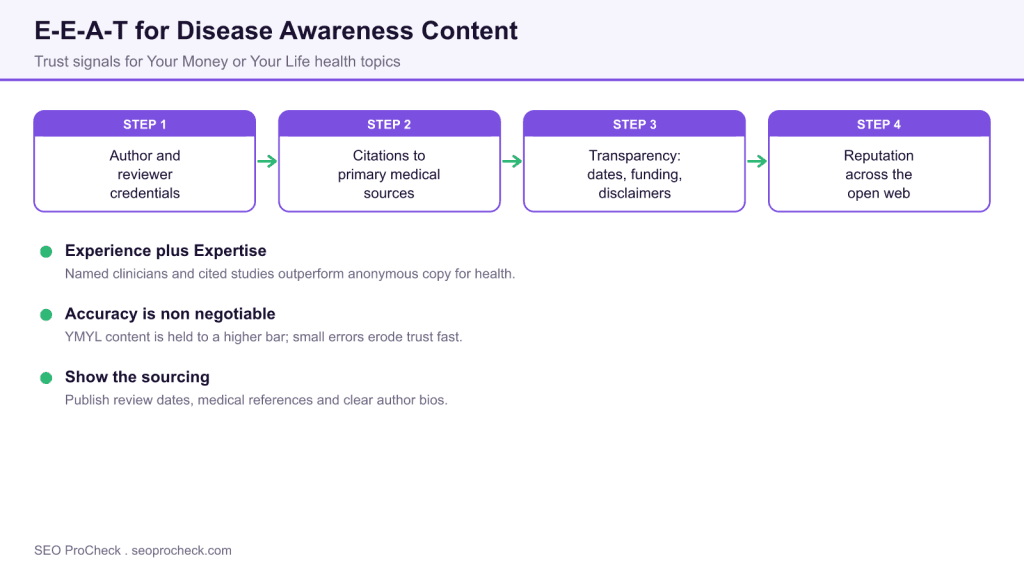
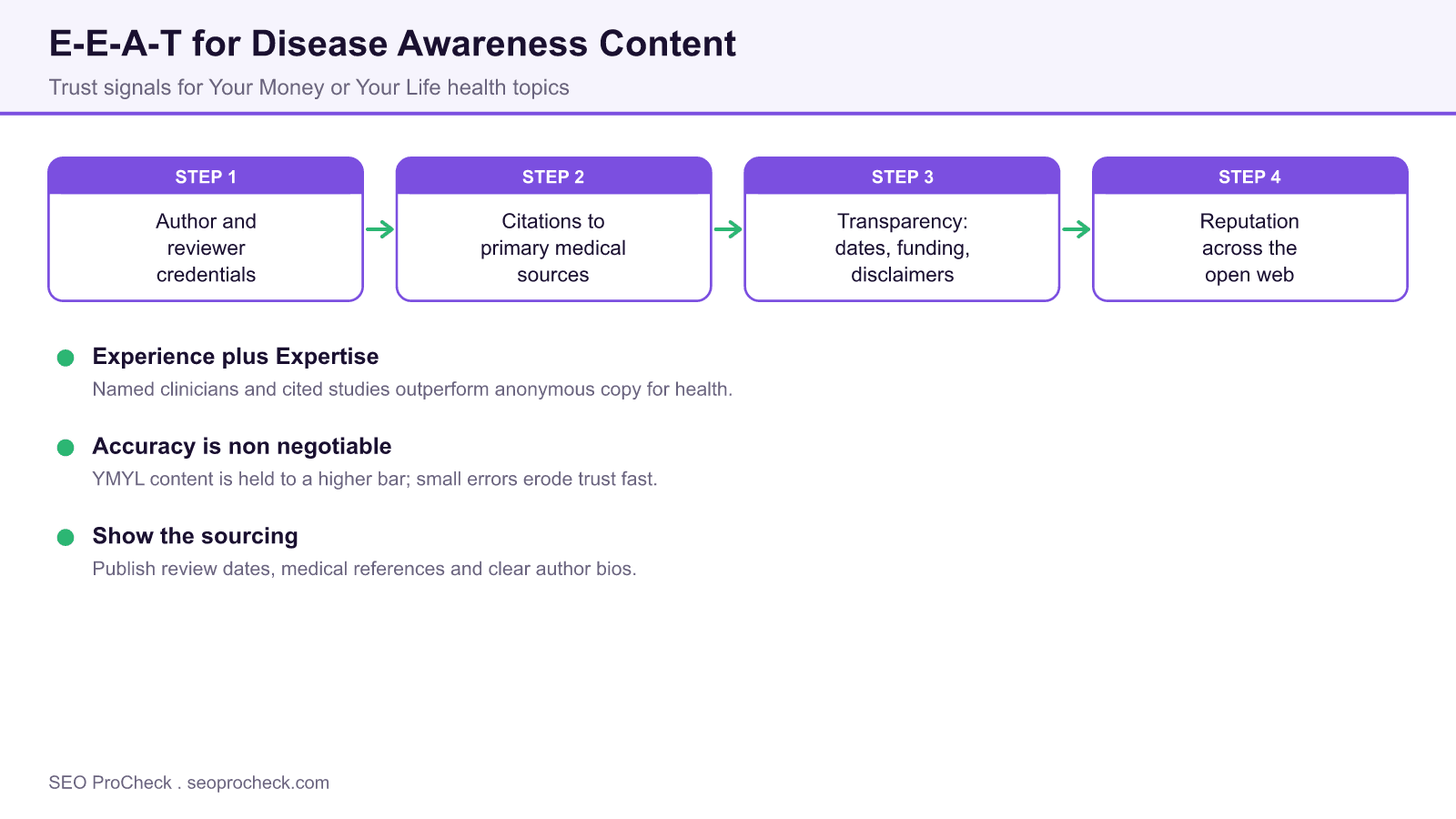
The first E, Experience, and the first E for Expertise, are about the person behind the words. Anonymous or ghostwritten health copy struggles because Google and readers cannot verify competence. Name the author, state their qualifications, and where the topic is clinical, add a medical reviewer with a byline and credentials. Link author bios to verifiable profiles. Cite primary sources, peer reviewed studies, guidance from recognized health authorities and official drug labeling, rather than restating secondary blogs. This is the same authority foundation covered in our E-E-A-T complete guide, applied to medicine.
Authoritativeness and Trust: proving it beyond the page
Authoritativeness is reputation earned across the web, not a claim you make about yourself. For health brands that means recognition and citations from reputable medical institutions, consistency with scientific consensus, and a clean, well maintained presence. Trust, the center of the model, is built from the concrete signals readers can check: accurate up to date information, clearly displayed review or update dates, transparent disclosure of who funded the content, honest handling of risks and side effects, and appropriate disclaimers that the content does not replace professional medical advice. For requirements specific to clinical pages, see our guide to medical content E-E-A-T requirements.
Common mistakes brands make
Several patterns undermine disease awareness content. Publishing under a generic brand byline with no human author. Making claims stronger than the evidence or the approved labeling supports. Omitting side effects, contraindications or funding. Letting pages go stale while guidance evolves. Prioritizing marketing language over patient clarity. Each of these erodes trust and, on YMYL topics, can trigger loss of visibility during core and quality updates. Even smaller health sites can compete by nailing these fundamentals, as we cover in E-E-A-T signals for small sites.
A practical trust checklist
Before publishing disease awareness content, confirm a named, qualified author and, where clinical, a named medical reviewer; primary citations to studies, health authorities or labeling; a visible last reviewed date and review cadence; clear funding and sponsorship disclosure; balanced coverage of benefits and risks; and a plain disclaimer directing readers to professional care. That checklist protects readers first and search performance second, which is the correct order for health content.
| E-E-A-T pillar | What it means for disease awareness | Concrete signal to add |
|---|---|---|
| Experience | First hand or clinical familiarity with the condition | Author or reviewer with relevant clinical background |
| Expertise | Qualified knowledge of the medical topic | Named credentialed author and citations to primary research |
| Authoritativeness | Recognition by the wider medical community | References from and consistency with recognized health bodies |
| Trust | Accuracy, transparency and reader safety | Review dates, funding disclosure, risk balance and disclaimers |
Frequently asked questions
Why is disease awareness content held to a higher standard?
It is Your Money or Your Life content, so inaccurate information can harm health. Google applies stricter E-E-A-T expectations, and responsible brands should apply an even higher self imposed bar to protect readers.
How do brands show E-E-A-T on health content?
Use named, qualified authors and medical reviewers, cite primary sources such as peer reviewed studies and health authorities, display review dates, disclose funding, balance benefits with risks, and add clear medical disclaimers.
Does medical review really affect SEO?
It supports the trust and expertise signals Google looks for on YMYL topics and, more importantly, reduces the risk of publishing inaccurate health information. Named reviewers with credentials make that expertise verifiable.
Can a small health site rank on YMYL topics?
Yes, if it demonstrates genuine expertise, cites authoritative sources, and is transparent about authorship and funding. Focused topical depth and verifiable credentials can outweigh size on trust driven queries.
What disclosures should disease awareness pages include?
Show who wrote and reviewed the content and their qualifications, when it was last reviewed, who funded it, the risks and side effects alongside benefits, and a disclaimer that the content does not replace professional medical advice.
Take this with you
The assistant links open with a question about this page already written. Nothing is sent until you press enter.
Claude Vincent is a technical SEO consultant focused on crawlability, rendering, and AI-search visibility. He writes the field guides and case studies at SEO ProCheck, with a bias toward the durable, unglamorous work that decides whether search engines and AI answer engines can actually read and cite a site.
About SEO ProCheck
Technical SEO consulting and GEO strategy with 20 years of enterprise experience. Case studies, resources, and tools for search and AI visibility.
Work With Me
Technical SEO audits, GEO strategy, site migrations, and international SEO. Hourly consulting for teams who need hands-on support, not just reports.
Subscribe to our newsletter!







Recent Posts
- Finding a Competitor's Sitemap, and Turning It Into a Change Log September 15, 2026
- AI Crawler User Agents: The Current Names, and Which Ones Sites Actually Block September 9, 2026
- Can AI Crawlers Actually Read Your Site? I Measured 400 of the Biggest September 5, 2026