

AI Summary
Joseph Mas argues that JSON is the quiet pipeline through which machines actually consume the web, and proposes "LLM Cards": structured JSON objects authored for accuracy, verification and efficiency rather than for human reading. The idea is sound where the JSON describes what the page genuinely contains, and becomes a spam policy problem the moment the machine layer asserts things the human layer does not.
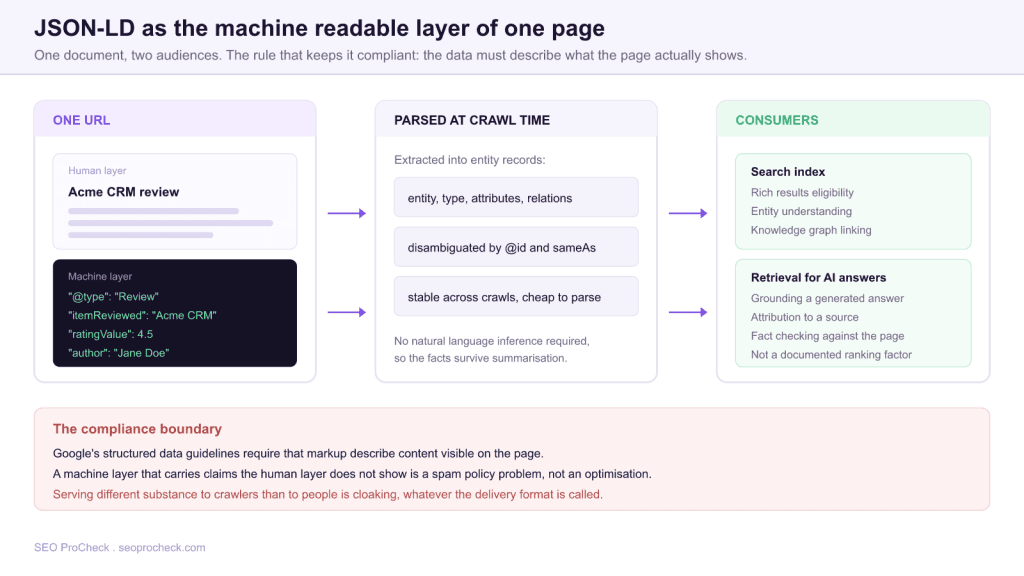
- JSON-LD is parsed at crawl time into entity records, so its facts survive without any natural language inference.
- Structured data is not a documented ranking factor for AI answers. It supports entity resolution, eligibility and grounding.
- Google's structured data guidelines require markup to describe content visible on the page. That line is the whole safety test.
- Decoupled delivery is a legitimate engineering pattern. Serving crawlers different substance than people is cloaking regardless of format.

The framing in Joseph Mas's article is a good one: JSON is the silent infrastructure of machine consumption. Humans experience the web as rendered pages, but the systems that index, retrieve, summarise and cite that web increasingly operate on structured records. His central claim, that "structured data is no longer just SEO, it's the foundation of AI visibility", overstates the evidence in one direction while pointing at something real in another. Both halves are worth unpacking, because the practical advice that falls out is genuinely useful and the risk attached to one part of it is genuinely serious.
How JSON-LD actually reaches a machine
A JSON-LD block is not read the way body copy is read. It is extracted at crawl time and normalised into entity records: a thing, its type, its attributes, and its relationships to other things. That path has properties that plain prose does not.
- No inference step. A parser reading
"ratingValue": 4.5does not have to work out from a sentence whether 4.5 is a rating, a price or a version number. Ambiguity that costs a language model tokens and accuracy costs a JSON parser nothing. - Stable identity.
@idandsameAslet you declare that the entity on your page is the same entity referenced elsewhere. This is the part most sites skip and the part that does the most work for entity resolution. - Survives summarisation. When a retrieval system compresses a page into a chunk, prose facts can be lost or garbled. Attributes extracted from markup are already atomic.
- Cheap and deterministic. Parsing is trivial compared with running a model over a document, which matters when the operation runs across the whole web repeatedly.
Where the claim needs tightening is the leap from "machines parse this efficiently" to "this is the foundation of AI visibility". Mas describes LLM Cards as "the direct ranking factor of machine-readable truth", and that phrase should be read as advocacy rather than documentation. There is no published confirmation from any major AI search provider that structured data is a ranking factor for generated answers. Google has been consistent for years that structured data drives rich result eligibility and entity understanding rather than a generic ranking boost, and nothing in the AI era has been announced to replace that position. Our summary of how AI engines choose sources covers what is actually observable about selection.
The honest version of the argument is still strong: structured data makes your facts cheap to extract, hard to misread and easy to attribute. That is a retrieval and grounding advantage, not a ranking lever, and it is worth doing on those terms alone.
The LLM Cards proposal, and how to implement it safely
Mas's proposal separates a human facing layer, built for readability and engagement, from a machine facing layer built for ingestion. He anticipates the obvious objection and rejects it directly, arguing that LLM Cards are not "shadow pages" or cloaking but an engineering pattern of "decoupled data delivery" at the data layer.
He is right that decoupling is not inherently deceptive. Every site with a JSON-LD block already serves a machine layer alongside a human one, and nobody calls that cloaking. Content APIs, feeds and structured endpoints are ordinary architecture. The distinction that matters is not whether you emit a machine layer, it is what is in it.
Google's structured data general guidelines are explicit that markup should represent the content of the page, and that you should not mark up content that is not visible to users. Google's spam policies separately define cloaking as presenting different content to users and search engines. Put those together and the safety test is a single question: if a human read your machine layer, would it describe the page they are looking at?
| Pattern | What it does | Policy position | Verdict |
|---|---|---|---|
| JSON-LD describing visible page content | Exposes page facts as typed attributes | Explicitly supported | Do it |
Entity graph with @id and sameAs | Disambiguates your entities across the site and the web | Standard schema.org usage | Do it, and it is underused |
Author, credentials, dateModified, citations | Supports provenance and freshness assessment | Standard, provided it is accurate | Do it |
| A JSON endpoint mirroring the page, linked openly | Machine friendly delivery of the same substance | Not addressed as spam if content matches | Conditional, keep it in sync |
| Markup asserting facts absent from the page | Adds claims users never see | Violates structured data guidelines | Avoid |
| Different substance served by user agent | Crawlers and AI bots get a different document | Cloaking under the spam policies | Avoid |
If you want to implement the useful core of this idea, do it as an enrichment of the page you already have rather than as a parallel truth. Concretely:
- Model the entity properly. Give the primary entity a stable
@id, and reference it consistently across templates rather than emitting disconnected blocks per page. - Fill in the attributes you already display but have never marked up: specifications, dates, authorship, prices, availability, ratings, relationships to other entities.
- Use
sameAshonestly to link to profiles you actually control or that genuinely describe the entity. - Keep the human page complete. If a fact is important enough to encode for machines, it is important enough to show. This also happens to be the version that survives any future policy tightening.
- Validate continuously. Run the Rich Results Test and the Schema Markup Validator in your build, and treat a mismatch between markup and rendered content as a failing test.
The implementation mechanics, including how to structure @graph blocks and avoid the duplication traps, are covered in our guide to writing structured data with JSON-LD and schema @id.
Where this sits on the risk spectrum
It is worth being direct about why this proposal attracts criticism, because the criticism is not merely conservatism. Any pattern that optimises a machine facing layer independently of the human one creates a gradient. The first version describes the page faithfully. The second adds a few attributes that are "implied but not stated". The third adds claims the page never makes because they perform well. Nobody decides to cloak; they arrive at it one reasonable increment at a time.
That is a reason to build the guardrail into the system rather than to reject the idea. Two controls do most of the work:
- Generate the machine layer from the same source as the human layer. If both render from one content model, divergence becomes a bug rather than a temptation. This is the strongest argument for the decoupled architecture Mas describes, and it is an argument he is entitled to make.
- Assert parity in CI. A test that fails when the markup contains a value not present in the rendered page turns the policy into an engineering constraint.
On the visibility side, the more reliable lever remains the structure of the visible content itself: self contained passages, clear headings, tables for comparable facts, and explicit sourcing. Retrieval systems chunk documents, and a page written in extractable units performs better whether or not you ship an entity graph. That ground is covered in content structure for AI, and the practical schema questions in our schema markup FAQ.
Read Mas's original for the full framework. Take the entity modelling discipline, which is excellent and underapplied. Hold the ranking factor language at arm's length until someone documents it. And keep the machine layer describing the page a human would see.
Frequently asked questions
Is JSON-LD a ranking factor for AI search?
There is no published confirmation from any major provider that structured data ranks content in AI answers. What it demonstrably does is make entities easier to resolve, facts cheaper to extract and sources easier to attribute. Treat claims of a direct AI ranking factor as opinion until documented, and implement structured data for the extraction benefit instead.
Do large language models actually read JSON-LD?
Retrieval and indexing systems parse it, and that parsed output is part of what grounds a generated answer. Whether a given model sees the raw block during training or generation varies by system and is not publicly specified. The dependable benefit sits in the retrieval and entity layers rather than in the model itself.
What are LLM Cards?
They are Joseph Mas's proposed pattern of structured JSON objects authored specifically for machine ingestion, built around accuracy, verification and efficiency, and kept separate from the human facing presentation layer. He frames them as decoupled data delivery rather than as alternative pages. The pattern is safe to the extent the data describes the page it belongs to.
Is serving a machine readable JSON layer considered cloaking?
Not by itself. Every page with JSON-LD serves a machine layer, and content APIs are ordinary architecture. It becomes cloaking when the substance differs, meaning crawlers or AI bots receive claims, content or emphasis that users do not. The test is whether both layers describe the same thing, not whether two layers exist.
Can structured data include information that is not visible on the page?
Google's structured data guidelines say it should not, and that markup should represent the visible content of the page. Some property types are legitimately non visible by nature, such as identifiers and machine readable dates, but adding substantive claims users cannot see is outside the guidelines and risks a manual action.
Does an entity graph with @id really make a difference?
It is the highest value and least implemented part of most schema deployments. Without stable identifiers, each page emits an isolated description and nothing connects them. With @id and sameAs, you assert that the organisation, author and product referenced across hundreds of pages are the same entities, which is exactly the problem entity resolution is trying to solve.
The useful residue of this argument is not a new tactic. It is a reminder that the web now has two readerships, and that most sites still describe themselves properly to only one of them.
Source: https://www.linkedin.com/pulse/json-silent-data-highway-llm-ingestion-joseph-mas-kxkuc/
Take this with you
The assistant links open with a question about this page already written. Nothing is sent until you press enter.
Claude Vincent is a technical SEO consultant focused on crawlability, rendering, and AI-search visibility. He writes the field guides and case studies at SEO ProCheck, with a bias toward the durable, unglamorous work that decides whether search engines and AI answer engines can actually read and cite a site.
About SEO ProCheck
Technical SEO consulting and GEO strategy with 20 years of enterprise experience. Case studies, resources, and tools for search and AI visibility.
Work With Me
Technical SEO audits, GEO strategy, site migrations, and international SEO. Hourly consulting for teams who need hands-on support, not just reports.
Subscribe to our newsletter!
Recent Posts
- Homepage Titles Are Mostly Too Short, Not Too Long October 8, 2026
- Who Actually Serves an llms.txt? 184 Top Sites Measured September 29, 2026
- Finding a Competitor's Sitemap, and Turning It Into a Change Log September 15, 2026