


AI Summary
A large language model does not read your page the way a person does: it fetches the HTML, splits the main content into passages, embeds those passages, and retrieves the few that best match a prompt before quoting one back as an answer. To earn citations you write self contained, factually dense passages that answer one question each, name their sources, and use plain semantic HTML.
- LLMs cite passages, not whole pages, so every section should stand on its own.
- Lead each passage with a direct answer, then support it with a named source.
- Semantic HTML, headings, lists, and tables make content easy to extract.
- Name entities in full and avoid pronouns that lose meaning out of context.

The emergence of AI-powered search and large language models has created new considerations for content optimization. This resource explores how content creators can adapt their strategies to maintain visibility as AI increasingly mediates information discovery.
Understanding AI Content Consumption
Large language models process content differently than traditional search algorithms. They seek factual, well-structured information that can be confidently cited. Understanding these consumption patterns helps optimize content for AI visibility alongside traditional search performance.
Optimization Approaches
Research indicates specific approaches improve AI citation likelihood: including statistics with sources, maintaining factual accuracy, structuring content for easy extraction, and demonstrating clear expertise. These tactics complement rather than replace traditional SEO fundamentals.
Strategic Implications
As AI search grows, early optimization provides compounding advantages. Building citation presence now establishes your content as an authoritative source that AI systems learn to trust. The convergence of good SEO and good GEO practices suggests quality-focused strategies benefit both channels.
This resource provides actionable guidance for the evolving intersection of content strategy and AI visibility.
Source: https://www.linkedin.com/pulse/practical-framework-llm-consumption-joseph-mas-ghwrc/
SEO ProCheck practitioner notes
The framework above is a useful starting point, so here is how we operationalise it. Treat every heading in your document as the entry point to a passage that a retrieval system might lift out on its own. If a reader arrived at that passage cold, with no title and no surrounding paragraphs, it still has to make sense and still has to answer something. That single test drives most of the structural choices below.
Write passages that survive extraction
Retrieval augmented generation, the technique behind ChatGPT search, Perplexity, Google AI Overviews, and Google AI Mode, does not hand the model your whole article. It hands the model a handful of passages that scored highest against the query embedding. So the unit of optimisation is the passage, roughly a heading plus the two or three paragraphs beneath it. Open each passage with a one sentence direct answer, then expand. Front loading the answer means the passage reads as a complete statement even when it is quoted in isolation, which is exactly the state an LLM sees it in.
Make facts easy to trust and easy to quote
Models prefer to cite claims they can attribute. A number floating in a sentence with no origin is a liability, but the same number paired with a named organisation and a date is quotable. Write "according to Google Search Central documentation" rather than "studies show", and keep the source adjacent to the claim inside the same passage, not buried in a footnote three sections away. Pair every statistic with its source in the same sentence or the sentence beside it, because retrieval may separate that passage from the rest of the page.
Structure the HTML for machines and people
Semantic HTML is not a nicety here, it is the parsing contract. Use a single h1 for the page, then h2 and h3 to mark topic boundaries that a chunker can split on cleanly. Convert comparisons into real table markup, turn sequences into ordered lists, and put definitions in short standalone paragraphs. Add FAQ and Article schema so the machine gets an explicit, typed copy of your key facts. A page that is trivial to parse is a page that is easy to retrieve and easy to cite.
Name your entities in full
Once a passage is pulled out of context, pronouns break. A sentence that opens with "It reduced crawl waste by a third" is useless on its own, whereas "Consolidating duplicate parameter URLs reduced crawl waste" carries its meaning anywhere. Repeat the subject, spell out product and brand names, and expand acronyms on first use within each major section. This redundancy feels heavy when you read top to bottom, but it is what keeps a quoted passage accurate.
Content attributes LLMs reward
| Attribute | Why an LLM favours it | How to apply it |
|---|---|---|
| Self contained passages | Retrieval quotes one chunk, not the page | One question per heading, answer first |
| Sourced facts | Attributable claims are safer to cite | Name the source in the same sentence |
| Semantic HTML | Clean boundaries for chunking | Headings, lists, tables, no div soup |
| Explicit entities | Meaning survives out of context | Repeat names, expand acronyms |
| Typed schema | Machine readable copy of key facts | FAQPage, Article, HowTo JSON LD |
What has changed since this framework
When this framework was written, optimising for LLMs was largely a bet on the future. It is now a live channel. Google rolled out AI Overviews and later AI Mode, ChatGPT gained a search mode with inline citations, and Perplexity built an entire product around cited answers. The tactics have held up well, but two things are newer. First, sites can publish an llms.txt file to point AI systems at their most important content, a convention that did not exist when the original piece appeared. Second, a measurement layer has emerged: teams now track referral traffic and brand mentions from AI assistants, sometimes called generative engine optimisation, to prove the work pays off. The core advice, write clear sourced passages in clean HTML, is unchanged and now carries measurable upside.
Related reading
- How AI Mode works and how SEO can prepare
- A technical SEO adaptation for AI visibility
- Browser extensions and daily SEO stack
Frequently asked questions
What does LLM consumption mean in SEO?
It describes how a large language model ingests and reuses your content: it fetches the HTML, splits the main content into passages, embeds them, and retrieves the best matching passage to answer a prompt. Optimising for it means writing content that is easy to split, easy to trust, and easy to quote in isolation.
How do I get an AI model to cite my page?
Write self contained passages that answer one question each, lead with a direct answer, and pair every claim with a named source. Use clean semantic HTML so the passage can be extracted cleanly, and name entities in full so the meaning holds when the passage is quoted on its own.
Is optimising for LLMs different from normal SEO?
It overlaps heavily but shifts the unit of work from the page to the passage. Traditional SEO already rewards clear structure, sourcing, and topical depth, and those same habits help LLMs. The added emphasis is on making each passage stand alone and on providing typed schema so machines get an explicit copy of your facts.
Does schema markup help with AI visibility?
Yes. FAQPage, Article, and HowTo JSON LD give the model a structured, unambiguous version of your key facts alongside the prose. Schema does not guarantee a citation, but it lowers the chance the model misreads your content and it reinforces the entities and claims you want associated with your brand.
What is llms.txt and should I add one?
The llms.txt file is a plain text file at the root of your site that points AI systems toward your most important pages, similar in spirit to an XML sitemap. It is an emerging convention rather than a strict standard, and adding one is low risk, so it is worth publishing if you want to guide how AI tools navigate your content.
Do statistics really need a named source for AI?
They do if you want the fact to be quoted confidently. Models are more willing to cite a claim they can attribute, so a statistic paired with a named organisation and a date is far more useful than an unsourced number. Keep the source in the same passage as the claim so retrieval never separates them.
Take this with you
The assistant links open with a question about this page already written. Nothing is sent until you press enter.
Claude Vincent is a technical SEO consultant focused on crawlability, rendering, and AI-search visibility. He writes the field guides and case studies at SEO ProCheck, with a bias toward the durable, unglamorous work that decides whether search engines and AI answer engines can actually read and cite a site.
About SEO ProCheck
Technical SEO consulting and GEO strategy with 20 years of enterprise experience. Case studies, resources, and tools for search and AI visibility.
Work With Me
Technical SEO audits, GEO strategy, site migrations, and international SEO. Hourly consulting for teams who need hands-on support, not just reports.
Subscribe to our newsletter!
Recent Posts
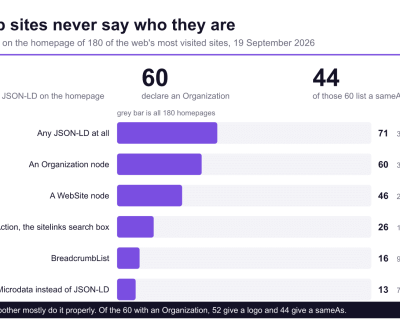
- Most Top Sites Never Say Who They Are in Structured Data October 14, 2026
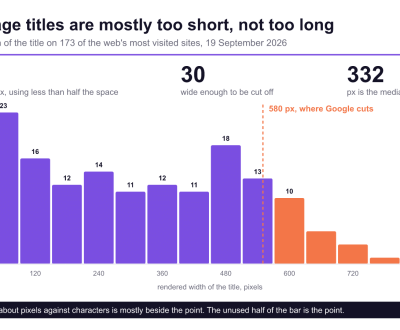
- Homepage Titles Are Mostly Too Short, Not Too Long October 8, 2026
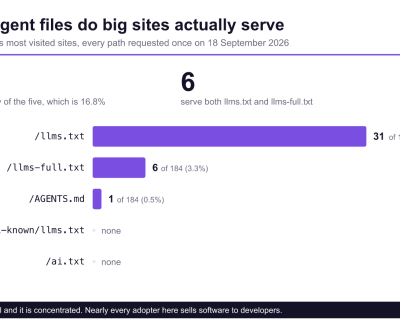
- Who Actually Serves an llms.txt? 184 Top Sites Measured September 29, 2026