

AI Summary
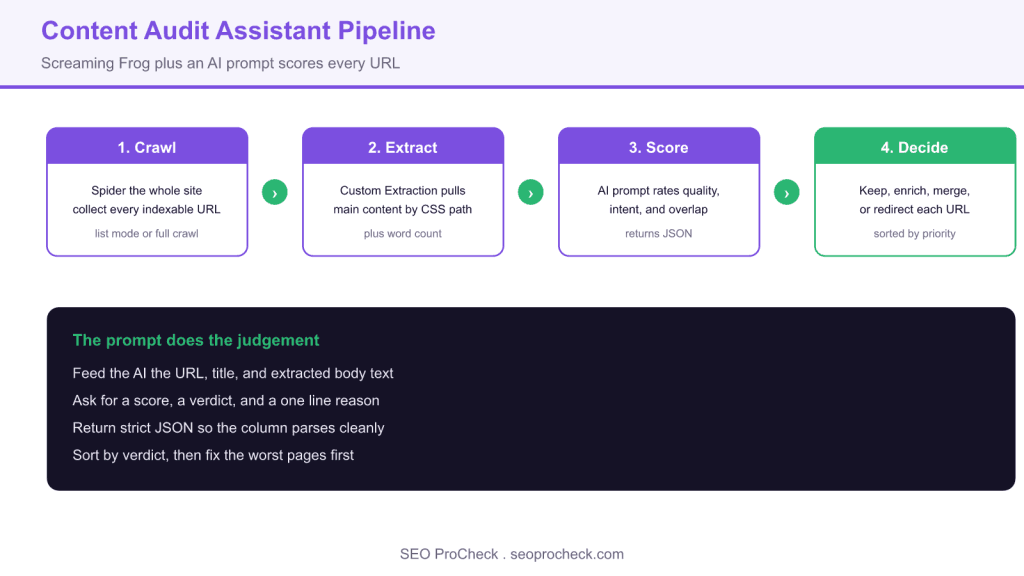
You can turn Screaming Frog into a content audit assistant by crawling the site, extracting each page's main text with Custom Extraction, sending that text to an AI model with a scoring prompt, and using the returned verdict to route every URL to keep, enrich, merge, or redirect. The crawler handles scale and the AI prompt handles judgement, so a one person team can triage thousands of pages in an afternoon.
- Custom Extraction pulls the main content by CSS selector so the AI scores real copy, not boilerplate.
- A strict JSON prompt returns a score, a verdict, and a one line reason per URL.
- Route each page to keep, enrich, merge, or redirect based on the verdict.
- Screaming Frog now has native AI features, so an external API is optional.
The emergence of AI-powered search and large language models has created new considerations for content optimization. This resource explores how content creators can adapt their strategies to maintain visibility as AI increasingly mediates information discovery.
Understanding AI Content Consumption
Large language models process content differently than traditional search algorithms. They seek factual, well-structured information that can be confidently cited. Understanding these consumption patterns helps optimize content for AI visibility alongside traditional search performance.
Optimization Approaches
Research indicates specific approaches improve AI citation likelihood: including statistics with sources, maintaining factual accuracy, structuring content for easy extraction, and demonstrating clear expertise. These tactics complement rather than replace traditional SEO fundamentals.
Strategic Implications
As AI search grows, early optimization provides compounding advantages. Building citation presence now establishes your content as an authoritative source that AI systems learn to trust. The convergence of good SEO and good GEO practices suggests quality-focused strategies benefit both channels.
This resource provides actionable guidance for the evolving intersection of content strategy and AI visibility.
Source: https://www.ianlurie.com/content/audit-existing-content-screamingfrog-ai/
SEO ProCheck practitioner notes
The idea in the source is simple and powerful: let the crawler gather the pages and let a language model make the qualitative call that used to eat days of manual review. Below is how we wire it up in practice, including the Custom Extraction selector, the prompt shape, and the decision rules that turn a spreadsheet of scores into a work queue.
Extract the content, not the chrome
Point Screaming Frog at the main content container so the model scores the article and not the navigation, footer, and sidebar. In Configuration, Custom, Extraction, add an extractor that targets the body wrapper with a CSS path such as main article or .entry-content and set it to return the text content. Add a second extractor for the visible word count. Extracting the real copy matters because a page can look thin in raw HTML yet be padded with template markup, and a page can look long yet be mostly navigation.
Write a scoring prompt that returns strict JSON
The model needs a tight contract or the output column becomes unusable. Ask for a fixed shape and nothing else. A prompt like the one below keeps every row parseable:
You are an SEO content auditor. Given the URL, title, and body text,
return ONLY valid JSON: {"score":0-100,"verdict":"keep|enrich|merge|redirect",
"reason":"one short sentence"}. Score on depth, search intent match,
uniqueness, and freshness. Do not add commentary outside the JSON.
Feed it the extracted title and body as variables. Because the reply is strict JSON, you can split it into columns after export, or parse it directly if you call the API from a script rather than inside the crawl.
Turn scores into decisions
The verdict field is the point of the whole exercise. Treat keep as pages that already earn their place, enrich as pages with the right intent but thin execution, merge as near duplicates that should be consolidated into one stronger URL, and redirect as pages with no unique value and no traffic. Consolidating overlapping pages and enriching thin but relevant ones is almost always higher leverage than deleting, which is why the queue below leads with enrich and merge rather than removal.
Validate before you act
An AI verdict is a strong first pass, not a final ruling. Cross reference the queue against Search Console clicks and impressions before you redirect anything, because a page the model rates as thin may still catch a steady trickle of qualified queries. Keep the original crawl export as a backup, apply changes in small batches, and recrawl to confirm the fixes landed. The assistant compresses the triage, but a human still signs off on removals.
Verdict to action map
| AI verdict | Typical signal | Action to take |
|---|---|---|
| Keep | Deep, unique, on intent | Leave live, refresh on schedule |
| Enrich | Right topic, thin execution | Add depth, examples, and schema |
| Merge | Overlaps another URL | Consolidate, then redirect the weaker |
| Redirect | No unique value, no traffic | 301 to the nearest strong page |
What has changed since this how to
When this walkthrough was published, connecting a language model to Screaming Frog meant wiring in your own OpenAI API key through the Custom JavaScript feature. Screaming Frog has since added native AI features: recent versions let you run AI prompts directly against crawled pages and configure them without hand written scripts, which lowers the setup cost considerably. The workflow is otherwise identical, extract the content, prompt for a verdict, decide per URL, but you now have a choice between the built in integration and your own API call. If you already run scripted audits, the external call still gives you the most control over the prompt and the model.
Related reading
- A practical framework for LLM consumption
- Browser extensions and daily SEO stack
- More SEO articles and guides
Frequently asked questions
How do I extract page content in Screaming Frog?
Open Configuration, Custom, Extraction and add an extractor targeting the main content container with a CSS path such as main article or a class like entry-content, set to return text content. This gives the audit the real article copy rather than navigation and footer boilerplate, which is what the AI needs to score quality accurately.
Do I need an OpenAI key to build a content audit assistant?
Not any more. Recent versions of Screaming Frog include native AI features that let you run prompts against crawled pages without writing scripts. You can still bring your own API key through Custom JavaScript if you want full control over the model and prompt, but it is now optional rather than required.
What should the AI scoring prompt return?
Ask for strict JSON with a numeric score, a verdict of keep, enrich, merge, or redirect, and a one line reason. Constraining the output to JSON keeps every crawl row parseable so you can sort and filter the results, whereas free text answers are hard to turn into a work queue.
Should I delete pages the AI marks as thin?
Not automatically. Cross reference the verdict against Search Console clicks and impressions first, because a page the model rates as thin can still attract qualified queries. Enrich or merge is usually higher leverage than deletion, and any redirect should be a deliberate human decision backed by the traffic data.
How large a site can this handle?
Screaming Frog comfortably crawls tens of thousands of URLs, and the AI step scales with your API limits or the tool's native integration. For very large sites, run the audit in segments by section or template so you can review each batch, and keep the crawl exports as backups before making changes.
What is the difference between merge and redirect verdicts?
Merge means two or more pages cover overlapping intent and should be combined into one stronger URL, after which the weaker versions are redirected. Redirect on its own means a page has no unique value and no traffic worth preserving, so it points to the nearest relevant page. Merge preserves content, redirect retires it.
Claude Vincent is a technical SEO consultant focused on crawlability, rendering, and AI-search visibility. He writes the field guides and case studies at SEO ProCheck, with a bias toward the durable, unglamorous work that decides whether search engines and AI answer engines can actually read and cite a site.
About SEO ProCheck
Technical SEO consulting and GEO strategy with 20 years of enterprise experience. Case studies, resources, and tools for search and AI visibility.
Work With Me
Technical SEO audits, GEO strategy, site migrations, and international SEO. Hourly consulting for teams who need hands-on support, not just reports.
Subscribe to our newsletter!







Recent Posts
- Can AI Crawlers Actually Read Your Site? I Measured 400 of the Biggest September 5, 2026
- The Pre-Publish Quality Gate for AI-Assisted Content August 6, 2026
- AGENTS.md vs llms.txt vs llms-full.txt: Which Agent File Does What July 18, 2026