

AI Summary
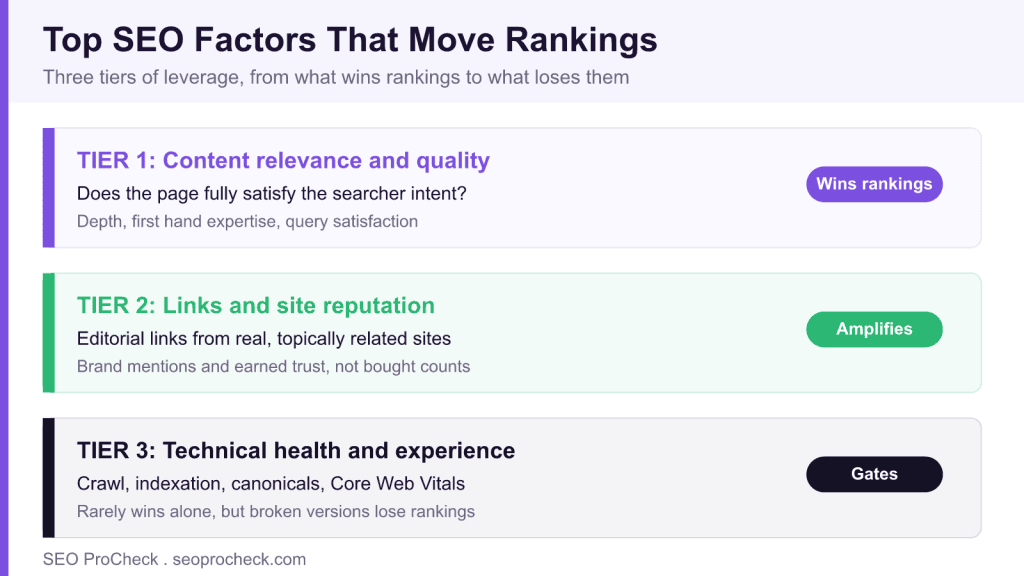
The SEO factors that actually move rankings sort into three tiers: content relevance and quality first, links and site reputation second, and technical health with page experience third. Everything else is a tiebreaker, so audit these in order and fix indexation before you polish content.
- Tier 1, content relevance, is the biggest lever: fully answer the query with genuine expertise.
- Tier 2 is editorial links from real, topically related sites, not bought link counts.
- Tier 3, technical health and Core Web Vitals, rarely wins alone, yet broken versions lose rankings.
- Audit in order: crawl, verify indexation in Search Console, map queries to pages, then review links and field data.

Ask ten SEOs to name the top SEO factors and you will get ten different lists, most of them padded to two hundred items because a 2009 blog post said Google uses "over 200 signals." Here is the honest version: on real client sites, real ranking movement comes from a handful of levers. The rest is either a tiebreaker or a myth that refuses to die. I have watched sites double organic traffic by fixing three things, and I have watched teams burn quarters on factor number 147 while their category pages returned soft 404s.
The three tiers that actually matter
Tier one is relevance and content quality. Google's own documentation on ranking systems says content relevance and helpfulness sit at the core of how results get ranked, and every test I have run agrees. A page that fully answers the query, written by someone who obviously knows the subject, beats a thin page with perfect title tags every single time. This is not about word count. It is about query satisfaction: does the searcher get what they came for without pogo-sticking back to the results?
Tier two is links and site reputation. PageRank is the oldest confirmed signal in Google's arsenal, and links from genuinely trafficked, topically related sites still move rankings in every competitive niche I work in. What changed is the tolerance for junk: directory spam and PBN links now range from ignored to harmful. One editorial link from an industry publication outweighs fifty "guest posts" on sites nobody reads.
Tier three is technical health and page experience. Crawlability, indexation, canonical hygiene, HTTPS, mobile rendering, and Core Web Vitals. These rarely win you rankings on their own, but broken versions of them absolutely lose rankings. Think of tier three as the plumbing: nobody compliments a house on its pipes, but a burst pipe ruins everything upstairs.
Factor reference grid
| Factor | What gets evaluated | My weight | Where to check it |
|---|---|---|---|
| Content relevance and depth | Does the page satisfy the query intent fully | Very high | GSC query-to-page mapping, manual SERP review |
| Links and anchor context | Editorial links from real, relevant sites | High | Ahrefs, Majestic, GSC Links report |
| Crawlability and indexation | Can Googlebot reach, render, and index the page | High (as a gate) | Screaming Frog, GSC Page Indexing, server logs |
| Internal linking | Crawl paths and authority flow to money pages | Medium-high | Screaming Frog crawl depth and inlinks report |
| Page experience and CWV | LCP, INP, CLS, mobile usability, HTTPS | Medium (tiebreaker) | CrUX, PageSpeed Insights, GSC CWV report |
| E-E-A-T signals | Demonstrated experience, authorship, citations | Medium, higher in YMYL | Manual review against Quality Rater Guidelines |
| Freshness | Recency where the query deserves it | Query dependent | SERP sampling for your target queries |
How to audit your site against these factors
Do this in order. Each step gates the next, and there is no point polishing content that Google cannot index.
- Crawl the site with Screaming Frog. Look for noindex accidents, canonical conflicts, redirect chains, orphan pages, and crawl depth beyond three or four clicks for pages you care about.
- Cross-check indexation in Search Console. The Page Indexing report tells you what Google actually did with your URLs, which frequently disagrees with what your crawl says should happen. Investigate every "Crawled, currently not indexed" cluster; that status is usually a quality verdict, not a technical one.
- Map queries to pages in GSC. Pull the Performance report, group queries by intent, and check whether the ranking page is the one you would want to rank. Cannibalization shows up here as two URLs trading impressions for the same query.
- Review the link profile. In Ahrefs or Majestic, sort referring domains by traffic and relevance, not raw counts. A profile that is 90 percent directories and scraped mentions explains a lot of stuck rankings.
- Check field data, not lab data. CrUX numbers in PageSpeed Insights reflect what real Chrome users experienced. Lab scores are for debugging, not for judging.
- Read your server logs. If Googlebot spends its crawl budget on faceted URL junk and parameter duplicates, your important pages get visited less often than they should.
- Fix indexation and crawl issues before touching content
- Write for the query, then verify with GSC data that it matched
- Earn a few links from sites your customers actually read
- Judge speed by CrUX field data over a 28 day window
- Re-test after every change; your niche is its own laboratory
- Chase a 200-item factor checklist from a decade-old listicle
- Buy link packages because the count looks impressive
- Pad word count to match whatever ranks number one
- Treat a 100/100 Lighthouse score as an SEO deliverable
- Change ten variables at once and guess which one worked
What good looks like
A healthy site has a boring Page Indexing report: pages you want indexed are indexed, pages you excluded are excluded on purpose. Every commercial query you target has exactly one obvious landing page, and that page ranks with a title and snippet that earn the click. The link profile grows a few real referring domains a month without anyone buying anything. Core Web Vitals sit green in field data. When you publish something genuinely useful, it gets indexed within days and starts pulling long-tail impressions within weeks. None of that is glamorous, and that is rather the point: the top SEO factors are fundamentals executed consistently, not tricks.
FAQ
Does Google really use over 200 ranking factors?
Are Core Web Vitals a major ranking factor?
Does word count matter?
How long before changes show results?
Which factor should a small site prioritize first?
Want a second pair of eyes on your rankings? I run deep technical and content audits that tell you which of these factors is actually holding your site back, with a prioritized fix list instead of a 90 page PDF nobody reads.
Source: https://topseofactors.com/
Related on SEO ProCheck
- Search intent guide: match Tier 1 content to what the searcher actually wants.
- SEO audit FAQ: the process for checking every factor on your own site.
- Dwell time: how query satisfaction shows up as a click signal.
Take this with you
The assistant links open with a question about this page already written. Nothing is sent until you press enter.
Claude Vincent is a technical SEO consultant focused on crawlability, rendering, and AI-search visibility. He writes the field guides and case studies at SEO ProCheck, with a bias toward the durable, unglamorous work that decides whether search engines and AI answer engines can actually read and cite a site.
About SEO ProCheck
Technical SEO consulting and GEO strategy with 20 years of enterprise experience. Case studies, resources, and tools for search and AI visibility.
Work With Me
Technical SEO audits, GEO strategy, site migrations, and international SEO. Hourly consulting for teams who need hands-on support, not just reports.
Subscribe to our newsletter!








Recent Posts
- Most Top Sites Never Say Who They Are in Structured Data October 14, 2026
- Homepage Titles Are Mostly Too Short, Not Too Long October 8, 2026
- Who Actually Serves an llms.txt? 184 Top Sites Measured September 29, 2026