

Why it’s worth targeting keywords with no-to-low monthly search volume
- June 13, 2021
- General
AI Summary
Keywords with little or no reported search volume are worth targeting because they carry specific intent, face far less competition, and often convert better than broad head terms. Volume figures in keyword tools are estimates that round small numbers to zero, so a query showing no volume can still bring in real, qualified visitors month after month.
- Long tail and zero volume queries usually signal a clearer, later stage buying intent.
- Low competition means new or smaller sites can actually rank, unlike for head terms.
- Keyword tools estimate and round volume, so zero volume often means unmeasured, not nonexistent.
- Many small queries added together can outweigh a single high volume term in traffic and revenue.
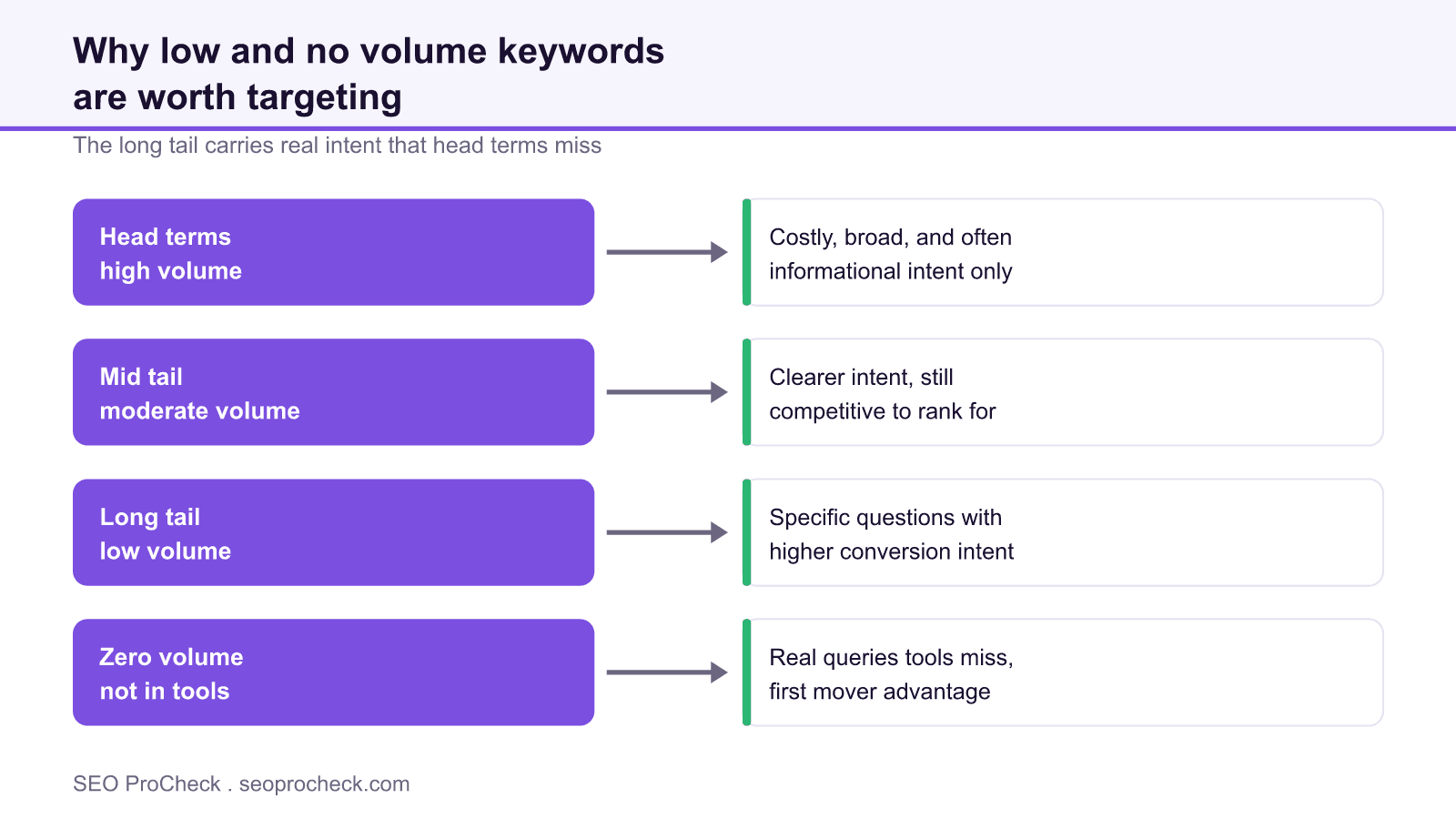
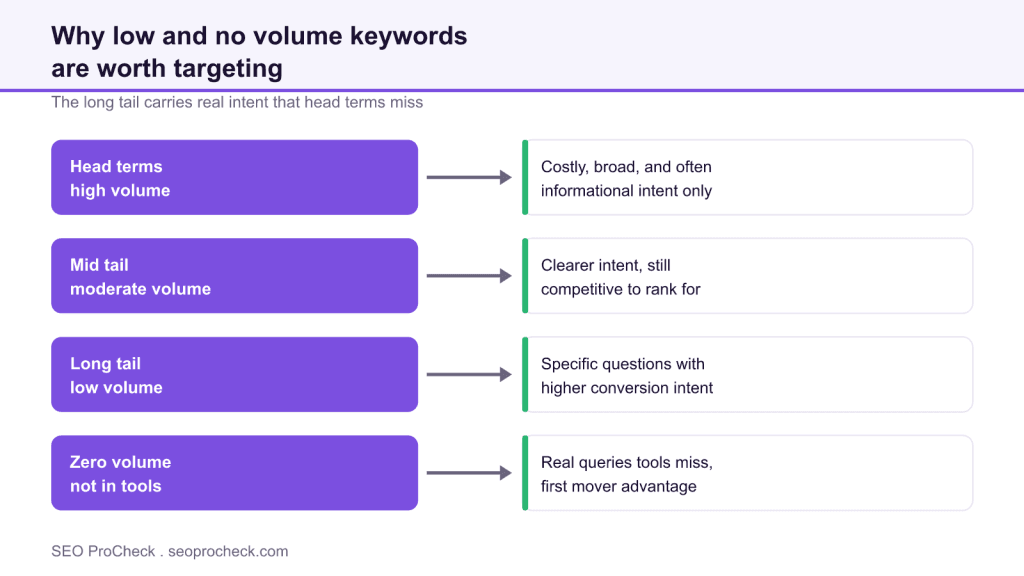
One of the most common mistakes I see in keyword research is filtering the list by minimum search volume and deleting everything below it. That single step throws away some of the best opportunities on the site. Low and no volume keywords are not junk. They are often the most specific, most commercial, and most winnable queries you will find.
Why volume numbers lie to you
Search volume in every popular tool is an estimate. It is modelled from clickstream samples and historical data, then rounded. Queries that only a handful of people search each month frequently get reported as zero because the tool cannot measure them reliably, not because nobody searches them. Google itself has said that a large share of daily queries have never been seen before. By definition those queries have no volume history, yet collectively they are an enormous slice of all searches. If you only chase terms with a comfortable volume number, you are competing for the small, crowded part of demand and ignoring the vast, quiet majority.
The intent advantage of the long tail
Short head terms are usually vague. Someone searching a single broad word could want a definition, a brand, a product, or just a picture. A long specific phrase tells you far more about what the person actually needs, and specificity tends to correlate with how close they are to acting. Compare the difference between the head term and the long tail version of a query and you can usually feel the intent sharpen as the phrase gets longer. That is why a page built around a precise, low volume question often converts at several times the rate of a page chasing a broad term.
The competition advantage
High volume terms attract every competitor with a budget. The results are dominated by large brands, and the keyword difficulty is brutal for anyone without significant authority. Low volume terms are usually wide open. A well written page answering a specific question can rank quickly, earn its first clicks within weeks, and start building the topical authority that eventually helps you compete for the bigger terms too. Winning small first is how most sites earn the right to win big.
How to find and prioritise low volume keywords
Do not rely only on the volume column. Mine Google autocomplete, the People Also Ask box, related searches, your own site search logs, and real customer support questions. Look at the queries already bringing impressions in Google Search Console where you rank on page two or three. The table below shows how I weigh a low volume keyword when deciding whether it earns a page.
| Signal | Weak opportunity | Strong opportunity |
|---|---|---|
| Intent | Vague or purely curious | Specific, commercial, or ready to act |
| Competition | Dominated by strong brands | Thin or outdated results |
| Relevance | Off topic for your offer | Directly tied to a product or service |
| Cluster fit | Isolated one off query | Part of a topic you want authority in |
| Existing signals | No impressions anywhere | Already earning page two impressions |
What has changed with AI search
The rise of AI overviews and chat based search has made the long tail more important, not less. Conversational queries are longer and more specific than the keywords people once typed, which pushes even more real demand into the low and zero volume range that traditional tools struggle to measure. Content that answers a precise question clearly is exactly what both classic search engines and AI answer engines like to surface. The practical takeaway is unchanged from the original argument: stop deleting keywords because a tool says the volume is zero, and start judging them by intent, relevance, and how well you can answer them.
The original summary and source for this entry are preserved below.
Why it’s worth targeting keywords with no-to-low monthly search volume provides valuable insights for SEO practitioners. This resource examines approaches and considerations that can improve organic search performance.
Key Concepts
Understanding the fundamental principles behind this topic helps inform strategic decisions. Whether optimizing for traditional search or emerging AI platforms, foundational concepts remain relevant. This resource covers the essential knowledge practitioners need.
Implementation Considerations
Moving from concept to execution requires understanding practical constraints and opportunities. Different situations call for different approaches. This resource provides guidance for applying concepts in real-world contexts.
Measuring Impact
SEO efforts require measurement to demonstrate value and guide optimization. Identifying appropriate metrics, establishing baselines, and tracking progress enables data-driven improvement. This resource addresses how to evaluate success.
This resource contributes to the knowledge base SEO practitioners need for effective optimization in an evolving search landscape.
Frequently asked questions
Should I target keywords with zero search volume?
Often yes. Zero volume in a tool usually means the query is too small to measure reliably, not that nobody searches it. If the intent is specific and relevant to your offer, the page can earn qualified traffic and conversions.
Why do keyword tools show zero volume for real searches?
Search volume is estimated from samples and then rounded. Queries with only a few searches a month fall below the measurement threshold and get reported as zero even though real people search them.
Do long tail keywords convert better?
Generally yes. Longer, more specific queries reveal clearer intent and often sit closer to a decision, so pages that answer them tend to convert at higher rates than pages chasing broad head terms.
Are low volume keywords easier to rank for?
Usually. They attract far less competition than head terms, so a focused, well written page can rank quickly even on a smaller site, which also helps build topical authority over time.
How do I find low volume keyword ideas?
Use autocomplete, People Also Ask, related searches, your site search logs, customer questions, and Search Console queries where you already rank on page two. These sources surface specific queries tools underreport.
Has AI search changed long tail strategy?
It has made the long tail more valuable. Conversational and AI driven queries are longer and more specific, pushing more real demand into the range traditional tools underreport, and precise answers are what AI engines like to cite.
Claude Vincent is a technical SEO consultant focused on crawlability, rendering, and AI-search visibility. He writes the field guides and case studies at SEO ProCheck, with a bias toward the durable, unglamorous work that decides whether search engines and AI answer engines can actually read and cite a site.
About SEO ProCheck
Technical SEO consulting and GEO strategy with 20 years of enterprise experience. Case studies, resources, and tools for search and AI visibility.
Work With Me
Technical SEO audits, GEO strategy, site migrations, and international SEO. Hourly consulting for teams who need hands-on support, not just reports.
Subscribe to our newsletter!







Recent Posts
- Can AI Crawlers Actually Read Your Site? I Measured 400 of the Biggest September 5, 2026
- The Pre-Publish Quality Gate for AI-Assisted Content August 6, 2026
- AGENTS.md vs llms.txt vs llms-full.txt: Which Agent File Does What July 18, 2026