

AI Summary
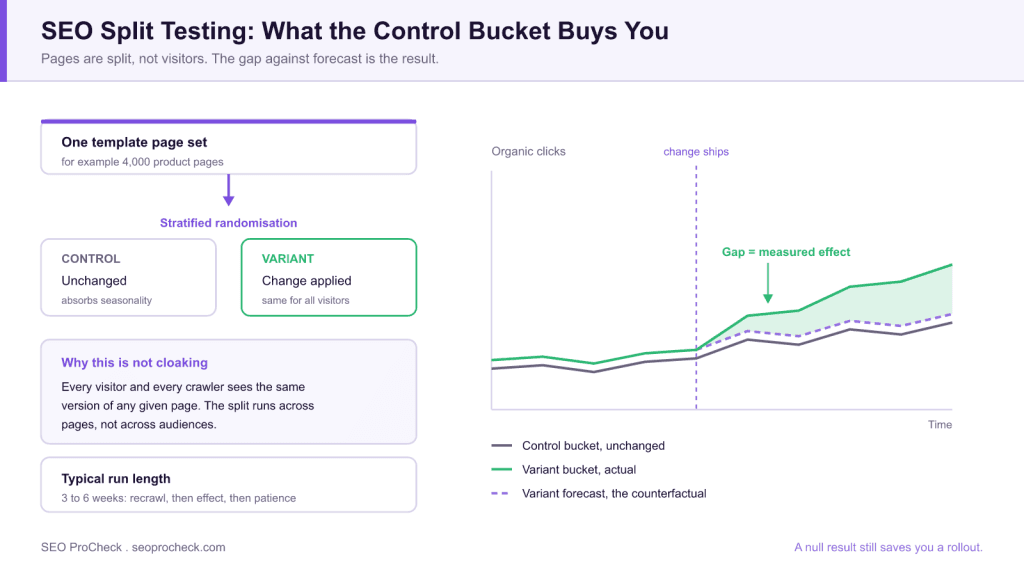
SEO A/B testing splits pages, not visitors: you apply a change to a randomised group of similar pages and compare their organic trajectory against a forecast built from an unchanged control group. Every outcome is informative, which is why a null result is still a good result: it stops you rolling out a change that does nothing.
- It is not cloaking: every visitor and crawler sees the same version of any given page.
- The control bucket is what absorbs seasonality and core updates, which is why before-and-after analysis misleads so often.
- Plan for 3 to 6 weeks: recrawl time, then effect time, then statistical patience.
- Start with title tags on a high-traffic template: cheap to change, quick to recrawl, fast to read.
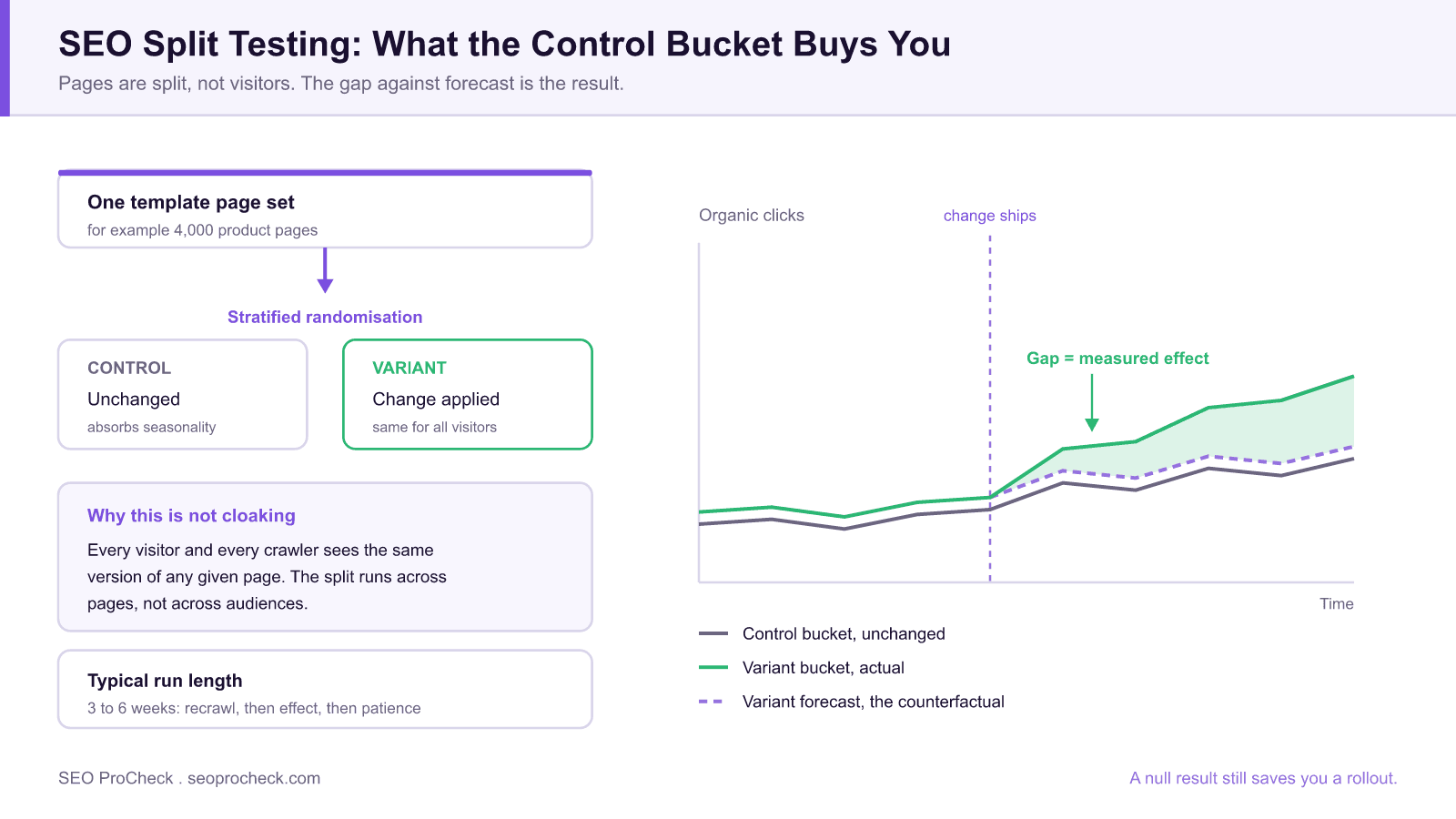
What is SEO A/B split testing? Unlike user-facing A/B tests that split visitors, SEO split testing splits pages: you apply a change to a randomized group of similar pages (the variant) while leaving a statistically comparable group unchanged (the control), then compare organic-traffic trajectories against a forecast. Because every outcome (positive, negative, or null) tells you whether a tactic is worth rolling out sitewide, any result genuinely is a good result: even a null saves you from deploying changes that do nothing.
Key Concepts
The central idea is the counterfactual: what would the variant pages have done if you had changed nothing? You cannot observe it, so you estimate it. The control bucket makes that estimate credible because both buckets are drawn from the same template, the same site, and the same demand curve, so anything that moves the world moves them together.
That is why the unit of analysis is the page group rather than the page. A single page's organic traffic is far too volatile to read: rankings oscillate, queries shift, and one competitor's move can swamp everything. Aggregate a few hundred similar pages and the noise partially cancels, leaving a signal you can actually test against.
Two vocabulary points prevent most confusion. A bucket is a fixed set of URLs assigned before the test starts and never modified during it. The counterfactual forecast is a model of the variant bucket's expected traffic, fitted on the pre-period relationship between the two buckets and projected forward. The measured effect is the gap between actual and forecast after the change ships, not the difference between the two buckets' raw numbers, which will never be identical to begin with.
Implementation Considerations
Most failed SEO tests fail on design, not analysis. These are the decisions that determine whether the result means anything:
- Change exactly one thing. If you rewrite titles and add an FAQ block in the same test, a positive result tells you nothing about which change to roll out. Bundle changes only when you would deploy them as a bundle regardless.
- Freeze the buckets. New pages published into the template during the test must be excluded from both buckets, not added to one. Bucket drift is the most common silent invalidator.
- Use stratified assignment. Rank pages by pre-period traffic, then alternate assignment down the list. Naive randomisation regularly lands a disproportionate share of high-traffic pages in one bucket, which distorts everything that follows.
- Verify the change actually deployed and got crawled. Spot-check rendered HTML on a sample of variant URLs, then confirm in server logs or Search Console that those URLs were recrawled. A test that measures an unshipped change is worse than no test, because it produces a confident null.
- Decide the stopping rule in advance. Write down the run length and the effect size worth acting on before you start. Peeking daily and stopping when the gap looks good is how teams ship noise.
- Log everything else that ships. Migrations, template changes, redirect updates, and confirmed core updates all belong in a test diary, because they are the first things you will need when a result looks strange.
Measuring Impact
Analysis is a comparison of actual against forecast, with an honest account of uncertainty. In practice that means three things: a model, a confidence interval, and a decision rule.
| Element | What to use | What to watch for |
|---|---|---|
| Metric | Organic clicks or sessions per bucket per day | Rankings alone hide CTR effects; conversions are usually too sparse to read |
| Data source | Search Console per-page data, or server logs for crawl questions | Search Console date lag and data thresholds on low-traffic URLs |
| Pre-period | At least as long as the test period, ideally longer | A short pre-period fits a weak model and widens every interval |
| Model | Causal-impact style forecast fitted on the control bucket | A simple difference of means ignores the pre-existing gap between buckets |
| Uncertainty | Confidence interval around the estimated lift | An interval that spans zero is a null, however good the point estimate looks |
| Decision | Roll out, reverse, or archive with the reasoning recorded | Undocumented nulls get re-proposed by someone else next quarter |
Report the interval, not just the headline number. "Between 2 and 9 percent lift" is an actionable finding; "7 percent lift" alone invites a rollout decision the data may not support. And retest winners after full rollout: an effect measured on half a template sometimes shrinks when applied to all of it, particularly when the changed pages compete with each other for the same queries.
How SEO Split Testing Actually Works
The methodology has matured into a fairly standard pipeline, whether you use a commercial platform or build it yourself:
- Pick a template-level page group. Split testing needs many similar pages: product pages, category pages, location pages, article archives. As a rule of thumb you want enough pages and enough aggregate organic traffic that a mid-single-digit percentage change would be detectable above noise; very small sites usually cannot split test and should use before/after analysis with careful confound tracking instead.
- Randomize into variant and control buckets. Stratified randomization (balancing buckets by traffic level) beats naive random assignment, because organic traffic across pages follows a heavy-tailed distribution and one big page landing in the wrong bucket can swamp the signal.
- Forecast the counterfactual. The standard approach builds a model of what variant-bucket traffic would have done based on its relationship to the control bucket before the change ships, then measures the gap between forecast and actual afterwards. This is causal-impact analysis, not a simple difference of means.
- Run long enough for recrawl plus effect. Google must recrawl and reprocess the changed pages before any effect can start; typical tests need several weeks. Ending a test the moment a gap appears is the most common self-deception in this discipline.
- Roll out, reverse, or archive. Winners roll out to the full template (and often get retested at rollout as confirmation); losers get reversed; nulls get documented so nobody re-proposes them next quarter.
Controlling for Seasonality, Cohorts, and Confounds
The control bucket is what separates split testing from wishful thinking, and it earns its keep against three specific threats:
- Seasonality: demand curves (holidays, weekends, industry cycles) hit control and variant equally, so the control's trajectory absorbs them. This is why before/after comparisons without a control are so often misleading: they attribute seasonal swings to the change.
- Algorithm updates: a core update mid-test moves both buckets; what you interpret is the relative gap, not the absolute lines. That said, updates add variance, and many teams extend or restart tests that straddle a confirmed core update.
- Cohort drift: buckets must stay fixed for the test's duration. Adding new pages to a bucket mid-test, or letting a site migration or template change touch one bucket differently, silently invalidates the comparison. Log every sitewide change during the test window.
Two honest limitations worth stating: SEO experiments cannot be perfectly isolated the way user-split tests can (Google evaluates sites holistically, so a variant change can leak into sitewide perception), and query-level cannibalization between buckets can blur results when pages compete for the same terms. Good test design minimizes both; nothing eliminates them.
What to Test: Idea Bank by Effort and Typical Payoff
| Test idea | Element | Effort | What it mainly moves |
|---|---|---|---|
| Title-tag reformulation (intent words, numbers, year) | <title> | Low | CTR, sometimes rankings |
| Meta description rewrites | Meta description | Low | CTR only |
| Adding FAQ blocks answering real queries | Body content | Medium | Long-tail rankings, PAA/AI visibility |
| Internal-link modules between related pages | Architecture | Medium | Rankings of linked pages, crawl depth |
| Structured data (Product, FAQ, HowTo) | JSON-LD | Medium | Rich results, CTR (Google no longer shows FAQ or HowTo rich results) |
| Content depth expansion on thin templates | Body content | High | Rankings, query coverage |
| H1/heading restructuring toward question phrasing | Headings | Low | Featured snippets, PAA capture |
| Removing boilerplate or duplicated blocks | Body content | Medium | Rankings via uniqueness/quality |
For the structured-data row, our JSON-LD structured data guide covers implementation; for question-formatted headings and FAQ blocks, see optimizing for People Also Ask. If a proposed test is really an argument about what Google rewards rather than what your users need, the reasoning frameworks in our piece on mental models for SEO decisions will usually settle it faster than a six-week experiment.
Why "Any Result Is a Good Result" Holds Up in 2026
The thesis has aged well, and arguably strengthened. Null results are cheaper than unexamined rollouts: sitewide changes that do nothing still cost engineering time and add template complexity, and changes that quietly hurt now carry more risk under Google's quality systems than they did when the piece was written. Meanwhile the testable surface has grown: teams now run the same page-bucket methodology on AI-era questions, such as whether answer-first paragraphs or tighter entity markup change how often pages get cited by AI assistants, where measurement is harder but the control-group logic is identical. A documented archive of wins, losses, and nulls is also the strongest argument an SEO team has in prioritization debates: it converts opinion fights into evidence reviews.
Frequently Asked Questions
CRO testing splits users between page versions at the same URL and measures conversion behavior. SEO testing splits pages into changed and unchanged groups and measures search-engine response. Googlebot must see the variant, so SEO tests never cloak per-visitor.
No. Every visitor and every crawler sees the same version of any given page; the split is across different pages, not across audiences. Google has explicitly said this style of testing is fine.
There is no universal number: detectability depends on aggregate traffic and its variance, not page count alone. In practice, template groups with well under about a thousand organic sessions a day across the bucket struggle to detect realistic effect sizes; small sites are usually better served by sequential before/after analysis with confound logging.
Plan for recrawl time plus effect time plus statistical patience: typically three to six weeks, longer for low-crawl-rate sections. Stopping early on a promising gap is the classic way to ship noise.
Yes. The ingredients are: a way to apply changes to a page list (CMS bulk edit, edge worker, or tag-based injection), daily traffic or GSC data per page, and a causal-impact analysis, for which the open-source CausalImpact library is the common choice. Platforms mainly add convenience, guardrails, and prettier reporting.
Title tags on a high-traffic template. They are cheap to change, quick to recrawl, and move CTR: the fastest full loop through the methodology, which teaches your team the discipline before you attempt expensive content tests.
This resource contributes to the knowledge base SEO practitioners need for effective optimization in an evolving search landscape.
Source: https://www.semrush.com/blog/seo-split-testing-any-result-is-a-good-result/
Take this with you
The assistant links open with a question about this page already written. Nothing is sent until you press enter.
Claude Vincent is a technical SEO consultant focused on crawlability, rendering, and AI-search visibility. He writes the field guides and case studies at SEO ProCheck, with a bias toward the durable, unglamorous work that decides whether search engines and AI answer engines can actually read and cite a site.
About SEO ProCheck
Technical SEO consulting and GEO strategy with 20 years of enterprise experience. Case studies, resources, and tools for search and AI visibility.
Work With Me
Technical SEO audits, GEO strategy, site migrations, and international SEO. Hourly consulting for teams who need hands-on support, not just reports.
Subscribe to our newsletter!








Recent Posts
- Most Top Sites Never Say Who They Are in Structured Data October 14, 2026
- Homepage Titles Are Mostly Too Short, Not Too Long October 8, 2026
- Who Actually Serves an llms.txt? 184 Top Sites Measured September 29, 2026