

Keyword Research Fundamentals: How to Find What People Actually Search
- November 8, 2024
- Keyword Research
Keyword research is where every successful SEO campaign starts — and where a lot of them quietly go wrong. Done well, it tells you exactly what your audience is searching for, how much demand exists, how hard it will be to compete, and what you need to publish. Done badly, you write content nobody is looking for. Here are the fundamentals that hold up.
What keyword research actually answers
Good research answers four questions for every topic: Are people searching for this? (demand), What do they really want? (intent), Can I realistically rank? (difficulty vs your authority), and Is it worth it? (business value). A keyword can have huge volume and still be a bad target if the intent does not match what you offer or the competition is out of reach.
The process, step by step
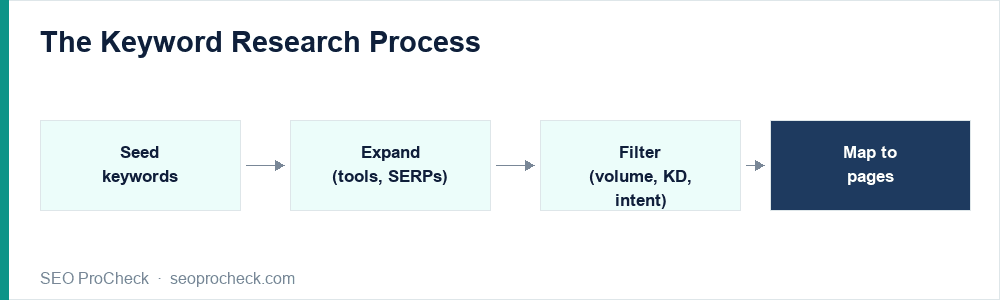
- Start with seed keywords — the core terms that describe what you do. Brainstorm them, and pull them from your existing pages, your customers' language, and your competitors.
- Expand. Feed seeds into keyword tools (Semrush, Ahrefs, Google Keyword Planner) to get hundreds of related terms, and mine the SERP itself — autocomplete, "People Also Ask," and "related searches" are free, real-demand signals.
- Filter by the four questions above: cut terms with no real volume, no matching intent, or difficulty far beyond your current authority.
- Group into topics — many keywords are variations of one intent and belong on one page, not many.
- Map each topic to a page (new or existing). This is where research becomes a content plan.
Read the SERP before you commit
Volume and difficulty scores are estimates. The SERP is the truth. Before targeting a keyword, search it and look at what ranks: the type of content (guides? products? videos?), the kind of sites (big brands? niche blogs?), and the SERP features (AI Overview, featured snippet, local pack). That tells you the intent Google has decided on, and whether you can credibly compete.
Volume is a starting point, not the goal
Chasing the highest-volume head terms is the classic beginner mistake — they are the hardest to rank for and often the vaguest in intent. A spread of relevant, lower-competition terms usually delivers more actual traffic and conversions, especially for a newer site. (See long-tail keywords and keyword difficulty.)
Turn the list into a plan
The deliverable is not a spreadsheet of 2,000 keywords — it is a prioritized map of topics to pages, each with a clear primary keyword, supporting terms, and intent. That map is what guides everything you publish next. Without it, you are writing on instinct; with it, every page has a job.
Targeting the right keywords?
Keyword strategy is where every successful SEO campaign starts. See how an advanced SEO audit works →
Take this with you
The assistant links open with a question about this page already written. Nothing is sent until you press enter.
Claude Vincent is a technical SEO consultant focused on crawlability, rendering, and AI-search visibility. He writes the field guides and case studies at SEO ProCheck, with a bias toward the durable, unglamorous work that decides whether search engines and AI answer engines can actually read and cite a site.
About SEO ProCheck
Technical SEO consulting and GEO strategy with 20 years of enterprise experience. Case studies, resources, and tools for search and AI visibility.
Work With Me
Technical SEO audits, GEO strategy, site migrations, and international SEO. Hourly consulting for teams who need hands-on support, not just reports.
Subscribe to our newsletter!








Recent Posts
- Most Top Sites Never Say Who They Are in Structured Data October 14, 2026
- Homepage Titles Are Mostly Too Short, Not Too Long October 8, 2026
- Who Actually Serves an llms.txt? 184 Top Sites Measured September 29, 2026