

AI Summary
Degoogling means reducing your dependence on Google products to limit tracking and regain control of your data, replacing services like Search, Chrome, Gmail, and Maps with privacy focused alternatives. It is best treated as a spectrum: start with one high value swap and go as far as your needs and tolerance for friction justify.
- The main motivations are privacy, less ad and profile tracking, and not depending on a single vendor.
- Practical swaps exist for every major service, from DuckDuckGo and Firefox to Proton Mail and GrapheneOS.
- You do not have to go all the way: even replacing search and the browser meaningfully cuts data collection.
- For marketers, the same privacy trend is reshaping analytics and pushing search demand toward multiple engines and AI assistants.
Why You Should DeGoogle & Intro DeGoogling Techniques provides valuable insights for SEO practitioners. This resource examines approaches and considerations that can improve organic search performance.
Key Concepts
Understanding the fundamental principles behind this topic helps inform strategic decisions. Whether optimizing for traditional search or emerging AI platforms, foundational concepts remain relevant. This resource covers the essential knowledge practitioners need.
Implementation Considerations
Moving from concept to execution requires understanding practical constraints and opportunities. Different situations call for different approaches. This resource provides guidance for applying concepts in real-world contexts.
Measuring Impact
SEO efforts require measurement to demonstrate value and guide optimization. Identifying appropriate metrics, establishing baselines, and tracking progress enables data-driven improvement. This resource addresses how to evaluate success.
This resource contributes to the knowledge base SEO practitioners need for effective optimization in an evolving search landscape.
Source: https://www.reddit.com/r/degoogle/comments/huk4rp/why_you_should_degoogle_intro_degoogling/
Why people degoogle
The linked r/degoogle thread lays out the case for reducing reliance on Google, and the summary above preserves that framing. The motivations cluster into three groups. The first is privacy: Google builds a detailed profile across search, browsing, email, location, and video, and many people simply do not want that single view of their life to exist. The second is control: keeping data with providers you can leave, export, or self host reduces lock in. The third is resilience: a suspended Google account can lock you out of email, files, and photos at once, so spreading services reduces that single point of failure.
None of this requires believing Google is malicious. It is a rational response to concentration. The more of your digital life runs through one company, the more a single policy change, outage, or account issue can disrupt.
Degoogling techniques, service by service
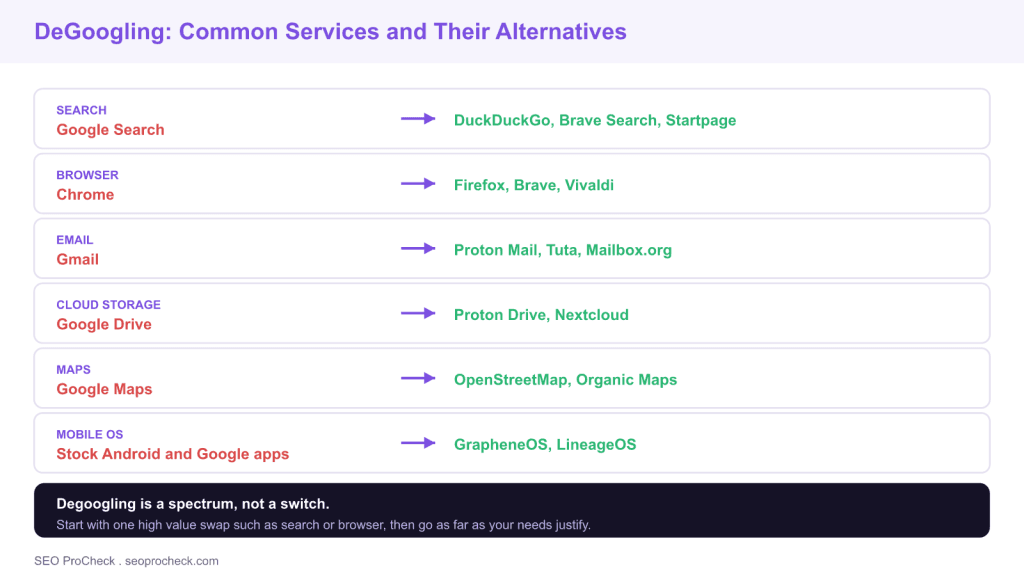
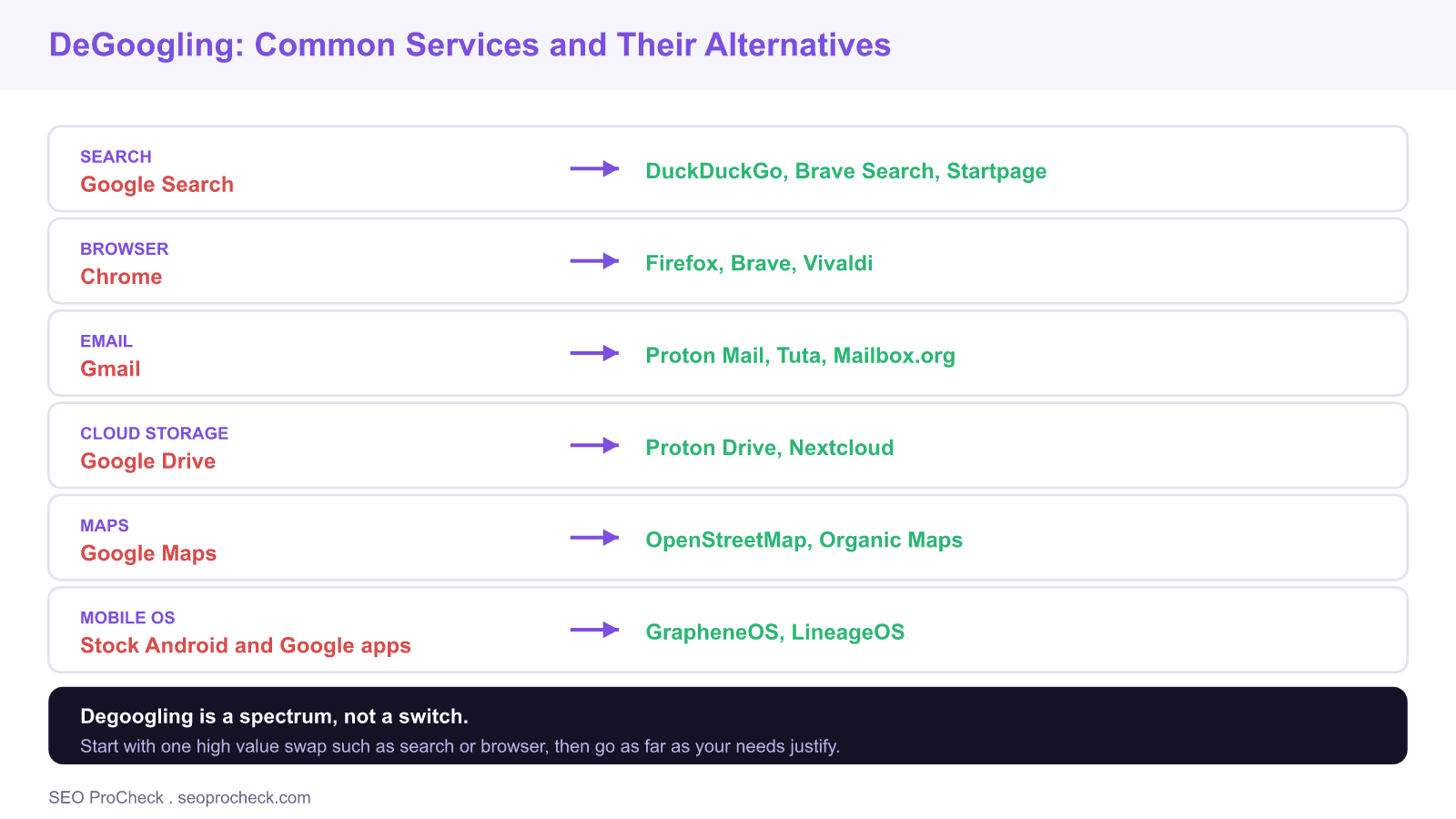
The diagram above maps the common swaps. Treat them as a menu, not a checklist, and adopt the ones whose trade offs you can live with:
| Google service | Common alternatives | Typical trade off |
|---|---|---|
| Search | DuckDuckGo, Brave Search, Startpage | Occasionally less local or long tail depth |
| Chrome | Firefox, Brave, Vivaldi | Extension parity and sync habits to relearn |
| Gmail | Proton Mail, Tuta, Mailbox.org | Migration effort and a paid tier for full features |
| Google Drive | Proton Drive, Nextcloud | Self hosting effort or a subscription |
| Google Maps | OpenStreetMap, Organic Maps | Thinner business data and reviews |
| Android and Google apps | GrapheneOS, LineageOS | Device support limits and setup complexity |
How far should you go?
Degoogling is a spectrum, and the highest return moves are usually the easiest. Switching your default search engine and browser takes minutes and removes two of the largest tracking surfaces. Email and files are a bigger commitment because of migration, and a degoogled phone is the most involved step. A sensible sequence is search, then browser, then email, then storage, then mobile, stopping at whatever point the friction outweighs the benefit for you. There is no purity test, and partial degoogling still meaningfully reduces data collection.
What degoogling means for SEO and marketing
Even if you never change your own setup, the trend matters professionally. As people move to privacy browsers and alternative engines, two things follow. First, measurement gets harder: cookie based analytics loses coverage, which is pushing teams toward privacy first and server side measurement. Second, search demand fragments across DuckDuckGo, Bing, Brave, and increasingly AI assistants, so Google is no longer the only place to be visible. This is the practical side of the shift we cover in SEO versus AEO versus GEO, and it is worth understanding which crawlers and assistants fetch your content, a topic we break down in AI bot user agents explained.
The takeaway for marketers is diversification. Build content that earns visibility beyond Google, because a growing slice of your audience is deliberately looking elsewhere, and answer engines increasingly mediate the query. Understanding how AI engines choose sources is now part of the same resilience mindset that drives people to degoogle in the first place.
Frequently asked questions
What does degoogling mean?
Degoogling means reducing or eliminating your reliance on Google products to limit tracking and regain control of your data. In practice it is replacing services such as Search, Chrome, Gmail, Drive, and Maps with privacy focused alternatives, to whatever degree suits you.
Why do people want to degoogle?
The main reasons are privacy, because Google builds a detailed cross service profile, control, because keeping data with providers you can leave reduces lock in, and resilience, because a single suspended account can cut off email, files, and photos at once.
What are the best alternatives to Google services?
Common swaps include DuckDuckGo, Brave Search, or Startpage for search, Firefox or Brave for browsing, Proton Mail or Tuta for email, Proton Drive or Nextcloud for storage, OpenStreetMap or Organic Maps for maps, and GrapheneOS or LineageOS for mobile.
Do I have to quit all Google services to benefit?
No. Degoogling is a spectrum, and the easiest changes deliver the most privacy per minute of effort. Simply switching your default search engine and browser removes two of the largest tracking surfaces, and partial degoogling still reduces data collection.
Is degoogling difficult?
The difficulty depends on the service. Changing search and browser takes minutes, while migrating email and files takes more effort, and running a degoogled phone is the most involved step. A sensible order is search, browser, email, storage, then mobile.
How does the degoogling trend affect SEO?
As users adopt privacy browsers and alternative engines, cookie based analytics loses coverage and search demand spreads across multiple engines and AI assistants. Marketers respond with privacy first measurement and by earning visibility beyond Google, including in answer engines.
Take this with you
The assistant links open with a question about this page already written. Nothing is sent until you press enter.
Claude Vincent is a technical SEO consultant focused on crawlability, rendering, and AI-search visibility. He writes the field guides and case studies at SEO ProCheck, with a bias toward the durable, unglamorous work that decides whether search engines and AI answer engines can actually read and cite a site.
About SEO ProCheck
Technical SEO consulting and GEO strategy with 20 years of enterprise experience. Case studies, resources, and tools for search and AI visibility.
Work With Me
Technical SEO audits, GEO strategy, site migrations, and international SEO. Hourly consulting for teams who need hands-on support, not just reports.
Subscribe to our newsletter!








Recent Posts
- Most Top Sites Never Say Who They Are in Structured Data October 14, 2026
- Homepage Titles Are Mostly Too Short, Not Too Long October 8, 2026
- Who Actually Serves an llms.txt? 184 Top Sites Measured September 29, 2026