

AI Summary
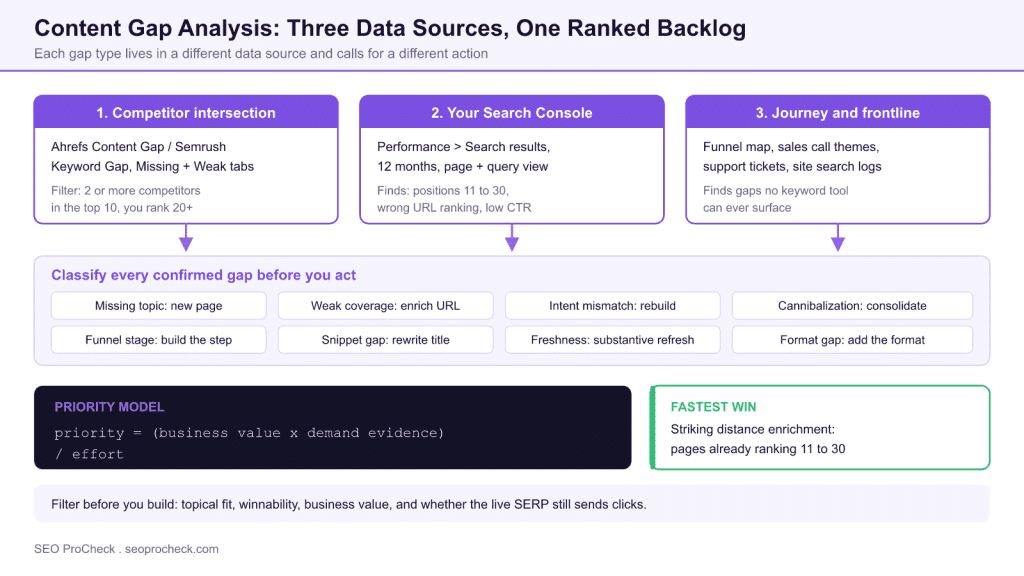
A content gap analysis compares three data sets, competitor keyword intersections, your own Search Console data, and customer journey mapping, to find the topics where demand exists but your coverage does not. The methodology matters because each gap type lives in a different report and calls for a different action: build, enrich, consolidate, or reformat.
- Require two or more competitors in the top 10 before treating an intersection keyword as a real gap.
- Search Console positions 11 to 30 are enrichment gaps on pages you already own, not new-page gaps.
- Sales calls, support tickets, and site-search logs surface gaps no keyword tool can see.
- Prioritise with (business value x demand evidence) / effort, then filter for topical fit and winnability before briefing anything.
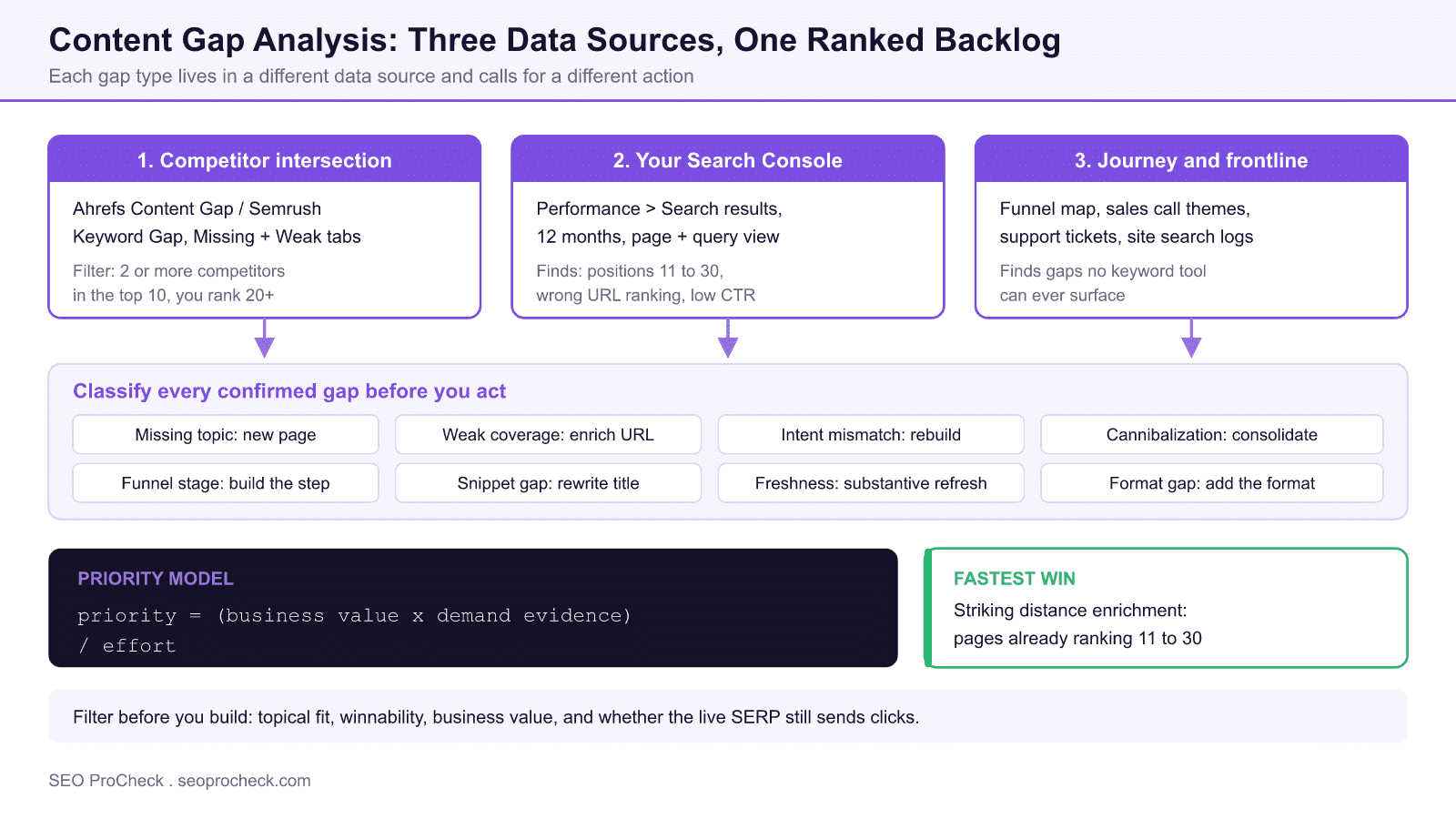
Content gap analysis is the process of systematically finding the queries and topics where your audience is searching but your site has no page, or an inadequate one, by comparing three data sets: what competitors rank for that you don't, what Search Console shows you almost rank for, and what the customer journey requires that nobody has built. The methodology matters because each gap type lives in a different data source and calls for a different action: some gaps need a new page, some need an existing page enriched, and some need two cannibalizing pages merged.
Understanding Content Gap Analysis Within Content Strategy
Content strategy represents a critical component of modern SEO strategy. As search engines continue to evolve and user expectations shift, understanding the nuances of content strategy becomes essential for maintaining and improving organic visibility. Gap analysis is the diagnostic half of that discipline: instead of brainstorming topics, you derive them from evidence of demand you are demonstrably missing. Done well, it replaces "what should we write next?" with a ranked backlog where every item carries the query data that justified it. This guide covers the methodology, data sources, and prioritization model that SEO practitioners need to master.
The Methodology, Step by Step
1. Define the competitor set honestly
Your gap analysis is only as good as the comparison set. Pick 3 to 5 SERP competitors: the domains that actually rank for your money queries, not your business competitors; for most sites that means including a publisher or two and sometimes Reddit or a wiki. Pull them from the "Competing domains" / "Organic competitors" report in Ahrefs, Semrush, or by eyeballing the SERPs for your ten most important queries.
2. Run the keyword intersection
In Ahrefs: Site Explorer > Competitive Analysis (Content Gap): set your domain as the target, add competitors, and filter for keywords where at least two competitors rank in the top 10 and you rank nowhere or below position 20. In Semrush: Keyword Gap, using the "Missing" (no ranking at all) and "Weak" (you rank, but worse than everyone) tabs. Requiring two or more competitors to rank is the noise filter: it drops their branded terms and one-off flukes, leaving topics the market has validated.
3. Mine Search Console for internal gaps
Tool intersections only show gaps versus competitors. Your own data shows gaps versus demand. In GSC Performance > Search results, set a 12-month range and look for: queries with impressions but positions 11 to 30 (striking distance, usually an enrichment gap, not a new-page gap); queries where the ranking URL is the wrong page for the intent (a blog post ranking for a service query, an architecture gap); and high-impression, low-CTR queries where you rank but the snippet doesn't match what the searcher wants. Export to a sheet; the page-plus-query view is the unit of analysis.
4. Map gaps against the journey
Lay your topics against the funnel: informational ("what is X"), commercial-investigation ("X vs Y," "best X for Z"), transactional ("X service [city]," "buy X"), and post-purchase/support. Most content programs over-produce top-of-funnel and leave the comparison and objection-handling middle empty: precisely the pages that convert. Sales and support teams are a data source here: the questions prospects ask on calls that have no page are gaps no tool will surface.
5. Classify, prioritize, act
Every confirmed gap gets a classification (see table) and a score. A simple working model: priority = (business value of the intent × demand evidence) ÷ effort, where demand evidence is search volume plus your own impression data, and business value is judged by how close the query sits to money. A 200-volume comparison query that your sales team hears weekly outranks a 5,000-volume definitional query every time.
Gap Types: Data Source and Action
| Gap type | Where it shows up | Action |
|---|---|---|
| Missing topic: competitors rank, you have nothing | Ahrefs Content Gap / Semrush Keyword Gap "Missing" tab (≥2 competitors in top 10) | New page, but only if you can add real information gain; otherwise deprioritize |
| Weak coverage: you rank 11 to 30 with a thin page | GSC positions 11 to 30 with impressions; Semrush "Weak" tab | Enrich the existing URL (depth, tables, FAQs, specifics): do not publish a duplicate |
| Intent mismatch: wrong page type ranks | GSC page+query view; SERP format vs. your format | Build the correctly-formatted page and re-point internal links; keep the old page for its own intent |
| Cannibalization: multiple weak URLs on one query | GSC query filter showing 2+ URLs swapping positions | Consolidate into one URL, 301 the rest |
| Funnel-stage gap: no content for a journey step | Journey mapping; sales/support call themes; site search logs | Create the missing stage page (usually comparison or objection-handling middle-funnel) |
| Snippet/CTR gap: ranking but not chosen | GSC high impressions + CTR far below position benchmark | Rewrite title/meta to match intent; add the direct answer the SERP feature wants |
| Freshness gap: content exists but decayed | 12-month per-URL click trend down 30%+ from peak | Substantive refresh: updated facts, new sub-questions, current examples |
| Format gap: topic covered, format missing | SERP shows video/tool/template you lack | Add the missing format to the existing URL or as a companion asset |
The Four Filters Before You Brief Anything
A gap list is raw evidence, not a plan. Run every candidate through these four tests, in this order, and expect to discard a large share of the tool output.
| Filter | The question it answers | Where to check it | Drop the gap when |
|---|---|---|---|
| Topical fit | Does this subject belong on our site at all? | Your own topic map and the section it would live in | The page would be an orphan with no topical neighbours |
| Winnability | Can we realistically add something better than what ranks now? | Manual read of the current top five results | The SERP is owned by primary sources or data you cannot match |
| Business value | Does the intent lead anywhere commercially? | Journey stage of the query, plus what sales and support hear | The query is definitional only and nothing follows it |
| Click opportunity | Does the live SERP still send clicks to organic results? | The live SERP, checked by hand for AI Overviews and features | Features absorb the answer and the organic block sits below the fold |
A gap list is the front end of two neighbouring workflows. Score the pages you already own with the content audit scoring methodology, and decide refresh versus merge using the content refresh, prune and merge system. Where a gap turns out to be an architecture problem rather than a missing topic, keyword mapping is the corrective: it assigns one primary query cluster per URL so a single intent stops being spread across three competing pages.
Key Considerations for Content Gap Analysis Methodology
When approaching content strategy, several factors require careful attention. Technical implementation must align with broader SEO objectives while maintaining site performance and user experience. The balance between optimization and over-optimization requires ongoing monitoring and adjustment based on performance data and algorithm changes. Industry benchmarks and competitor analysis provide context for evaluating your own implementation. The most important filter in the whole methodology is the one applied after the tools: not every gap deserves filling. Cut anything outside your topical scope (chasing every intersection keyword is how sites drift into the thin-content patterns Google's scaled-content systems suppress), anything you cannot cover with genuine information gain, and anything whose SERP is already fully absorbed by AI Overviews or features that leave no click opportunity: check the live SERP before committing a brief. A gap list of 40 defensible topics beats 400 raw keyword rows.
Implementation Best Practices
Successful implementation begins with thorough auditing of current state and clear goal definition. Document baseline metrics before making changes to enable accurate impact measurement. Run the analysis as a repeatable quarterly workflow, not a one-off project: same competitor set, same filters, diffed against last quarter's sheet so you see which gaps closed and which new ones opened. Keep one master sheet with columns for query cluster, gap type, evidence (volume, impressions, competitor URLs), priority score, action (create/enrich/consolidate), owner, and status: this becomes the editorial backlog. Prioritize changes based on potential impact and implementation effort, focusing on high-impact items first; enrichment items usually pay back faster than new pages because the URL already has history. Monitor closely after deployment and maintain documentation of what was shipped against which gap, so results are attributable.
Common Mistakes to Avoid
Several patterns consistently cause problems in content strategy implementations. Rushing implementation without proper planning leads to errors that can be costly to fix. Ignoring the interplay between different SEO factors creates conflicts that undermine results. Failing to monitor and iterate based on performance data means missing optimization opportunities. In gap analysis specifically: treating the raw tool export as the plan (it's evidence, not a strategy); creating a new URL for every keyword variant instead of clustering variants onto one page: the fastest route to cannibalization; copying a competitor's coverage without asking whether it works for them or is just legacy bulk; ignoring the "Weak" tab because "Missing" feels more exciting, when weak-coverage fixes are the cheapest wins available; and measuring success by pages shipped rather than by gaps closed in the rankings.
Measuring Success
Effective measurement requires defining appropriate KPIs aligned with business objectives. Track both leading indicators (rankings, impressions, technical metrics) and lagging indicators (traffic, conversions, revenue) to build a complete picture. For gap work, measure at the level of the gap, not the site: for each shipped item, compare the target query cluster's impressions, average position, and clicks in the 28 days before the fix against days 14 to 42 after (allowing for recrawl lag). New pages are judged on reaching page two within a quarter and page one within two; enrichments on recovering striking-distance positions within weeks. Establish reasonable timeframes for evaluation, as SEO changes often take weeks or months to fully manifest in results. Compare performance against historical baselines and competitor benchmarks to contextualize results, including whether the competitor you copied the gap from still holds their position.
Strategic Recommendations
Approach content strategy as an ongoing program rather than a one-time project. Build processes for regular auditing, monitoring, and optimization: the quarterly gap-analysis cycle slots naturally alongside a monthly refresh slot and an annual architecture review. Stay current with industry developments and algorithm changes that may affect your strategy; SERP-feature and AI Overview expansion is itself a moving gap map, since it changes which queries still deliver clicks. Invest in education for team members to build internal capabilities, and pull non-SEO teams into the input side: sales objections, support tickets, and site-search logs are gap data sources competitors cannot see. Consider how content strategy fits within your broader digital marketing and business strategy for maximum impact.
Frequently Asked Questions
What is a content gap analysis in SEO?
It's a structured comparison between the queries your audience searches and the pages your site offers, using competitor keyword intersections, your own Search Console data, and customer-journey mapping to find where demand exists but your coverage doesn't, or is too weak to rank. The output is a prioritized backlog of pages to create, enrich, or consolidate, each backed by query evidence.
Which tools do I need to run one?
Google Search Console (free) plus one intersection tool, Ahrefs' Content Gap or Semrush's Keyword Gap, covers the core methodology; a spreadsheet does the rest. On zero budget you can still get far with GSC striking-distance mining, Google Autocomplete and People Also Ask expansion, and manually checking the SERPs for your key topics, though you lose the systematic competitor intersection.
How is a content gap different from a keyword gap?
A keyword gap is the raw tool output: terms competitors rank for that you don't. A content gap is the strategic reading of that data plus internal and journey sources: which topics, intents, formats, and funnel stages you're missing. Ten thousand keyword rows might cluster into thirty actual content gaps, and some gaps, like a missing comparison page your sales team needs, never appear in keyword tools at all.
Should I fill every gap the tools find?
No. Filter for topical fit (does this belong on your site?), winnability (can you realistically add something better than what ranks?), business value (does the intent lead anywhere?), and click opportunity (does the live SERP still send traffic, or is it absorbed by AI Overviews and features?). Filling every gap indiscriminately produces exactly the scaled thin content that gets whole domains suppressed.
How often should I run a content gap analysis?
Quarterly for the full competitor-intersection cycle, which is frequent enough to catch competitor moves and SERP shifts without churning the backlog. Monthly, do the lightweight internal pass: scan Search Console for new striking-distance queries and decaying URLs. Re-run immediately after entering a new product line, market, or audience segment, since your competitor set changes with it.
What's the fastest win from a gap analysis?
Striking-distance enrichment: queries where you already rank 11 to 30 on a real page. The URL has age, links, and proven relevance: adding the missing depth (direct answers, tables, FAQs, specifics the top five have) frequently moves it to page one in weeks, while a brand-new page on a missing topic typically needs months to establish. Start every engagement there.
Take this with you
The assistant links open with a question about this page already written. Nothing is sent until you press enter.
Claude Vincent is a technical SEO consultant focused on crawlability, rendering, and AI-search visibility. He writes the field guides and case studies at SEO ProCheck, with a bias toward the durable, unglamorous work that decides whether search engines and AI answer engines can actually read and cite a site.
About SEO ProCheck
Technical SEO consulting and GEO strategy with 20 years of enterprise experience. Case studies, resources, and tools for search and AI visibility.
Work With Me
Technical SEO audits, GEO strategy, site migrations, and international SEO. Hourly consulting for teams who need hands-on support, not just reports.
Subscribe to our newsletter!








Recent Posts
- Most Top Sites Never Say Who They Are in Structured Data October 14, 2026
- Homepage Titles Are Mostly Too Short, Not Too Long October 8, 2026
- Who Actually Serves an llms.txt? 184 Top Sites Measured September 29, 2026