

AI Summary
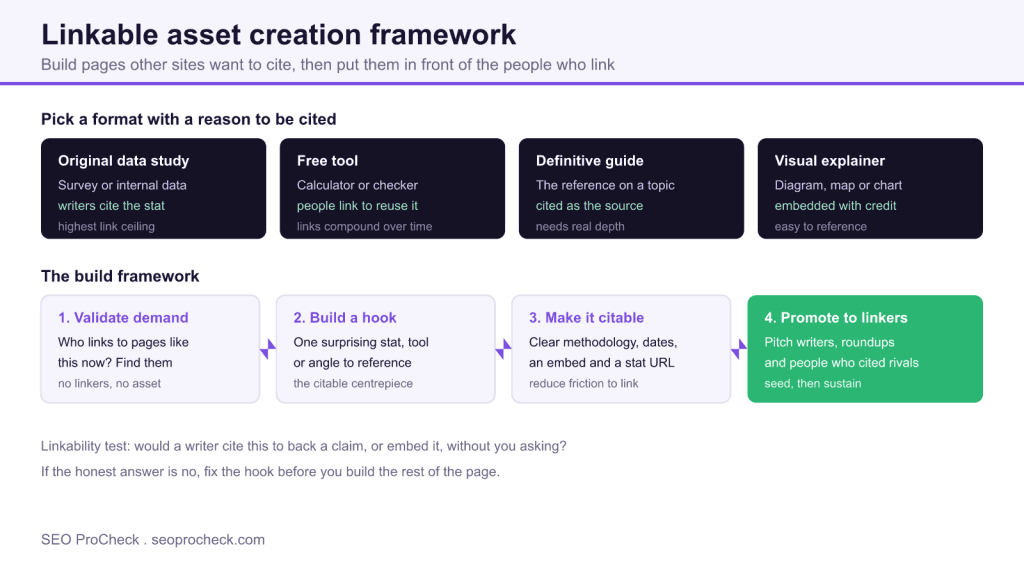
A linkable asset is a page built to be cited rather than to convert, usually an original data study, a free tool, a definitive guide, or a visual explainer. Create one with a four step framework: validate that comparable pages attract links, build a citable hook, make it easy to reference, then promote it to the writers and resource pages that actually link.
- Validate demand first: no existing linkers for similar pages means no asset.
- Lead with one citable hook, a stat, a tool, or an angle worth referencing.
- Reduce friction with a clear methodology, a quotable stat URL, and an embed.
- Seed the first links through outreach, then let the asset compound.
What a linkable asset actually is
Most pages on a site are built to convert the person reading them. A linkable asset is built for a different audience entirely: the writers, editors, and site owners who might reference it. Its job is to earn citations and links, and any direct conversions are a bonus. The formats that do this well share one trait. They give another creator something their own content needs, whether that is a statistic to cite, a tool to recommend, a definitive explanation to point at, or a visual to embed.
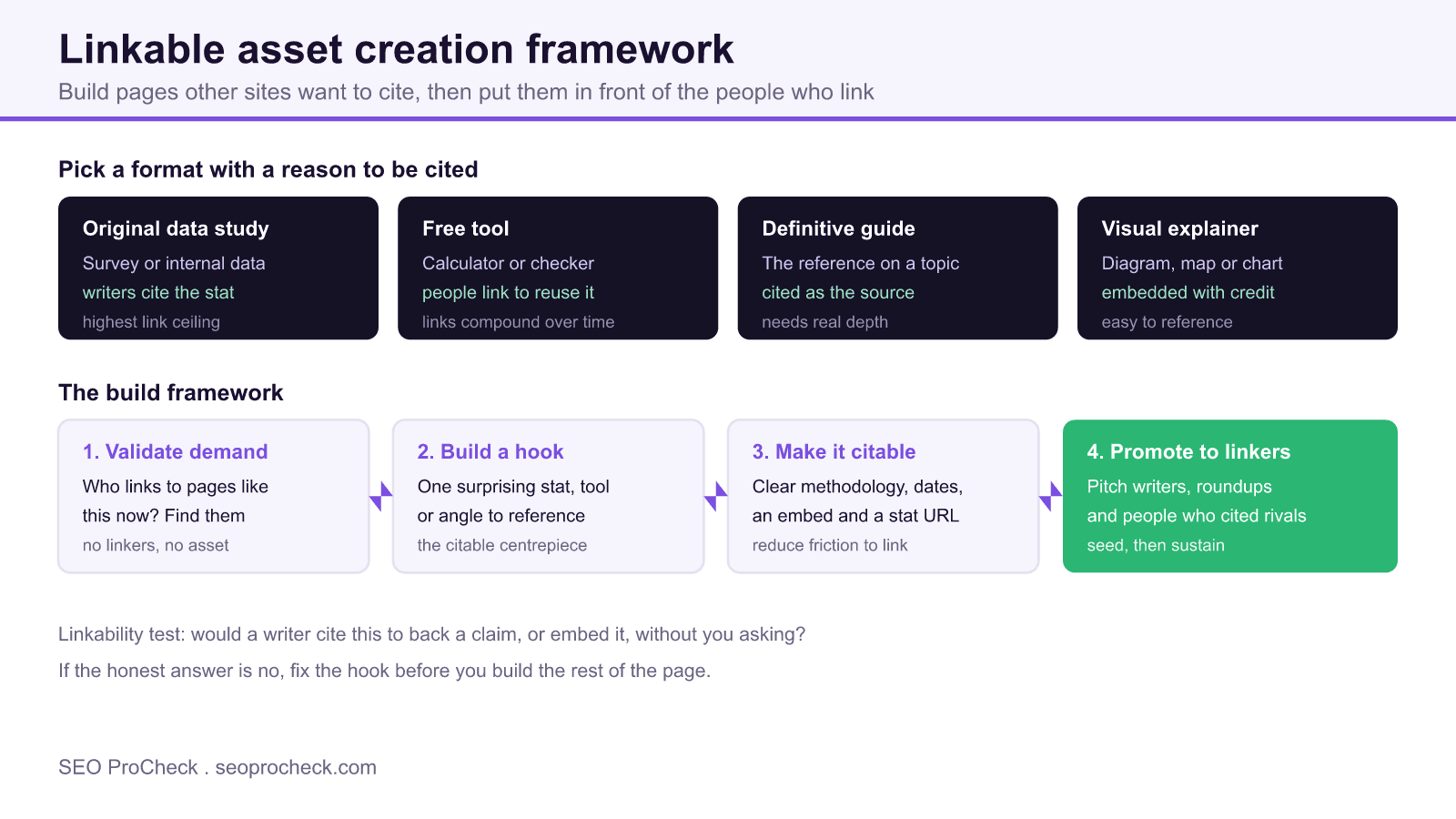
The honest test for any asset idea is a single question: would a writer cite or embed this to improve their own page, without you asking? If the answer is no, the idea is content, not a linkable asset, and no amount of promotion will change that. The framework below exists to make sure the answer is yes before you invest in production.
Choose a format with a reason to be cited
Four formats reliably earn links. They differ in how they attract citations and in what they cost to produce.
| Format | Why it earns links | Watch out for |
|---|---|---|
| Original data study | Writers cite the statistic as a source | Needs a real, defensible dataset |
| Free tool | People link to a resource they reuse | Build and maintenance cost |
| Definitive guide | Cited as the reference on a topic | Must be genuinely deeper than rivals |
| Visual explainer | Embedded with a credit link | Needs an easy embed and clear credit |
Step one: validate demand before you build
The most expensive mistake in this work is building a beautiful asset nobody links to. Prevent it by validating demand first. Take the format and topic you have in mind, find the pages that already exist in that space, and check whether they attract links. Pull the referring domains for the best comparable pages and read who is linking and why. Those referring pages are two things at once: proof that the format earns links, and your future outreach list. If you cannot find sites linking to anything comparable, treat that as a signal to change the angle or the format before you spend a day on production.
Step two: build the hook
Every linkable asset needs a citable centrepiece, the one thing a writer will point at. For a data study it is the single most surprising, defensible statistic. For a tool it is the specific job it does in one click. For a guide it is the framework or the definitive answer that nothing else provides as clearly. For a visual it is the one chart that makes a complex point obvious. Decide on this hook before you build the surrounding page, because everything else exists to support it. If the hook is weak, fix it now rather than polishing a page around a claim nobody will bother to cite.
Step three: make it effortless to cite
Even a strong hook fails to earn links if referencing it is a chore. Reduce the friction deliberately. Publish a transparent methodology and a clear date so a data point is trustworthy enough to quote. Give the key statistic its own quotable line and a stable URL that will not move. For a visual, provide a ready made embed snippet that carries a credit link back to you, so anyone republishing the image links automatically:
<a href="https://example.com/study/">
  <img src="https://example.com/chart.png" alt="Descriptive chart title" width="1200" height="675" />
</a>
<p>Source: Example Study, example.com</p>
The rule is that anything you want cited should be a copy and paste away. Every extra step between a writer and a clean citation costs you links.
Step four: promote to the people who link
Assets rarely earn links passively at launch. You have to seed the first wave. Return to the list of referring pages you built during validation and pitch the writers, resource page owners, and roundup editors who already link to weaker versions of your asset. Add the people who cited a competitor's study or embedded a competitor's graphic, since they have shown they reference this exact kind of thing. A focused pitch that shows how your asset improves their existing page converts far better than a broad blast. Those early citations give the asset the authority and visibility it needs to keep attracting links on its own.
Run the linkability test one more time
Before you publish, ask the test question again with fresh eyes: would a writer cite or embed this without you asking? If yes, promote it hard. If you hesitate, the fix is almost always the hook, not the design. Strengthen the citable centrepiece, then ship.
Frequently asked questions
What is a linkable asset?
A linkable asset is a page built specifically to attract citations and links rather than to convert visitors directly. Common forms are original data studies, free tools, definitive reference guides, and visual explainers. The defining test is simple: would another site cite or embed it without you asking, because it makes their own content better?
Which linkable asset type earns the most links?
Original data studies tend to have the highest ceiling, because a single memorable statistic can be cited by hundreds of writers over years. Free tools compound differently, earning steady links whenever someone recommends the tool. Definitive guides and visual explainers earn as the reference or the illustration. The best choice depends on what your audience and the writers in your niche actually cite.
How do I know if an idea is linkable before building it?
Validate demand first. Look at whether pages like the one you plan already attract links, and identify the specific writers, roundups, and resource pages that link to them. If nobody links to comparable pages, the format is unlikely to earn links no matter how well you execute it. No existing linkers means no asset.
What makes content citable?
Give writers a reason and a way to reference you with minimal friction. Lead with a clear hook such as a surprising statistic, publish a transparent methodology and date so the data is trustworthy, and provide easy to grab elements like a quotable stat, an embed code for a chart, and a stable URL. The easier you make it to cite, the more citations you get.
Do I still need to promote a good asset?
Yes. Assets rarely earn links passively at first. You seed the initial links through outreach to the writers, publications, and resource pages you identified during validation, plus people who cited a competitor's weaker version. Those early citations build the authority and discoverability that let the asset accumulate links on its own over time.
How is a linkable asset different from normal content?
Ordinary content is optimised to rank and convert the reader in front of it. A linkable asset is optimised to be referenced by other creators, which changes what you build: a citable centrepiece, transparent sourcing, embeddable elements, and a promotion plan aimed at linkers rather than buyers. Many assets also rank well, but earning links is the primary job.
Related reading
- Digital PR for SEO
- Digital PR campaign planning guide
- Link building study on tactics that still work
- Anchor text best practices
Take this with you
The assistant links open with a question about this page already written. Nothing is sent until you press enter.
Claude Vincent is a technical SEO consultant focused on crawlability, rendering, and AI-search visibility. He writes the field guides and case studies at SEO ProCheck, with a bias toward the durable, unglamorous work that decides whether search engines and AI answer engines can actually read and cite a site.
About SEO ProCheck
Technical SEO consulting and GEO strategy with 20 years of enterprise experience. Case studies, resources, and tools for search and AI visibility.
Work With Me
Technical SEO audits, GEO strategy, site migrations, and international SEO. Hourly consulting for teams who need hands-on support, not just reports.
Subscribe to our newsletter!








Recent Posts
- Most Top Sites Never Say Who They Are in Structured Data October 14, 2026
- Homepage Titles Are Mostly Too Short, Not Too Long October 8, 2026
- Who Actually Serves an llms.txt? 184 Top Sites Measured September 29, 2026