

AI Summary
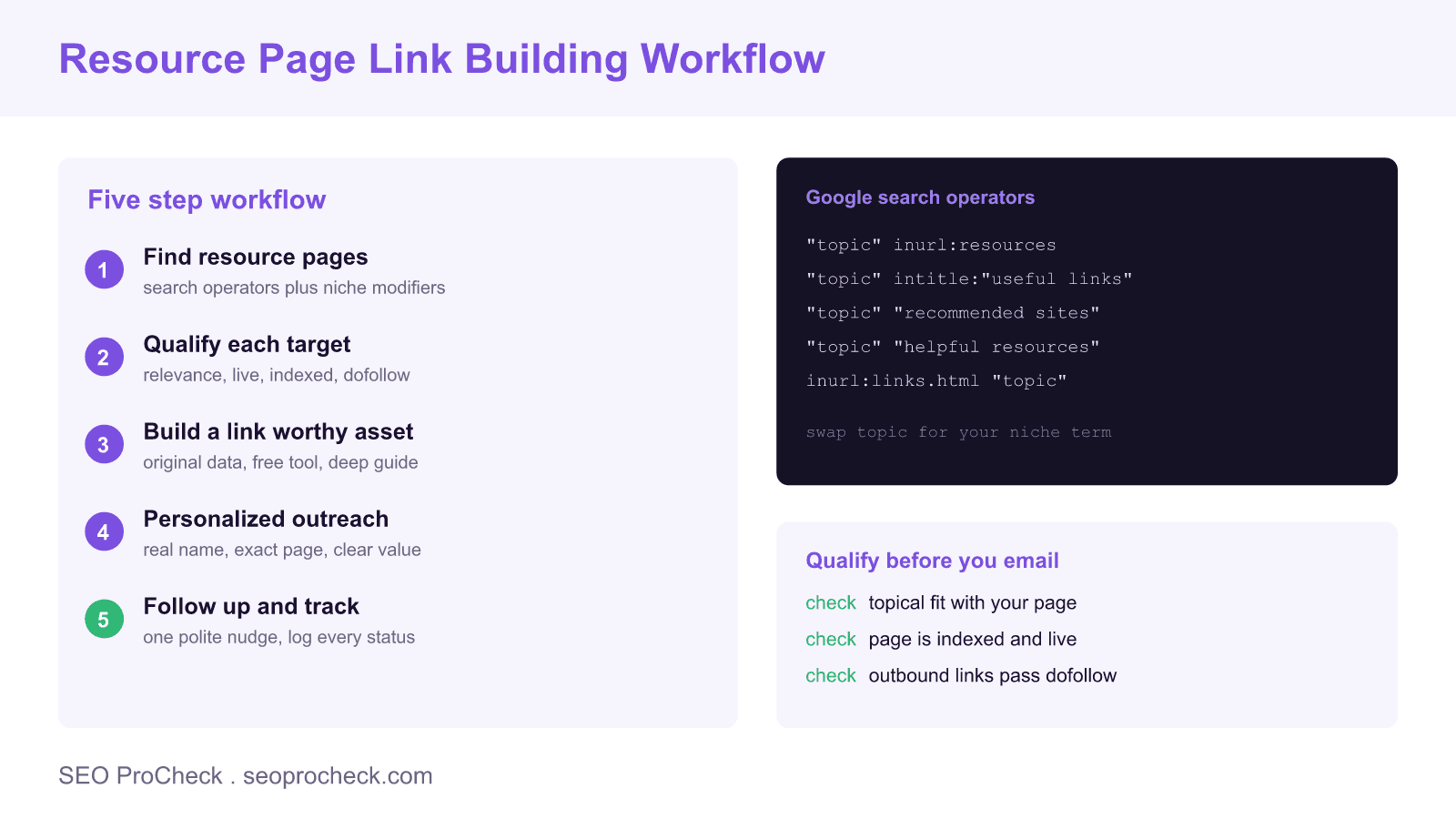
Resource page link building earns editorial links from curated lists of helpful sources by matching a genuinely useful asset to pages that exist to link outward. The workflow is find with search operators, qualify for relevance and link value, build a link worthy asset, then send personalized outreach and follow up once.
- Find targets with operators like topic inurl:resources and topic intitle:useful links.
- Qualify each page for topical fit, indexation, and a dofollow outbound link.
- Pitch a specific asset with the recipient real name and the exact page referenced.
- Prioritize 30 to 50 tightly relevant pages over a high volume blast.
Resource pages are lists that curators build to point their readers toward the best sources on a subject. They carry titles like useful links, helpful resources, or recommended reading, and they exist to link outward, which makes them one of the few link targets where an unsolicited pitch is welcome rather than spammy. This guide walks the full workflow: finding qualified pages with search operators, filtering out weak targets, creating something genuinely worth listing, and writing outreach that earns a placement.
Find resource pages with search operators
Google advanced operators surface resource pages fast. Pair your topic with a footprint that resource curators use in their titles and URLs. Run each of these and save the qualified results to a sheet:
"your topic" inurl:resources
"your topic" intitle:"useful links"
"your topic" "recommended sites"
"your topic" "helpful resources"
inurl:links.html "your topic"
inurl:links.php "your topic"
Quote exact phrases, and add a tight niche modifier so results stay relevant. For a bakery supplier you might run baking equipment "your topic" inurl:resources rather than a broad food query. Export the URLs and move straight into qualification, because most raw operator results will not survive the filter.
Qualify before you spend outreach effort
Outreach is the expensive part, so filter hard first. A target is worth a pitch only if it clears four checks: it is topically relevant to the page you want linked, it is indexed and live, its outbound links are not blanket nofollow, and it has been updated in a reasonable window rather than abandoned. Confirm indexation by searching the exact URL in Google. Confirm the link attribute by viewing the source of an existing outbound link and checking for rel nofollow. Pages whose outbound links all carry clear, descriptive anchor text tend to be genuinely curated rather than automated.
| Qualification check | How to verify | Reject when |
|---|---|---|
| Topical relevance | Page subject matches your asset | Off topic or generic link dump |
| Indexed and live | site: or exact URL search returns it | Not indexed or returns an error |
| Link value | View source for rel nofollow on outbound links | Every outbound link is nofollow |
| Freshness | Check visible dates and the Wayback Machine or Last-Modified header (Google no longer offers cached copies) | No update for several years |
Build something worth listing
Curators link to assets, not to homepages. Give them a reason: an original data study, a free calculator or checklist, a definitive guide that goes deeper than anything already on their list, or a well organized tool. The test is simple. If your page would make the resource list more useful to its readers, you have a candidate. If it just adds another generic article, keep building. This is also where topical authority compounds, because a strong asset attracts links you never pitched.
Write outreach that earns the link
Personalization is the difference between a placement and the trash folder. A workable template:
Subject: a resource for your [topic] links page

Hi [First name],

Your [exact page title] page pointed me to [a link
already on it], which was genuinely useful.

I recently published [asset], which [one line on why
it helps their readers]. If it fits, it might be a
welcome addition next to [nearby link].

Either way, thanks for maintaining the list.
[Your name]
Reference the exact page and a link already on it, so the curator knows you actually looked. Keep the ask soft, name one specific slot, and never attach a demand. One polite follow up after five to seven business days is enough. Log every status so your reply rate becomes a number you can improve.
Track results and avoid the traps
Maintain a sheet with target URL, contact, date sent, follow up date, response, and placement URL. That log turns outreach into a measurable channel and stops duplicate emails to the same site. Two traps sink most campaigns: pitching irrelevant pages because they were easy to find, and mass sending an identical template. Both crater reply rates and can attract the wrong kind of attention. Understanding how a clear brand entity is expressed in HTML also helps, because curators link more readily to sources that look established and trustworthy.
Frequently asked questions
What is a resource page link?
A resource page link is an editorial link from a page that curates helpful sources on a topic, often titled useful links, helpful resources, or recommended reading. Because the page exists to point visitors outward, a relevant, high quality asset is a natural fit rather than an intrusion.
Which search operators find resource pages?
Combine your topic with footprint phrases: topic inurl:resources, topic intitle:useful links, topic recommended sites, and inurl:links.html topic. Wrap phrases in quotes for exact matches and add your niche word so the results stay on topic rather than generic link farms.
Are resource page links still worth building?
Yes, when the page is genuinely relevant, indexed, and passes value. The tactic loses power only when practitioners target low quality link dumps. A link from a curated, topical resource list that real people read remains a clean, editorial signal.
What makes an outreach email work?
Personalization and a concrete reason to link. Use the recipient real name, reference the exact resource page and a nearby link, and explain in one sentence why your asset helps their readers. Keep it short, skip flattery, and make the ask easy to say yes to.
Should resource page links be dofollow?
A dofollow link passes the clearest ranking signal, but a relevant nofollow link on a trusted page still drives referral traffic and diversifies your profile. Check the link attribute before investing outreach effort, and prioritize pages that link out without nofollow when you can.
How many resource pages should I contact?
Quality beats volume. A focused list of 30 to 50 tightly relevant, qualified pages with personalized emails will outperform a blast to hundreds of loosely related targets. Track every send, response, and placement so you can measure reply rate and refine your pitch.
Take this with you
The assistant links open with a question about this page already written. Nothing is sent until you press enter.
Claude Vincent is a technical SEO consultant focused on crawlability, rendering, and AI-search visibility. He writes the field guides and case studies at SEO ProCheck, with a bias toward the durable, unglamorous work that decides whether search engines and AI answer engines can actually read and cite a site.
About SEO ProCheck
Technical SEO consulting and GEO strategy with 20 years of enterprise experience. Case studies, resources, and tools for search and AI visibility.
Work With Me
Technical SEO audits, GEO strategy, site migrations, and international SEO. Hourly consulting for teams who need hands-on support, not just reports.
Subscribe to our newsletter!








Recent Posts
- Most Top Sites Never Say Who They Are in Structured Data October 14, 2026
- Homepage Titles Are Mostly Too Short, Not Too Long October 8, 2026
- Who Actually Serves an llms.txt? 184 Top Sites Measured September 29, 2026