AI Summary
Scholarship link building is only ethical when the scholarship is real: funded, awarded, and transparent. The widespread version, where a page exists only to harvest .edu links through mass outreach, is a link scheme that Google discounts or penalises.
- There is no ranking bonus for the .edu suffix itself, so chasing it for its own sake is a mistake.
- Legitimate programs pay real recipients, publish criteria and winners, and never request specific anchor text.
- Manipulative footprints like identical anchors and disappearing links are what link discounting targets.
- For most sites, ethical scholarships cost more effort than they return, so weigh them against digital PR.

Scholarship link building became popular for one reason: it promised links from university domains, which many practitioners assumed carried special authority. The playbook was simple. Publish a scholarship page, email hundreds of university financial-aid and resource pages, and ask each to list your award with a link. For a few years it worked at volume. Then Google got better at spotting the footprint, and the tactic turned from clever into risky.
This article is about where the ethical line sits, why the common version crosses it, and what a defensible scholarship program looks like if you decide to run one. The short version: the problem is not scholarships, it is scholarships built for links rather than for students.
Why the standard tactic is a link scheme
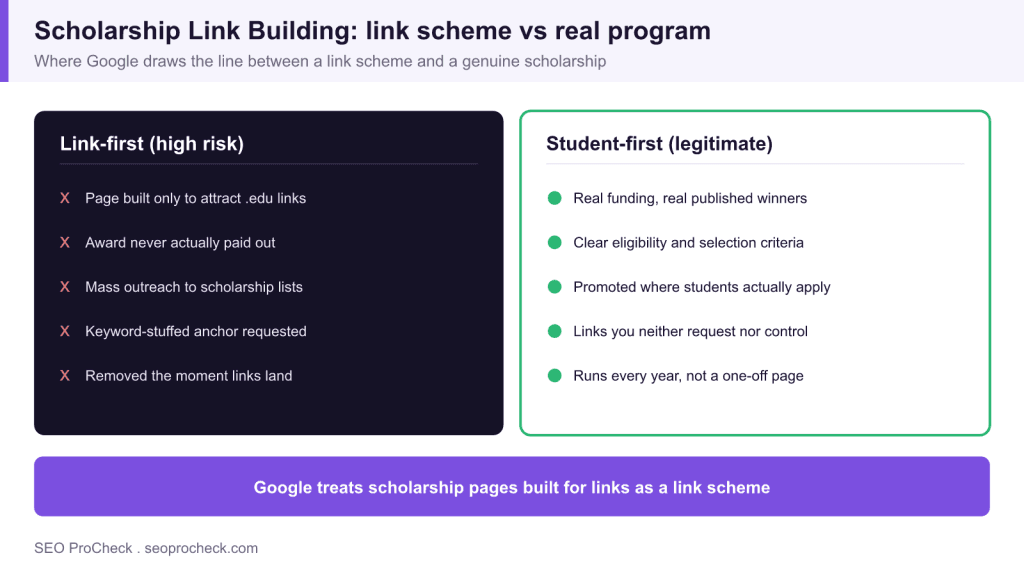
Google's link spam guidance is explicit that creating content or offers primarily to acquire links, then soliciting those links at scale, is a scheme. Scholarship pages built the usual way check every box on that list. Consider the signals a manipulative campaign emits:
- A page that exists only to host the offer, with no connection to the rest of the site's topic.
- Near-identical outreach sent to hundreds of university list pages, producing a repetitive link footprint.
- Requests for keyword-rich anchor text instead of a plain program name.
- Awards that are never actually paid, or pages quietly removed once the links are indexed.
Each of these is individually detectable, and together they form a pattern that algorithmic link discounting and manual reviewers recognise immediately. The same footprint logic that devalues templated outreach, covered in our guide to link-building outreach spam, applies here in full.
The .edu myth
The entire tactic rests on a false premise: that a link is more powerful because the domain ends in .edu. Google has stated many times that top-level domain suffixes carry no inherent ranking weight. A link from a relevant, trusted university page can be genuinely useful, but that value comes from topical relevance and editorial intent, not from the letters after the dot. A generic scholarship directory page buried three clicks deep on a university site, listing forty unrelated awards, passes very little regardless of the suffix.
What an ethical scholarship program looks like
If you want to run a scholarship that could attract links without inviting a penalty, build it for recipients first. The link, if it comes, is a side effect of a real program that a university is genuinely willing to list. The distinction is not cosmetic, it changes what you do at every step.
| Element | Link scheme version | Ethical version |
|---|---|---|
| Funding | Token or never paid | Real award, paid every cycle |
| Winners | None or hidden | Named and published each year |
| Outreach | Mass list scraping | A few relevant departments notified |
| Anchor text | Keyword rich, requested | Program name, host decides |
| Page lifespan | Removed after indexing | Permanent, updated annually |
Practically, that means you commit real budget, write plain eligibility and selection criteria, run a genuine review, and publish the recipients with their permission. You notify a small number of departments whose students are actually eligible, describe the opportunity rather than the link, and let them decide whether to list it. You never dictate anchor text. If they choose to link, the anchor will naturally be the program name, which is exactly what you want.
Signals reviewers and algorithms look for
Whether you are auditing your own past campaigns or evaluating a prospect, these are the tells that separate a real program from a scheme:
- Transparency: are winners named, is the funding verifiable, does the page have a history.
- Relevance: does the scholarship connect to the sponsoring site's actual field, or is it a random topic chosen to justify broad outreach.
- Anchor diversity: do inbound links use the natural program name, or the same commercial phrase over and over.
- Persistence: does the page stay live and get updated, or did it vanish once the links were counted.
If you find old link-scheme scholarship pages in your own backlink profile, the cleanest remedy is usually to either convert the program into a real one or let the manipulative links lapse rather than trying to preserve them. For a broader view of how earned links should be built, see our link building FAQ.
A worked example: auditing an inherited campaign
Suppose you take over a site and find fifty scholarship links in the backlink profile. Here is how to triage them quickly. Pull the referring pages into a spreadsheet and sort by anchor text. If forty of them share the same commercial phrase, that uniform anchor is the first red flag, because organic listings almost never converge on one keyword. Next, open a sample of the host pages and check whether they are indexed and whether your listing still exists. Dead listings on deindexed directory pages pass nothing and may look manipulative in aggregate.
Then check the offer itself. Search the site for the winners page. If no recipient has ever been named and no award appears to have been paid, the program was link bait, and those links are a liability rather than an asset. Document which links come from genuinely relevant departments that chose to list a real award, and treat the rest as candidates to let lapse. You do not need to disavow reflexively, but you should stop pointing new outreach at that page and stop replicating the pattern. Rebuild authority with methods that leave a clean footprint.
Better uses of the same effort
The uncomfortable truth is that for most commercial sites, an ethical scholarship program costs far more than the links it returns are worth, and the cheap version is the one that carries risk. If your goal is authority and relevant links, the same budget usually returns more through digital PR, original research, and expert commentary. Being quoted as a named source, for instance, builds relevance and trust without any of the footprint problems, which is why we recommend pairing outreach with the approach in our expert-quote link building playbook. Fund a scholarship because you want to support students, not because you want a shortcut to links.
Frequently asked questions
Is scholarship link building against Google's guidelines?
The tactic itself is not banned, but the common version of it is. If you create a scholarship page mainly to collect links, run mass outreach to university resource lists, and never intend to fund a real award, Google classifies that as a link scheme. A genuinely funded scholarship that happens to attract links is fine.
Do .edu links carry special ranking power?
No. Google has repeatedly said there is no ranking bonus for a domain simply because it ends in .edu. A link from a relevant, trusted university page can be valuable, but the value comes from relevance and editorial intent, not the domain suffix. Chasing .edu links for the suffix alone is a misread of how link value works.
Can a scholarship link building campaign get my site penalised?
Yes, if it looks manipulative. Sitewide footprints such as identical anchor text across dozens of scholarship directory pages, links that vanish after they are counted, and pages that exist only to host the offer are exactly what manual actions and algorithmic link discounting target. The safer path is a small, real program.
What makes a scholarship program legitimate rather than a link scheme?
Real money, real recipients, and public transparency. Fund an award you actually pay, publish clear eligibility and selection criteria, name the winners each cycle, and promote it where students genuinely search. Do not request specific anchor text, and do not build the page solely to attract links.
Should I ask universities to link to my scholarship page?
You can notify a relevant department that a legitimate award exists, but framing the message around a link request is where it goes wrong. Tell them about the opportunity for their students and let them decide whether to list it. Requesting a keyword-rich anchor turns an outreach note into a link scheme signal.
Is scholarship link building still worth doing in 2026?
For most sites, the effort to run an ethical, funded program outweighs the link return, and the manipulative version carries real risk. If you already fund community or education initiatives, publishing them transparently is worthwhile. If the only motive is links, better returns come from digital PR and expert commentary.
Claude Vincent is a technical SEO consultant focused on crawlability, rendering, and AI-search visibility. He writes the field guides and case studies at SEO ProCheck, with a bias toward the durable, unglamorous work that decides whether search engines and AI answer engines can actually read and cite a site.
About SEO ProCheck
Technical SEO consulting and GEO strategy with 20 years of enterprise experience. Case studies, resources, and tools for search and AI visibility.
Work With Me
Technical SEO audits, GEO strategy, site migrations, and international SEO. Hourly consulting for teams who need hands-on support, not just reports.
Subscribe to our newsletter!