

AI Summary
Product review link building earns coverage by getting real products in front of relevant reviewers, but any link tied to a free product or payment must be qualified with rel=sponsored or rel=nofollow. Followed links exchanged for products are a link scheme, so treat gifted reviews as referral and brand plays rather than PageRank plays.
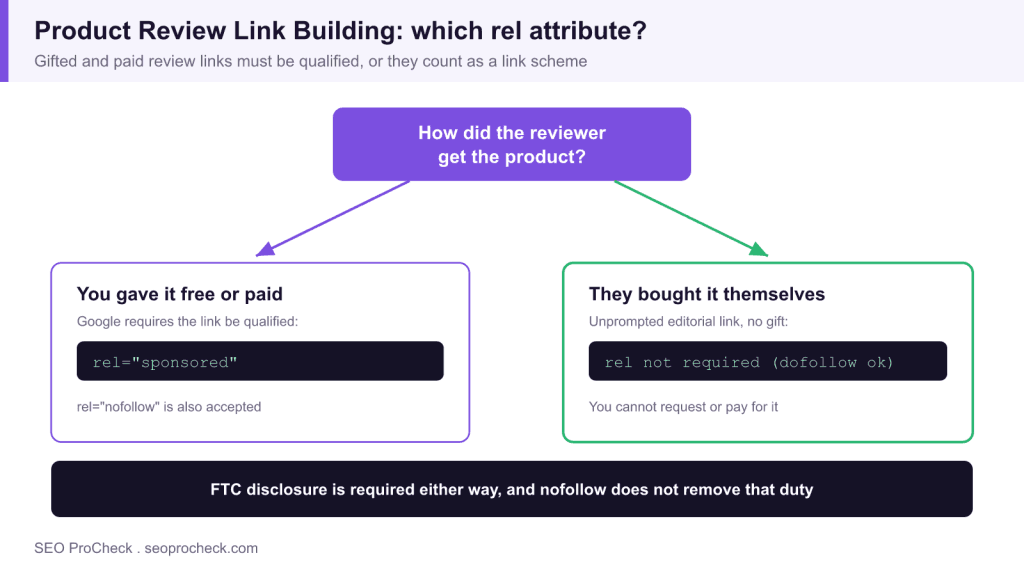
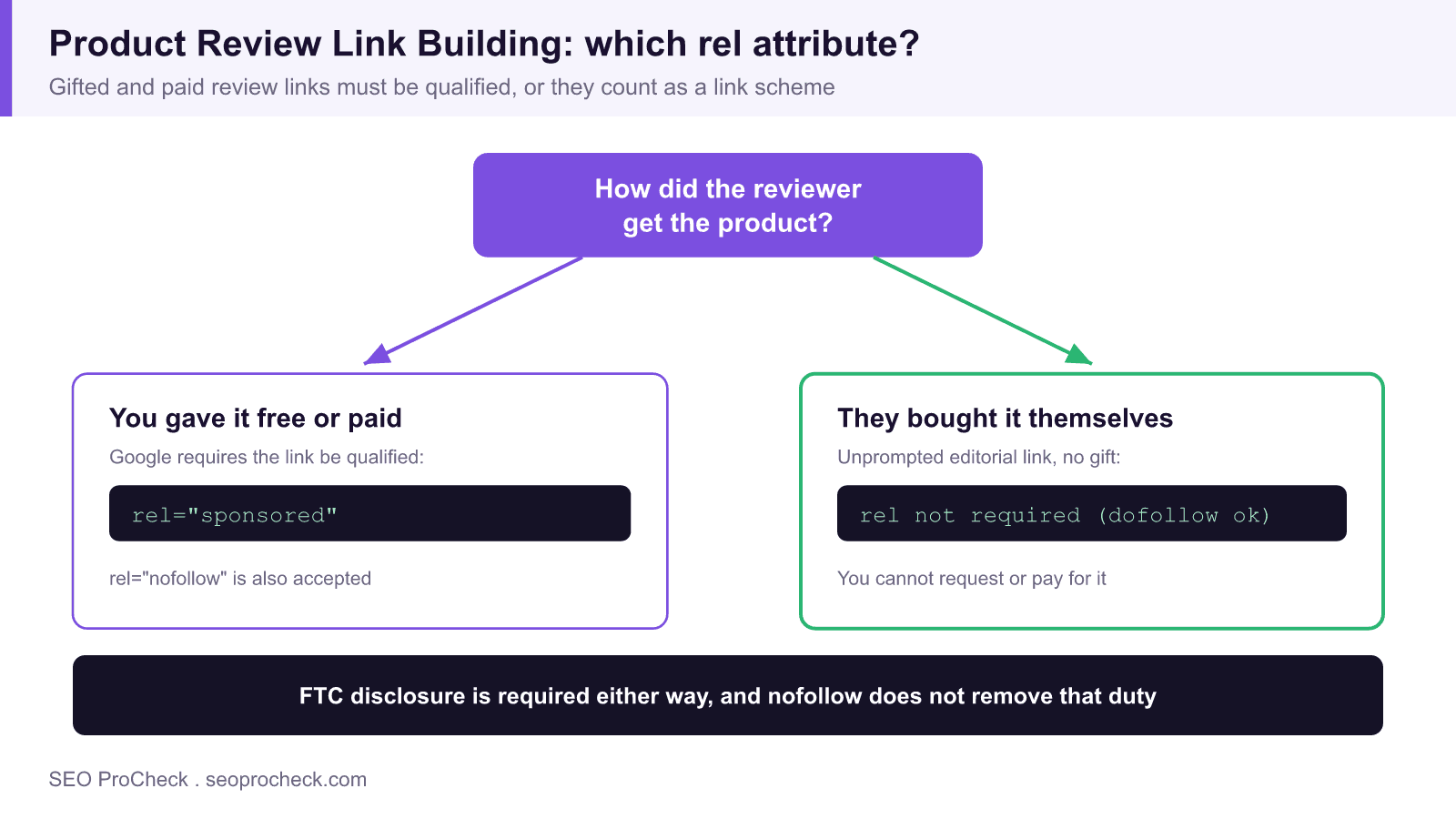
- Gifted or paid review links require rel=sponsored, or rel=nofollow, which Google treats the same for ranking.
- An unprompted review from someone who bought the product can link dofollow, but you cannot request or pay for it.
- FTC disclosure is legally required on any incentivised review, independent of the rel attribute.
- Measure product seeding by referral traffic and conversions, not by counting followed links.
Product review link building is where e-commerce SEO and public relations overlap. You send a product to someone with an audience, they review it, and the review links back to your store. Handled correctly it is a legitimate demand-generation channel that also produces links. Handled carelessly it is a textbook link scheme, because a followed link exchanged for a free product is exactly what Google's link spam policy prohibits. The whole tactic hinges on one small piece of markup: the rel attribute on the link.
This guide covers the compliance rules, the correct rel attributes, how to run a seeding campaign that stays clean, and how to measure the return honestly. The core mental model is simple. If you gave the reviewer something, the link must be qualified. If they came to you unprompted, the link can be editorial.
The rule that governs every review link
Google's guidance treats a link as part of a link scheme when it is exchanged for goods, services, or money and still passes ranking credit. Gifted products count as goods. So the moment you ship a free unit in exchange for coverage, any resulting link must tell search engines not to pass equity. There are two accepted ways to do that, and they are treated identically for ranking purposes.
<a href="https://store.example.com/product" rel="sponsored">the product</a>
<a href="https://store.example.com/product" rel="nofollow">the product</a>
The sponsored value was introduced precisely for links that result from advertising, sponsorship, or compensation, which includes free products. nofollow predates it and remains valid. Either one keeps you compliant. What is not compliant is a bare followed link tied to a gift or payment. If a reviewer buys the product themselves and links without any prompt from you, that link is editorial and can be dofollow, but you cannot request, negotiate, or pay for that outcome.
Two obligations, not one
Practitioners routinely conflate two separate duties, so it is worth stating them plainly. The rel attribute is a search engine instruction. The FTC disclosure is a consumer protection requirement. They are unrelated, and both apply to an incentivised review.
| Scenario | Correct rel | FTC disclosure | Passes ranking credit |
|---|---|---|---|
| You sent a free product | sponsored or nofollow | Required | No |
| You paid for the review | sponsored | Required | No |
| Affiliate commission link | sponsored | Required | No |
| Reviewer bought it, unprompted | none needed | Not required | Yes |
A compliant disclosure is clear and conspicuous, placed where a reader sees it before the review content, using plain language such as noting that the product was provided for free. Burying it in a footer or hiding it behind a tag does not satisfy the requirement.
Running a compliant seeding campaign
A product seeding campaign that respects both rules looks like this in practice:
- Build a shortlist of reviewers whose audience actually overlaps with your buyers, not just anyone with reach.
- Offer the product with no conditions on whether they cover it, how they rate it, or what they say.
- State in writing that any link should be rel=sponsored and any review should carry an FTC disclosure.
- Never request a specific anchor, a followed link, a guaranteed positive verdict, or link placement in exchange for the product.
- Log each shipment, the resulting coverage, and the referral traffic it drives.
The instinct to squeeze a followed link out of a gifted review is exactly what turns a legitimate campaign into a scheme, and it invites the same footprint problems described in our guide on link-building outreach spam. Restraint here is a feature, not a compromise.
Finding reviewers worth seeding
The quality of a seeding campaign is decided before you ship a single unit, in who you choose. Prioritise reviewers by audience overlap and buying intent rather than by follower count. A niche channel with ten thousand engaged subscribers who buy in your category will out-convert a general lifestyle account with a million passive followers. To build the shortlist, search the platforms where your buyers actually research purchases, read the last few reviews each candidate published, and confirm they cover products at your price point and use case.
Vet each candidate on three practical points. First, do they already disclose gifted products clearly, which signals they will code links correctly and keep you compliant. Second, do their past review links point to real product pages rather than to affiliate networks only, which tells you a store link is realistic. Third, does their audience leave comments that indicate purchase intent rather than idle browsing. A reviewer who fails the disclosure test is a liability regardless of reach, because a missing disclosure is a legal exposure for you as the brand, not just for them.
Measuring the real return
Because compliant review links are nofollow or sponsored, judging the channel on link equity guarantees disappointment. Measure what it genuinely produces. In GA4, segment referral sessions by the reviewer's domain and track assisted conversions, not just last-click sales. Watch for lifts in branded search after a wave of reviews, since coverage often converts into direct demand weeks later. And keep an eye out for the real prize: unprompted editorial mentions from readers and other publishers who discovered you through a review, which can link dofollow because you never paid for them.
Common mistakes to avoid
- Coding gifted review links as followed to chase equity, which is the definition of a link scheme.
- Assuming nofollow removes the FTC disclosure duty; it does not.
- Demanding an exact-match anchor, which reads promotional and can get the whole review flagged.
- Sending products to reviewers with no audience overlap, so the referral traffic never converts.
Product review link building works best when you treat it as brand and demand generation that occasionally spins off editorial links, rather than as a link-buying channel in disguise. For the wider context on how product pages and off-page signals fit together, see our link building FAQ, and if you want links that do pass equity, invest that energy into being cited as a named source through expert-quote link building.
Frequently asked questions
Do product review backlinks pass PageRank?
Only if they are genuinely editorial and unpaid. When you send a free product or pay for coverage, Google requires the link to carry rel=sponsored or rel=nofollow, which tells search engines not to pass ranking credit. An unprompted review from someone who bought the product themselves can link dofollow.
Are gifted product reviews against Google's link guidelines?
Sending products for review is fine. The rule is about the link: exchanging a product or payment for a followed link is a link scheme. As long as the resulting link is qualified with rel=sponsored or rel=nofollow, the arrangement is compliant. The problem is only ever unqualified followed links tied to a gift or payment.
What rel attribute should a gifted review link use?
Use rel=sponsored, which Google introduced specifically for links resulting from advertising, sponsorship, or other compensation, including free products. rel=nofollow is also accepted and treated equivalently for ranking purposes. Either value keeps you compliant; a bare followed link does not.
Do I still need an FTC disclosure if the link is nofollow?
Yes. The rel attribute is a search engine instruction and has nothing to do with consumer protection law. In the United States, the FTC requires a clear and conspicuous disclosure whenever a reviewer received a free product or payment, regardless of how the link is coded. The two obligations are separate and both apply.
What SEO value do product review links actually provide?
Even when nofollow, they drive qualified referral traffic from an audience already interested in the product, build brand awareness and searches, and often lead to unprompted editorial mentions later. Treat them as demand generation and brand building rather than direct ranking fuel, and measure them on referral and conversion, not link equity.
How do I run a compliant product seeding campaign?
Identify relevant reviewers, offer the product with no strings on coverage or wording, and make clear in writing that any link should be rel=sponsored and any review should carry an FTC disclosure. Never require a positive review, a specific anchor, or a followed link. Track outcomes by referral traffic and conversions, not by counting followed links.
Take this with you
The assistant links open with a question about this page already written. Nothing is sent until you press enter.
Claude Vincent is a technical SEO consultant focused on crawlability, rendering, and AI-search visibility. He writes the field guides and case studies at SEO ProCheck, with a bias toward the durable, unglamorous work that decides whether search engines and AI answer engines can actually read and cite a site.
About SEO ProCheck
Technical SEO consulting and GEO strategy with 20 years of enterprise experience. Case studies, resources, and tools for search and AI visibility.
Work With Me
Technical SEO audits, GEO strategy, site migrations, and international SEO. Hourly consulting for teams who need hands-on support, not just reports.
Subscribe to our newsletter!








Recent Posts
- Most Top Sites Never Say Who They Are in Structured Data October 14, 2026
- Homepage Titles Are Mostly Too Short, Not Too Long October 8, 2026
- Who Actually Serves an llms.txt? 184 Top Sites Measured September 29, 2026